
As with my previous post, “Making and Offering Despachos,” in this post I discuss aspects of the misha (In Spanish, the mesa) in response to questions I have been asked while traveling around the United States as a teacher of the Andean tradition.
The same disclaimers apply here as did with the despacho post!
- Seeking the “why” of your practice takes you back to basic Andean cosmovision.
- These are the teaching as I understand them and as preserved through the lineage of Juan Nuñez del Prado, and his teachers, don Benito Qoriwaman, don Andres Espinosa, and don Melchor Desa; or it is information I learned from paqos with whom I have worked. So it is not definitive beyond this scope.
- There is next to no way to make a mistake with Andean practice if your ayni is conscious and clear.
- Because of ayni, most energy work is invisible, so ceremony and ritual are almost always choices rather than requirements when undertaking Andean practices; therefore, most “must do” instructions are personal preferences of teachers and should be taken as such, especially if the teacher cannot justify the practice based on the core Andean cosmovision.
When students ask about how to do something, such as how to make or use a misha, my 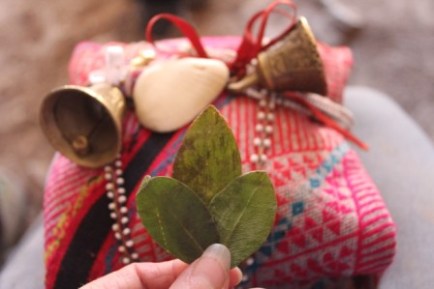 preference is always to ask the “why” of what they are doing, leading them back to the basics of the Andean cosmovision. When you understand the foundation of the tradition, you will better know how to evaluate what you are being taught, especially when it comes to ritual or ceremony.
As I said in the despacho post, there is next to no rote ritual in the Andes because the foundational principle of practicing is ayni, which is by definition intensely personal. I advise you to go to the despacho post (August 2016) and read the first half so that I don’t have to repeat all of the information about the core precepts of the Andean tradition here.
So, what is a misha? It’s a bundle of objects, mostly stones, which are called khuyas, that have personal meaning for the paqo. Misha is the ancient Quechua term for what is called in Spanish the mesa. It means “sign.” It is the “symbol” of personal power. It is not your actual personal power, but is an outward symbol that you are a paqo—a follower of the Andean mystical tradition of Peru. As a paqo, you are in training to become a master of ayni. The better your ayni, the more personal power you have—and so the “stronger” or “more powerful” your misha, since it represents or embodies your personal power.
Khuya means “affection.” The items you gather into your misha bundle are objects infused with your munay, or love. They represent your ayni connections to teachers, the most important spirit beings, places you have worked such as temples or sacred sites, and the most important, loving, transformative events of your life and people in your life. These khuyas are gathered together and wrapped in a cloth, which is the misha.
Let’s now look at some common questions about the misha and its use.
How do you make a misha?
Many beginners on the Andean mystical path ask this question. They see paqos with mishas and they, rightly, want one, too. The answer is that, generally speaking, you don’t “make” a misha, it is a gift that you accept, piece by piece, as you engage life.
Think of the misha as a material diary of your life and your journey as a paqo and as a human being.
Every khuya represents an important event, person, feeling, or learning in your life. So, khuyas can come to you in myriad ways. They can mark a karpay given you by your teacher. They may be “gifted” to you by a spirit being. You may be attracted to a stone or other item at a sacred place. You may choose an object to represent a significant turning point or relationship in your life. There are as many ways to receive or choose a khuya as there are 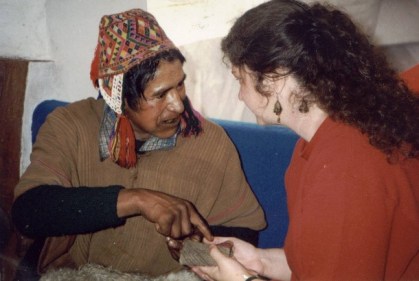 experiences in life.
For instance, the newest khuya in my misha is a small wooden cross that my siblings and I placed in one of my mother’s hands as she slipped away from this life in hospice. She held it the entire last week of her life, and when she dropped her body, I took that cross and added it to my misha as a khuya of my deep love for a woman who was not only an incredible mother but my best friend. She represented the epitome of many qualities that I try to model in my life. This khuya not only embodies our mutual love, but serves as a reminder of those qualities that I continue to aspire to in my own conscious evolution.
What is true of all khuyas is that each is infused with meaning and munay. You care for that khuya as you do any precious gift: by wrapping it in a cloth or otherwise protecting or preserving it. With that first khuya you have started your misha.
So the truest answer to the question of how you “make” a misha is: Live your life.
Does every misha (or khuya) have power?
No, not necessarily. The misha is representative of your personal power. For the most part, it does not confer power on you, it reflects what is in you at the current time. So, its power is commensurate with your personal power. If you have very little personal power, then so does your misha. If you have a lot, then so does your misha.
No matter what kind of khuyas you have in your misha—a small meteorite, a crystal, a stone from Apu Ausangate, an object representing a person you love—the individual khuyas are not really transmitters of power per se. You have to develop a relationship with each khuya.
Even though in the Andean mystical tradition everything in the cosmos is seen as a living being, if you do not have an ayni relationship with that item, then it cannot have much of an impact on you. The ayni relationship is always a two-way flow. If you are gifted a khuya, its energy cannot penetrate your poq’po if you are not open to receiving it. And even if you 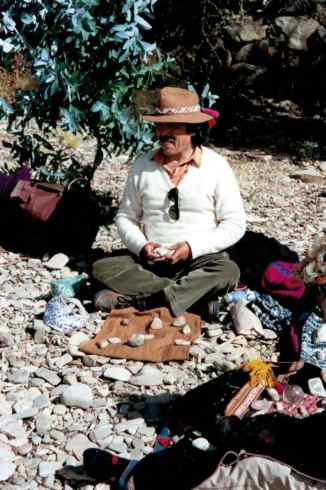 do receive its energy, you can only understand and use it to the level of your own conscious evolution. So while khuyas can transmit “power,” receiving and using that power is dependent on you and the state of your energy and consciousness.
Khuyas can be teachers, even powerful ones. But they can’t make you powerful. You have to accumulate your own personal power. As good teachers, usually they talk to you only at your level of understanding, or maybe a little higher so that they can challenge you and help you grow. But you have to have some measure of personal power (clear and effective ayni) to even open a dialogue with a khuya “spirit being” or to be able hear it. It is always wise to “work” with a new khuya. It’s like meeting a new friend. The relationship may be tentative and even awkward at first, but the more you connect and spend time together, the easier and more relaxed, deep, and meaningful the relationship becomes.
All of this is why, it is possible to have a misha of “powerful” khuyas and yet not have a misha of power! If you don’t have the ayni to relate to the khuyas, they might as well be powerless because you won’t be able to recognize or use the power. Remember, your misha is representative of your power, not only the power of the khuyas in it. However, a paradox is that khuyas may gift themselves to you because they represent the potential within you.
I remember one trip to Peru in which a few of us—all relatively new to the Andean path— were sitting around with don Mariano Apasa Marchaqa. Our small mishas were spread out on the ground around us. He leaned over and picked up one, put the bundle to one of his ears, and appeared to be listening. After a minute or so, he placed the bundle down again, remarking, “That is a misha of power.” Since the woman whose misha it was didn’t feel especially well versed in the tradition or powerful herself, she and we took his declaration to mean that she had attracted powerful khuyas, even though she had not yet accumulated a lot of personal power herself. It’s as if the khuyas, as spirit beings, recognized her potential and were patiently waiting for her to catch up!
The core of the interaction is that your misha represents your personal capacity for power (making ayni) right now in your life, no matter what level of latent power each khuya has within it. Thus, you can grow into your misha, in effect catching up with the khyuas in it. They are very patient!
How do you work with a misha?
Let me start by saying anything you can do with a misha, you have to first learn to do without it.
The misha doesn’t necessarily confer power; it mostly channels what personal power you have. Your focus has to be on perfecting your ayni, which equates with your personal power—your capacity to be in relationship with the living universe. Therefore, you never want to turn anything, including your misha, into a fetish.
A fetish is something in which you project your power. But if you ever lose the fetish, then you believe you have also lost your power. Don’t do that with your misha or any of the individual khuyas! They are a sign of your power, but are not your actual power. So whatever you can do with a misha, you can do without it.
At the core of the Andean cosmovision is that energy must follow intent. Intent is your  power/ayni. So no matter how you use your misha, it is only an outward representation of your intent, whether you use it for healing or blessing or anything else. So when I discuss some of the uses of the misha below, always remember that it is you and your intent that is driving the energy, not the misha itself.
The misha is a primary “eater” of hucha, so you will often see paqos running it over people’s bodies to reduce their hucha. But it is not really the misha alone that is doing anything. It is the paqo’s intent that is driving the energy through the misha. That paqo is simply using the misha as a repository for the hucha.
If you have experienced this or watched this process, you will no doubt have noticed that the paqos move their mishas in two primary ways. The most common process is to run the misha over your body in a downward stroking motion. The other, less common way is to move the misha upward, from your feet toward your head. You probably won’t ever see a paqo making circles around your body with the misha, or making squiggly lines around your body, or some other motion. It’s almost always a downward motion from head to toe or an upward motion from toe to head. What are they doing and why are they doing it this way?
The answer: saminchakuy or saiwachakuy.
In case you don’t know, there are two primary practices in the Andes: saminchakuy and saiwachakuy. Saminchakuy is a downward flow of energy: you use your intent to pull sami down from the cosmos into the poq’po while releasing hucha down into Mother Earth. This is the “cleansing” practice that moves hucha. In contrast, saiwachakuy is an upward flow of energy. Using intent, you direct sami up from Mother Earth into your poq’po to empower yourself. It has nothing much to do with hucha.
So look behind the outward movements and the colorful bundle that is the misha and you will see that the main way to use the misha is to either release hucha or empower with sami. There is nothing mysterious about this, despite the personal style with which the paqo may be performing the work. It is saminchaky and saiwachakuy, only using the misha to bolster and direct intent!
It’s a similar situation when you use a misha to “open” a person’s qosqo (or other center) or use the mullu khuyas to weave the chunpis and open the mystical eyes. The misha and khuyas are tools that represent or channel power, but are not the power itself. For instance, when performing the karpay for the chunpis (Chunpi Away), the paqo first connects with Mother Earth and so is actually channeling her sami up through himself or herself and the khuya to help the person (along with the person’s intent, of course). It is actually Mother Earth who is doing the karpay, not the paqo (and much less so the tools of misha or khuya)!
You often see paqos blowing through their misha or talking into it, addressing the spirits through it. Again, it is not the misha that is conferring power, it is the intent of the paqo that is passed through the misha. The misha is like the telephone line that is broadcasting the ayni of the paqo. The paqo doesn’t need the misha, but it is a beautiful practice to use the bundle to outwardly represent his or her munay and ayni.
Do khuyas have specific purposes?
Yes, they do. All of the paqos I have worked with, especially those who have gifted me a khuya, have explained that khuyas have different powers. One may be especially good at eating hucha. Another may be able to confer a blessing, and sometimes for specific reasons such as blessing you for a trip. But everything I said earlier is true to the tradition as I know it: you have to have the personal power to use the khuya. It can’t give you a  power you are not capable of using. You can’t even discover the specific use of a khuya if you can’t first establish an ayni relationship to open an “dialogue” with the khuya. It can do nothing on its own, and that is the important thing to understand.
Recently while in Peru, I asked Juan about a khuya I have—a gift from a Q’ero paqo—that has an elaborate ceremony attached to its use. Juan smiled and said, “All of that is third level.” What I understood him to mean is that at the third level of consciousness we tend to complicate things, to make the khuyas (and ourselves) “special” by imparting ritual and complex “magical” abilities to them. When we reach the fourth level, we realize that intent is what drives energy and we have less (or no) need for elaborate outer ritual. I have found this to be true in my own practice over the last twenty years. Watch out for the ego! Attaching “importance” to the self or sacred object can obscure what really counts, which is your munay and intent (your ayni). Ayni is almost always invisible. Most of the time, no one will ever know when a master is “working” the energies. He or she will not need outward displays.
Do you ever work with the misha open? And if so, how is the misha organized?
I have never seen a paqo from the south-central Andes work with an open misha. Because the primary purpose is to move energy (outward manifestation of inward intent), the bundle is usually closed and then run over the body or blown into or spoken into to establish a relationship with spirit.
I also have never heard or witnessed a teaching where a paqo opened his bundle and proscribed a particular organization for the khuyas in the misha. The way you configure your misha is personal to you because your intent and ayni are personal. You may arrange things according to any kind of structure, perhaps in an arrangement reflecting the three worlds, the yanantin/mastinin/tawantin, or some other pattern that is your personal preference and has personal meaning for you.
The situation is very different for paqos from the northwest coastal traditions. They have elaborate misha configurations and complex symbolic explanations for placement. But that is not true of the Q’ero of south-central mountain tradition, at least to my knowledge and in my experience.
Finally, remember that your misha is a “sign” that you are a paqo, following the Andean tradition. As such, it connects you to all the spirit beings and other paqos of the tradition . You are never alone as a paqo. However, your misha is always and only representative of you—and you alone. If you are following a rote schema, you are mirroring someone else’s ayni relationships, not your own. There is nothing wrong with agreeing to “universal” meanings and a teacher’s instructions for where to place something and what it means as long as that feels true in relation to your own beingness and ayni relationships.
If you want to make your open misha into a map of the self or a map of the three worlds or a map of the universe, there is nothing to stop you from doing so. Just know that that schema, too, is a symbolic construct. It confers no magical knowledge or powers. What you can do in your life is what you have the personal power to do. Personal power is ayni. No magical incantation or symbolic map can change your ayni. It may heighten your focus to do your work, it may feel good or look beautiful, but it can’t in and of itself change your energy one iota.
Can you change what’s in your misha?
Absolutely. As a symbol of your personal power, your misha changes as you change. Khuyas that had meaning ten years ago may no longer have that meaning today. New items may call you as you have new experiences and you grow and change. You are not static, so you misha cannot be either.
Traditionally, it is common to open your misha, “feed it,” and change anything in it once a year. Often that is done on August 1, the day, it is said, that Pachamama and the Apus “awaken.” They listen more closely, so we have opportunity to be in deeper ayni with them and state our intent for manifestation over the next year. As we do a self-review and refocus, we may change our mishas. (See my post “Independence Day Andean Style – July 1, 2015.)
What if you lose your misha or a khuya?
Replace it! I asked Juan this years ago and he said, very simply, “If you lose a khuya, go out into your backyard and pick another stone. Then infuse it with the affection and feelings you had about the one you lost.” Remember, khuyas are not fetishes, not magical totems. They are only representative of what is within you. Simply infuse the new stone with the 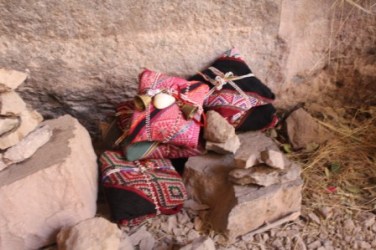 feelings you had about the old. Same for the entire misha.
There is much more to say about the misha, but this covers the basics. As I stressed in the despacho post and again here, don’t worry about what others tell you do—including me—but drop deep inside and discover what you feel. Your ayni is your guide to your practice. You can have all the tools of a paqo, including a misha, but they can’t make you a “better” paqo. Only your ayni can. That said, part of being a paqo is knowing your lineage and its cosmovision. When you know the elemental and core aspects of the cosmovision, you will almost always know what is important in your practice. Don’t be swayed by complexity, symbolism, ritual, ceremony. Simply trust your heart—and your results, as they are the measures of your power because they are the direct “feedback” about your ayni from the kawsay pacha.
[Note: Photos 1, 6, and 7 were taken by Lisa McClendon Sims. She owns the copyright, so these photos may not be shared, copied or reproduced without her written permission.]
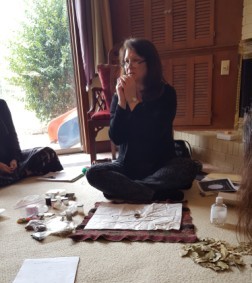 have traveled around sharing the tradition, I get a lot of questions about the despacho. There seems to be a lot of conflicting information about how to properly make and offer a despacho: Do you open sacred space first? Do you always make the most beautiful despacho possible? Are you in a state of thanksgiving and reverence? If you offer the despacho through burning it, do you watch it burn or turn your back to the fire?
 That’s just my preference—to strip things down to the essential with no razzle-dazzle. This preference may not be yours. So, if you don’t care that your practice aligns with the established Andean cosmosvision of this lineage of paqos, then there is no need to read any further. But if that matters to you, or you are just curious to read another point of view from what you may be used to, then I hope that you will gain some insight about offering a despacho from this long post.
 The Spanish word “despacho” is the translation of this Quechua term, although its meaning depends on context: dispatch, communication, shipment, office or study, among other meanings. The first two meanings in this list are most appropriate to an Andean despacho offering.
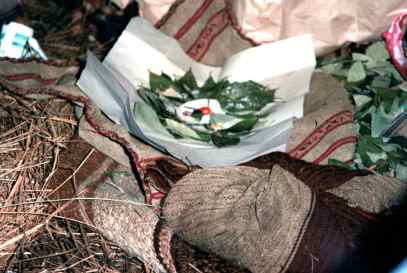 would one made by don Mariano Apasa Marchaqa. In the same way, your style of making a despacho is likely to be different from mine, and we might change our styles depending on the reason we are making a particular despacho offering.
 space clearing or ordering is not necessary. You might like to do that. Fine, do it. Performing such ceremony can mark the beginning of the despacho-making process, help focus your attention, foster a greater sense of beauty, and bring a group into collective resonance. It might also be part of your ayni to connect with the spirits, as in opening a dialogue. But it is not required. Ayni is invisible! If you choose to it make visible, fine, but know that undertaking this kind of initial ceremony is a choice, not a necessity.
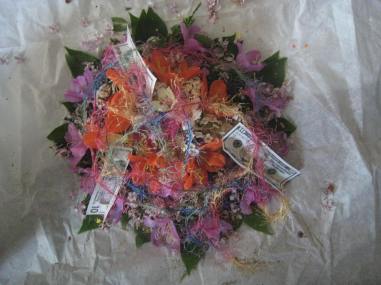 actually make the despacho, including what you put in it and its design and organization.
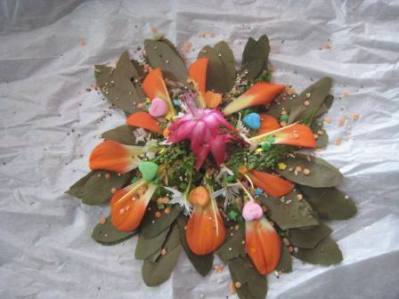 that occasion is not complete if you as the host are not fully present.
 There really is no right or wrong—it’s really, really hard, if not impossible, to make a “mistake” in Andean mystical practice because intent is at the heart of everything in this tradition and always trumps ritual. However, there is “more Andean” and “less Andean” and sometimes as a practitioner of this tradition, you have to question your teacher about the “why” of a practice. The answer may be in alignment with the ancient cosmovision or may be simply personal preference, but your teacher should be able to explain that difference clearly to you.
 At the current time, this post may speak more to those from the United States, who are in the midst of a presidential election cycle, but it is relevant to all who take their civic duties seriously.
 things are going well and unhappy two days later when they are not. You are kind when people treat you well and are insulting or hurtful to them when they do not. You are madly in love this month and angrily kicking your lover out the door the next.
 As you go to the voting booth, in the United States on November 8 or elsewhere at other times, ask yourself: Who among the candidates understands and acts from ayni instead of ch’allay? Also remember that ayni is not a stream of earthbound energy; it has cosmic ramifications. It is always cosmic in scope because everything, including human consciousness and its intent, is part of the vast web of a living universe. So ask yourself: Which candidate’s platform and vision have the most beneficial impact not only at the personal level but at the spiritual and cosmic level?
 masintin and yanantin. In their simplest forms, masintin is a relationship of shared characteristics whereas yanantin is one of dissimilar characteristics. Yanantin relations tend to cause the most hucha—but only if the person is blind to the energy dynamic. A person wise in the ways of energy dynamics will be aware of where and how his or her relations are similar and where they are dissimilar, and act accordingly to prevent discord and harm. It’s easy to act from feelings (empathy, compassion, kindness, generosity) when feeling kinship with another person or group (masintin). Fourth-level maturity comes into play when those interactions feel distant and different (yanantin). When faced with a combative press, a disparaging opponent, a hostile crowd, a fickle ally or a ferocious foe, the skills of the fourth level are crucial to keeping the yanantin energies from creating hucha for all involved.
 , being able to propose action and then take it; following through on words with actions). An effective leader will have harmonized the three human gifts within. That person will say what he or she means, do what he or she says, and both speak and act (with munay and from ayni) with the larger good in mind. Someone who has harmonized the three human powers within is someone who has integrity, which surely is a core characteristic we want in those whom we elect to govern.
 grandeur we can hardly fathom. It is rich in diversity beyond the scope of our imaginations. But its grandeur and fecundity are not beyond our means of experience.
 send a seqe out to a lemon tree, your taste buds won’t protest at the acidity. Instead, you perceive the energetic signature, or “personality” if you will, of that lemon tree. Does it feel light, heavy, healthy, sick, coherent, dissonant, or a host of other possible perceptions? According the Andean tradition, and to many other energy traditions, everything in the universe—even those things that are inorganic—has some semblance of sentience, of consciousness. So it may well be that you also perceive the consciousness of that lemon tree. It might even “talk” to you!
 others who interact with that object all the time. For example, I said above that you might try tasting different kinds of cars. I actually tried that as an experiment. After doing this exercise or training hundreds of times, I realized I had never tasted cars. Beyond its basic “isness” as a metal and plastic and rubber object, I wondered if different models tasted differently. I tasted a Cadillac (metallic, sinuous almost like flowing mercury, and more) and a Subaru (felt like a weave of wires, or mesh, and of wood and smokiness, and more. I ended the exercise by “tasting” a Nissan sedan. When I connected my seqe to the Nissan I was overwhelmed with visions of candy and the taste of sweetness. No matter what I did, I couldn’t get past those perceptions. When I talked about this in the class after we regrouped from doing this exercise, one young woman smiled and look conspiratorially at her Mom, who was sitting next to her with a look of surprise on her face. Turns out the Nissan was the young woman’s car—and she was a candy maker! She delivered a lot of chocolates and other confections from that car. That was an intuitive overlay, but it was so strong that I never really got a perception of that Nissan.
 physics called Phase-Conjugate-Adaptive-Resonance, or PCAR. It says that everything is made of energy and information fields. Information rides on energy. When you connect energetically, you can, if you have the power and sensitivity, extract information from that energy field. There is an ayni exchange, from you to the object and from the object back to you, and the more concentrated your attention and coherent your energy, the more information-rich the interchange will be. I think PCAR is a great way to think of both natural and manmade objects and landscapes as “beings.” It helps us understand what we are doing when we “taste” all the various aspects of the Pachamama. When our practice is refined, we can go deeper than just “tasting” the energy; we can delve into the pool of information contained in that object’s field.
 coast of Peru, and most of it was probably imported or traded into Peru from what is now Ecuador and other countries north of Peru. The flesh of the oyster was considered as the food of the Gods.
 —and opens the mystical eyes—the ñawis—I will briefly go over the belts. There are four of them: one is around the lower trunk of the body, called the yana chunpi or black belt; another is at the belly area, called the puka chunpi or red belt; the belt at the chest and heart level is called the qori chunpi or gold belt; and the one around the throat is the qolqo chunpi, or silver belt. When you open the three eyes of the head—the two physical eyes and seventh eye in the middle of the forehead—you pull in violet energy, so this area around the head at eye level is sometimes referred to as the kulli chunpi, or purple belt, although it is not formally considered a belt.
 ceremony. This aspect of the karpay is called Ñawi K’ichay, which literally means opening the eyes.
 The Inka Empire was called the Tawantin because four nations were integrated into one Empire. It also refers to the sacred integration of four factors. A despacho, or nature offering, is always based on a tawantin. Many other aspects of the mystical work are based on a tawantin. Finally, the stone with five protrusions is named after the number five, pisqantin. (The picture is of my set of mullu chunpis, which, according to the estimation of my teacher, Juan Nuñez del Prado, were probably made in the late 1800s. The stones are pretty large, with the five stone filling the palm of my hand.)
 Q'enti Wasi - House of the Hummingbird