This is a long, long post, so thank you for your patience. It’s long because it covers one of the core practices of the Andean tradition—the despacho—and there is a lot to say. As I have traveled around sharing the tradition, I get a lot of questions about the despacho. There seems to be a lot of conflicting information about how to properly make and offer a despacho: Do you open sacred space first? Do you always make the most beautiful despacho possible? Are you in a state of thanksgiving and reverence? If you offer the despacho through burning it, do you watch it burn or turn your back to the fire?
Usually, when someone asks me a question, about the despacho or any other aspect of Andean practice, I ask, “Why are you doing it that way?” or “Why did your teacher tell you to do it that way?”
If they can’t answer, then we have reached the heart of the problem—undertaking a practice without knowing the foundation of Andean cosmosvision. If you have a thorough understanding of the essence of the Andean cosmovision, you will almost always know if a practice is in accord with the tradition or if it is more likely the personal preference of a teacher, the addition of a teacher’s non-Andean area of expertise (psychology, philosophy, etc.) or an overlay from another tradition. That is why I believe that answering the “why” questions are paramount to being a skilled paqo.
Let me start with some disclaimers! Because ayni—reciprocity—is at the heart of the Andean tradition, personal intent will always trump technique. If your intent is pure, strong, focused, you really can’t go wrong and are almost always on the right track in your ayni exchange with the cosmos of living energy and the spirit beings. But there is a “more Andean” and a “less Andean” way to do things because practice rests on the foundation of the Andean cosmovision. That’s why my manner of teaching the tradition is to always, always, always go back to the cosmovision as it was taught to me through Juan Nuñez del Prado and his lineage of don Benito Qoriwaman, don Andres Espinosa, and don Melchor Desa. Is this the only lineage worth studying? No. But it is a lineage of three of the most respected master paqos of the recent past. Is theirs the only way to practice the tradition? No. But the benefit I find in this lineage’s teaching is that the “why” is always explained, and so my practice can be as simple, essential, efficient, and practical as the tradition itself.
 That’s just my preference—to strip things down to the essential with no razzle-dazzle. This preference may not be yours. So, if you don’t care that your practice aligns with the established Andean cosmosvision of this lineage of paqos, then there is no need to read any further. But if that matters to you, or you are just curious to read another point of view from what you may be used to, then I hope that you will gain some insight about offering a despacho from this long post.
Let’s begin by acknowledging that there is an Andean cosmovision that has survived the centuries through oral transmission. Although every living tradition changes over time, to survive it must retain its core beliefs. In the Andes these beliefs include that:
- The universe is one of living energy (kawsay). One aspect of this living energy is the Pachamama, the material universe. Everything is made of kawsay.
- We are in constant interchange (ayni) consciously or unconsciously with this living energy.
- Energy is just energy. Only humans project a moral overlay on to energy according to their ethics, values, etc.
- Only humans slow down the living energy (called hucha), which over time may deplete some of our well-being. But hucha is not negative, bad or contaminating; it is just slow kawsay: kawsay we don’t radiate perfectly.
- If we have a sufficiently coherent energy body (poq’po) there is no expression of energy that we need to fear. The more coherent our poq’po, the more “personal power” we have, which means the more effective our ayni will be.
- There are spirit beings, we can communicate with them, and they can teach us, empower us, and assist us.
These are a few of the core convictions of the Andean cosmovision that will come into play as we examine our despacho practice. Why and how we do something should be rooted in these foundational, largely unchanging Andean beliefs.
The “ how” is easy, as we all have our way of undertaking the practices. But too many times, when people ask about whether one way or another is preferable, they can’t trace the “how” back to the “why.” Being unable to do so, they will have to blindly accept everything someone tells them—including me!—instead of being able to assess its reliability for themselves. And if they can’t make those considered distinctions, then it is unlikely they will ever master the practices of the tradition. To achieve mastery, at the very least we have to be fully engaged through our intent, not practice by rote.
Let me be crystal clear: There is not one way to do things, but there are some explanations and reasons for carrying out Andean practices in a particular way that are more elemental to Andean cosmovision and, thus, closer to the “spirit” of the tradition.
So, all that said, I trust we can agree that our understanding and knowledge of the cosmovision do affect our practice. Let’s turn our attention now to the despacho.
Questions and Answers About the Despacho
What Is a Despacho and How Do You Make One?
Despacho is the Spanish word for the nature bundle and offering that in the ancient Quechua is called the hayway (pronounced sort of like “hi-why”), which literally means “offering.” A haywarisqa is the practice of making the offering and the one who makes it. The Spanish word “despacho” is the translation of this Quechua term, although its meaning depends on context: dispatch, communication, shipment, office or study, among other meanings. The first two meanings in this list are most appropriate to an Andean despacho offering.
As an offering, the despacho is a bundle of items infused with your personal power and intent and offered in ayni to the cosmos or spirit beings. It has a base of paper, which is covered with natural and manmade items that represent your intent and your state of mind, heart, and being. The items you select for a despacho have both universal meaning (shell = divine feminine, cross = divine masculine, etc.) and personal meaning. Once you have made the despacho, you then close up the bundle and offer it to the spirits by burning it, burying it, or releasing it in a body of water.
Although there are general guidelines for making a despacho (paper, shell, cross, k’intus, offering items), there is no one set of rules for its structure or organization. There are no fixed placements for the items because the despacho must be true and authentic to your intention.
For example, don Manuel Qespi’s styles included the following: if he wanted to bring air and openness to something in the intent of the despacho, he would place the items loosely and spaciously, often out toward the edge of the paper. If he wanted to bring stability and groundedness to a situation, he would cluster the items close to the center of the paper. Since the choice for where to place items depends on intent and purpose, there can be no standardized way to organize a despacho. Because of ayni, a despacho is by definition personal (between you and the spirit beings) and idiosyncratic (this is your offering, wish, desire, or whatever, and so like no one else’s).
Ascribing meaning to most of the items for the despacho can also be entirely personal. For instance, in premade despacho bundles you can buy in the market in Peru, there is usually a little “wheel” of metal figures and symbols. Among them is the lock and key. I know some paqos who teach that you never put the lock and key in your despacho, as it will lock out your intent, countering your ayni. I also know others who teach to always put the lock and key in, saying it unlocks your deepest ayni and intent. Bottom line: it’s your despacho—what you put in it is infused with your meaning, through your own intent and personal power.
The making of a despacho not only mirrors the intent of why you are making it, but also reveals your personal style as a paqo. In fact, once you get to know a paqo you can look at a row of despachos and pick out the one that a particular paqo made. That’s because paqos develop “signature” styles. A despacho made by don Manuel would be recognizable, as 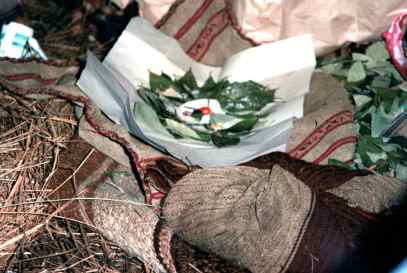 would one made by don Mariano Apasa Marchaqa. In the same way, your style of making a despacho is likely to be different from mine, and we might change our styles depending on the reason we are making a particular despacho offering.
In Andean mysticism you never just copy your teacher. Over time, you develop your own way of making a despacho, and you may have several “templates” that you follow purely from personal preference. I have drawings of some of the types of despachos don Manuel Q’espi used to make. He used a completely different placement of k’intus and items in a “male” despacho than a “female” one. Sometimes he would not even use a shell and a cross, instead making a central cross or X with fine granular incense. And he sometimes arranged the k’intus in rows, not a circle around the center.
Bottom line: Be yourself and be true to your ayni. Don’t make a despacho by rote.
How Do You Open Sacred Space Before Making a Despacho?
When it comes to an “opening” ceremony for despacho making, it’s a personal choice, not a necessity. There is very little ritual or ceremony in the Andean mystical tradition, but there is nothing wrong with performing ceremony if you are conscious that it is only a personal preference. But to get to the heart of the question, I have to ask, “Why do you need to open or create sacred space?” and “What space is not sacred?”
Even if seen as metaphor, the words “open” or “create” sacred space hint at a misunderstanding of the Andean conception of energy. They imply that you have to open a door to the sublime that has been closed to you. That before your invocation, you are in a space devoid of or lacking in the sacred. This view is counter to Andean cosmovision of a universe infused everywhere and at all times with sami.
According to the Andean tradition, there is no place except within the human energy body that is not pure sami (refined energy), so everything, everywhere is sacred. The entire kawsay pacha is living energy in its most refined state. And even if you feel hucha within yourself, hucha is not bad, contaminating, or unsacred. So my point is that ceremonial  space clearing or ordering is not necessary. You might like to do that. Fine, do it. Performing such ceremony can mark the beginning of the despacho-making process, help focus your attention, foster a greater sense of beauty, and bring a group into collective resonance. It might also be part of your ayni to connect with the spirits, as in opening a dialogue. But it is not required. Ayni is invisible! If you choose to it make visible, fine, but know that undertaking this kind of initial ceremony is a choice, not a necessity.
As I said, there is next to no rote ritual in the Andean tradition. You will indeed see many paqos (at least, those with whom I have worked) whisper into a k’intu or their misha (mesa) before starting to make a despacho. They are communing with their guiding spirits or the cosmos at large. They are calling the spirits to come closer or asking that their prayers be received. They may honor the three worlds and the three human powers. If you want to call this personal communication with spirit guides or beings by the words “opening sacred space,” okay. But that is not really an accurate way of describing what they are doing—which is deepening their ayni in an intensely personal and nearly private way.
Why Offer a Despacho?
To understand the “why” of the despacho, it’s helpful to realize that when training in the tradition, the despacho is usually one of the first practices you are introduced to. Why?
Because the despacho is the primary way of teaching about ayni (reciprocity).
There are hundreds of types of despachos, which means that there are hundreds of reasons for offering an despacho. What underlies them all is ayni. Ayni is always and only the “why” of a despacho. The despacho is the outward action and manifestation of the inward energetic and intentional gesture of personal reciprocity with the living cosmos.
The intent of a despacho will always be expressing one of these three stances of ayni:
- An offering of thanksgiving, gratitude, or appreciation that honors or acknowledges someone or something. You can be honoring your parents or the spirits being. You can be thanking the spirit beings for a turn of good fortune or a return to health. You can be making a gesture of appreciation for your life or your new car. You can be acknowledging the wisdom of the ancestors or a new insight into yourself that has helped you overcome stuck beliefs or behavior.
- A request. In this kind of despacho you are asking for something. It might be the help or influence of the spirit beings or the general largesse of the living cosmos. You might be asking for a blessing such as for fertility to bear a child or assistance to birth a new business. Or you might be requesting a break, such as an end to or relief from your suffering or heartache. When you make this kind of despacho, it is important to be true in your ayni and make a despacho that reflects your feelings. If you are depressed, make an offering of your depression. If you are angry, make an offering of your anger. A despacho is not always pretty. If it is an offering of your depression to the cosmos with a request of release that means your despacho actually is your depression, not just a mirror of it or substitute for it.
- To make atonement. This kind of despacho is called a pago, or payment. This kind of despacho is a purely energetic ayni for making amends, asking forgiveness, or acknowledging a personal shortcoming in thought, word or deed.
Every possible kind of despacho falls into one of these three ayni categories, so when you are preparing to actually make the despacho, knowing this “why” will guide how you 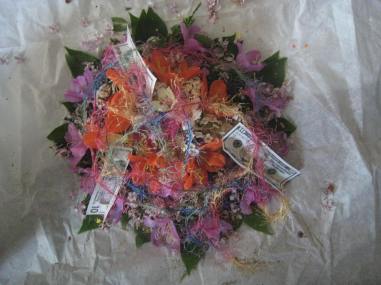 actually make the despacho, including what you put in it and its design and organization.
How Do You Offer a Despacho?
In my work with various paqos over the years, I have only ever seen one way of offering a despacho, but as I share the tradition around the country I have become aware that there is a different opinion and diametrically opposite practice. I can only offer an answer based on my understanding of Andean cosmovision through the lineage that I follow.
The two schools of thought are that when you offer a despacho, let’s say by burning it, you:
- witness the offering and the burning until the despacho is fully consumed
- you turn your back so you can’t see the offering consumed and you detach from the outcome of the offering
I have only ever seen paqos offer a despacho in the first way, by witnessing the offering until it is fully consumed. Admittedly, that is a small sample of paqos. So I won’t base my answer only on how I have seen it done by the paqos I happened to work with, but on what makes sense in terms of the universal, underlying cosmovision of the Andes through this lineage.
Don Benito Qoriwaman taught ayni through the practice of the despacho. He explained that when you make a despacho it is like inviting the most honored guests (the spirit beings) to your house and making and serving them the finest food (everything you put in the despacho, especially your intent).
(As an aside: Don’t misunderstand that the “finest food” means anything sentimental. As I indicated earlier, if you are making a request to lift a deep depression, then the main ingredient of your meal for the spirits will be your dark and debilitating depression.)
Knowing that a despacho is like preparing the finest meal of yourself and your intent for the spirits to dine on, I ask, “Why would you ever turn your back on these most honored guests?”
You wouldn’t. You would serve them and commune with them. You invited them, and they have come to meet you and dine on your intent. If they accepted your invitation, then you can be sure they want you there with them. So, you would enjoy, not reject, their company.
Moreover, there is nothing in the Andean tradition, at least that I have ever heard, that teaches fear of the spirit beings. Respect, yes. But not fear. They are not intimidating strangers. They are your friends! You are honoring them, making a meal for them—and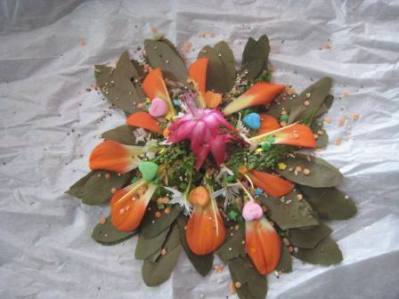 that occasion is not complete if you as the host are not fully present.
If it is a group despacho, nothing changes. If possible, you don’t send a surrogate (your teacher or a master paqo) to be with the spirit beings on the group’s behalf. If anything of you is in the despacho, you commune with the spirits yourself (along with the others in the group) because the despacho is always about ayni—and your ayni is part of the group despacho. The only caveat is if a paqo is making a despacho on your group’s behalf. The group may witness the despacho-making, but is usually not deeply involved. In this case, the group may not be involved in actually offering it to the fire.
In addition, paqos almost always closely witness the spirits “eating” their offering. They assess the color and direction of the smoke, how the bundle burns, if it is fully consumed, and so on. All of that has meaning in terms of how the spirits “accept” your ayni. You can’t do that if you have your back turned.
Another aspect of offering the despacho is how you relate to your prayer, request, or payment. Some say you must “detach” from the offering, which is another reason to turn your back while the despacho is burning.
From what I know about the Andean mystical tradition through the lineage in which I studied, I can’t imagine a paqo ever telling anyone to “detach” from their despacho offering. A despacho is the deepest expression (outward and inward) of your ayni. Ayni is inseparable from your intent. You can’t detach from ayni, only be unconscious to it.
Plus, from the Andean perspective, when you undertake a practice, you expect results. You absolutely expect them! That’s the practicality of the Andean tradition. The expectation is that if your ayni is “accepted” by Spirit, you will not only get what you asked for, but you will showered with blessings greater than what you asked for. That expectation is the furthest thing possible from detachment!
Detachment is a decidedly Buddhist stance, where craving is at the root of human suffering. That is not even close to the Andean view. In fact, Andean practices are almost the opposite of detachment. For instance, in the “play area” at Qoyllurit’i, people embody their desire (intent, ayni). They act it out, in great detail and with a spirit of both intensity and playfulness. Andeans embody to fully immerse themselves in an experience, not to detach from it or the intent that drives them to undertake the experience in the first place.
It is true that sometimes we detach from how the ayni is returned to us, but we never detach from expecting a return or the process of making and offering the despacho. The universe of living energy is untold times greater in its generosity and creativity than we are, so how we receive our ayni may not look like we expected it to, but we always know that ayni is the law of the cosmos and so we never “detach” from it. I am talking about attention and intention, not about craving or obsessing, which may be hucha-producing. We can be humble in our offering and still strong in our intent, but humility is not detachment. If you are offering a despacho—the supreme expression of ayni—then almost by definition you are exercising a stronger than normal intent: the whole point of a despacho is to concentrate your intent beyond its normal level by embodying it in material form, so you have every reason to keep your expectations high while also remaining humble before Spirit.
All of this is why I think detachment is a contamination from another tradition and is counter to the core of the Andean cosmovision and the spirit of despacho-making and despacho–offering.
I hope that this long post has helped you see that the “why” of what you are doing as a paqo is as important as what you do. When you are told to “Do it this way,” ask yourself, “Is this way in alignment with Andean cosmovision?” If it isn’t, then you can safely assume that the teaching is personal to that teacher and not a “must do” in terms of the core of the tradition.
 There really is no right or wrong—it’s really, really hard, if not impossible, to make a “mistake” in Andean mystical practice because intent is at the heart of everything in this tradition and always trumps ritual. However, there is “more Andean” and “less Andean” and sometimes as a practitioner of this tradition, you have to question your teacher about the “why” of a practice. The answer may be in alignment with the ancient cosmovision or may be simply personal preference, but your teacher should be able to explain that difference clearly to you.
The Andean tradition is beyond most dogma, but you can layer any kind of psychology, philosophy, ceremony, or poetry onto its practices without those practices losing effect (if your ayni is effective and strong). But why do that? I propose that in your development as a paqo the most productive approach is to strip things down to their foundation before choosing to dress them up to make them more fun or appealing or whatever. Doing so, to me at least, is the best way to honor the lineage, respect the tradition, and become the most effective paqo you can be for your own conscious evolution and that of the world.
(Note: I am traveling in Peru for a large part of September so will not be available to moderate comments or questions until my return.)
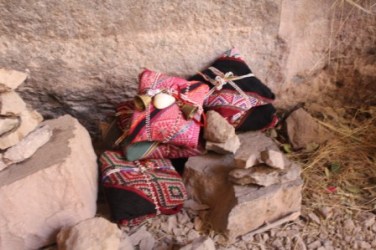
(Also, thank you to Fran for pictures of some of her despachos.)

 others—the revolution as conscious evolution starts within.
 state of being. As writer and teacher Marianne Williamson says, every moment is a choice about your “ministry.” Will it be a ministry of fear or one of love (munay)? Does it arise from respect or does it only marginalize or denigrate? Long before Williamson was a public figure, she was a cocktail waitress. She decided that her ministry was to be the best, most life-affirming waitress she could be. The bar where she worked was her “church.” She started right where she was and as who she was—a waitress in a bar at a restaurant—and did not defer her work until she had a larger stage or a different environment. Most important, she started by deciding who she wanted to be, before she started acting on that state of being.
 The medieval mystic Kabir reminds us that when it comes to outward gestures, “Why run around sprinkling holy water? There’s an ocean inside you, and when you’re ready you’ll drown.” The mystical drowning is not life threatening, but life affirming.
 those of us on the Andean path. It’s a time to do our personal inner work, so as we change, grow, and transform we contribute to the greater well-being of the world.
 than is the more domesticated mountain puma. Paqos work with the mountain cats, not the jungle cats.
 we still need to release hucha, our focus in the Taripay Pacha, as creatures of conscious evolution, is to increase the sami in ourselves and foster it in others. This is a huge conceptual shift. It is almost like making a shift from carrying the burden of original sin to celebrating ourselves as creatures of original virtue. You can see how massive a change this shift in perspective can engender as we move our focus from releasing to generating, from reducing hucha to actively increasing sami.
 The symbols of wholeness are the tawanatin and the chakana. The chakana is the Andean cross, but it is more than a symbol of an empire or a culture. It is a symbol of a living tradition—of a bridge between cultures. As Juan Nuñez del Prado says, we are each a chakana—we are people who are building a bridge between traditions and fostering the shift from one age to another, more evolved age.
 to the salka (the unrefined, the wild), although that might be stretching the metaphor a bit.
 preference is always to ask the “why” of what they are doing, leading them back to the basics of the Andean cosmovision. When you understand the foundation of the tradition, you will better know how to evaluate what you are being taught, especially when it comes to ritual or ceremony.
 experiences in life.
 do receive its energy, you can only understand and use it to the level of your own conscious evolution. So while khuyas can transmit “power,” receiving and using that power is dependent on you and the state of your energy and consciousness.
 power/ayni. So no matter how you use your misha, it is only an outward representation of your intent, whether you use it for healing or blessing or anything else. So when I discuss some of the uses of the misha below, always remember that it is you and your intent that is driving the energy, not the misha itself.
 power you are not capable of using. You can’t even discover the specific use of a khuya if you can’t first establish an ayni relationship to open an “dialogue” with the khuya. It can do nothing on its own, and that is the important thing to understand.
 . You are never alone as a paqo. However, your misha is always and only representative of you—and you alone. If you are following a rote schema, you are mirroring someone else’s ayni relationships, not your own. There is nothing wrong with agreeing to “universal” meanings and a teacher’s instructions for where to place something and what it means as long as that feels true in relation to your own beingness and ayni relationships.
 feelings you had about the old. Same for the entire misha.
 At the current time, this post may speak more to those from the United States, who are in the midst of a presidential election cycle, but it is relevant to all who take their civic duties seriously.
 things are going well and unhappy two days later when they are not. You are kind when people treat you well and are insulting or hurtful to them when they do not. You are madly in love this month and angrily kicking your lover out the door the next.
 As you go to the voting booth, in the United States on November 8 or elsewhere at other times, ask yourself: Who among the candidates understands and acts from ayni instead of ch’allay? Also remember that ayni is not a stream of earthbound energy; it has cosmic ramifications. It is always cosmic in scope because everything, including human consciousness and its intent, is part of the vast web of a living universe. So ask yourself: Which candidate’s platform and vision have the most beneficial impact not only at the personal level but at the spiritual and cosmic level?
 masintin and yanantin. In their simplest forms, masintin is a relationship of shared characteristics whereas yanantin is one of dissimilar characteristics. Yanantin relations tend to cause the most hucha—but only if the person is blind to the energy dynamic. A person wise in the ways of energy dynamics will be aware of where and how his or her relations are similar and where they are dissimilar, and act accordingly to prevent discord and harm. It’s easy to act from feelings (empathy, compassion, kindness, generosity) when feeling kinship with another person or group (masintin). Fourth-level maturity comes into play when those interactions feel distant and different (yanantin). When faced with a combative press, a disparaging opponent, a hostile crowd, a fickle ally or a ferocious foe, the skills of the fourth level are crucial to keeping the yanantin energies from creating hucha for all involved.
 , being able to propose action and then take it; following through on words with actions). An effective leader will have harmonized the three human gifts within. That person will say what he or she means, do what he or she says, and both speak and act (with munay and from ayni) with the larger good in mind. Someone who has harmonized the three human powers within is someone who has integrity, which surely is a core characteristic we want in those whom we elect to govern.
