
To consistently live at the fourth level, you have to express all three human powers at that level. Those powers are yachay (intellect, perception, reasoning), munay (love  under your will) and llank’ay (action in the world). To monitor my own state of being in reference to these three powers, I try to rotate through them, spending a few months working on each one, seeing where I am deficient and acknowledging where I am sufficient. As part of my recent work with yachay, I checked on my related power of qaway, which amounts to “seeing reality as it really is.” That means perceiving the world stripped of my own projections, beliefs, misconceptions, and so on. As part of this practice, I realized I really have no idea what the state of the world is. I feel concern for my own country and our apparent backsliding in our political and cultural maturity, and I certainly am aware that there are conflicts and wars, climate change, racial and gender inequalities, famine, disease, poverty—the list of human challenges seems endless. It’s hard to remain positive. . . However, I had no real yachay and qaway (accurate and clear-eyed) sense of the world. Then, metaphorically speaking, a book fell into my lap. . . . Hans Rosling’s Factfulness. There is a lot of carefully vetted data in this book about both our challenges and our triumphs as human beings and societies.
Rosling challenges us to test our knowledge and emotional-based perceptions (yachay) about the state of the world. So I am going to do that here, asking you seven questions that are pitched to readers in the book or that I have devised from data in the book. See how well you do.
- In low-income countries across the world today how many girls finish primary school?
- A: 20 percent
- B: 40 percent
- C: 60 percent
- In the last 20 years, the proportion of the world population living in extreme poverty has. . .
- A: almost doubled
- B: remained more or less the same
- C: almost halved
- How many of the world’s 1-year-old children today have been vaccinated against some disease?
- A: 20 percent
- B: 50 percent
- C: 80 percent
- Where does the majority of the world population live?
- A: Low-income countries
- B: Middle-income countries
- C: High-income countries
- How many people in the world have some access to electricity?
- A: 35%
- B: 50%
- C: 85 %
- In 1900, only 0.03% of the Earth’s land surface was protected as national parks and other reserves. How much is protected today (2016 statistics)?
- A: 0.06%
- B: 7%
- C: 15%
- In 1800, of 194 countries counted, 193 permitted forced labor or it was practiced by the state. In 2017, how many countries still sanction forced labor?
- A: 3
- B: 76
- C: 193
Here are the answers. How did you do?
1. C 2. C 3. C 4. B 5. C 6. C 7. A
If you are like me, you saw the state of the world in a more negative light than it actually is. The truth is, there are major reasons to celebrate. What I didn’t tell you before the test was the subtitle of Rosling’s book, because I didn’t want to hint at the nature of the answers: Ten Reasons We’re Wrong About the World—and Why Things Are Better Than You Think.
As I read this book and educated myself, I was amazed to count the number of areas where we humans have made enormous progress. Are there still countless injustices? Yes. Is there still needless suffering? Yes. For example, while the majority of the world lives at a much higher standard of living then they did a hundred years  ago, there are still more than 800 million people living in extreme poverty. There is so much work to do. . .
Still, we are not “seeing reality as it really is” if we focus on only one or the other of these ways of seeing the world: the seemingly intractable inequities and problems, or the astonishing gains that humankind has made. As paqos, we want to see both. We seek to tackle challenges and contribute to the continued well-being of the world, while we acknowledge the benefits that have been gained by so many.
Having learned that the world is a much better place than it has ever been in the past, how do we continue our progress?
Individually and together. Through gestures grand and modest.
This blog is not an advertisement for the organizations I choose to support in order to increase the well-being of the world, but I present two of them as examples of how we can help—at least in part by applying our yachay. We can’t be led only by our emotions. We can’t rely on advertising and media appeals. We have to dig in and educate ourselves if we want to make the greatest impact. So, we would do well to spend a little time getting to know what the problems are, the contexts and challenges, the potential solutions and their unexpected ramifications.
Of course, we start with ourselves, improving our own state of being and evolving our own consciousness, and then we seek to expand the circle of well-being to those around us, our communities, and our nations. But today each one of us truly can have a global reach. We can be teqse paqos, or universal paqos. Here are two examples of how.
Chickens! I researched chickens. Raising chickens can have enormous benefit to both the health (protein-rich eggs, meat) and financial condition (selling eggs and chickens) of people currently living in poverty. If they have access to some land, people can easily raise chickens, which can almost immediately improve their health and economic circumstances. Chickens don’t need elaborate upkeep, they multiply  rapidly, the kids can help tend them, and there is always a market for them and their eggs. I love the relative simplicity of chickens as a partial antidote to both poverty and low nutrition. I donate flocks of chicks. So does billionaire Bill Gates, who has heralded raising chickens as one of the quickest and most long-lasting ways to improve the condition of millions of impoverished people. Gates supports the same organization I donate to: Heifer International (www.heifer.org). You can give a struggling family somewhere in the world a flock of chicks for $20. The return on such as small investment is incalculable.
I like to go for maximum impact. Using my yachay, I asked “How can my modest donations or efforts improve conditions for the most people?” Another answer: clean water. I recently signed up with an organization that is visionary in their mission of providing millions of people with clean water and stellar in the execution of that mission.
One of the most pressing problems in the world is unnecessary deaths from treatable diseases. The number-one culprit for causing such disease is contaminated water. There are hundreds of millions of people who still don’t have access to clean sources of water. That’s right—hundreds of millions of people are still drinking filthy water and suffering the consequences: sickness, blindness, deformity, and even death. And most have to spend hours a day walking to the water source (a lake or stream) and hauling it home. This is the job mostly of women, many of whom suffer from degenerative neck and spinal conditions from years of carrying such weight (up to 40 pounds for one jerry can of water).
Dozens of organizations are on the front lines of providing potable water by building wells, but they have had mixed results because many of them don’t stick around to train local people on how to maintain the wells or how to get the parts to fix them. According to one statistic, at least 40% of all wells are idle at any one time, or permanently out of commission, due to maintenance issues. But at least one organization has tackled that problem: Charity: water. I urge you to check them out (www.charitywater.org). Read founder Scott Harrison’s book Thirst, about how he  went from being a drugged-out partying nightclub promoter to building one of the most effective organizations for providing millions of people access to clean water. His yachay is impressive! As is his llank’ay (action) and munay (love).
There’s another, indirect, yachay issue connected to Harrison and his organization that I learned about while doing my homework on the organization. He is a disrupter in the non-profit sector, and many non-profits are attacking him, mostly because they perceive a marketing and perception problem with how to address to the public the need for raising money for administrative costs. Harrison ruffles the feathers of many people in the non-profit sector because they fear they are at a disadvantage, but this too is part of the process of change. This “where does the money go” debate helps us all to understand the practical problems an organization faces when mounting an effort to tackle a complex, global problem. Harrison is innovating a sector that has not changed much over decades, and it is causing some painful ripples across that universe of organizations. But in the process, he is helping all of us dive deeper into the realities of what “charity” is and how it is best administered. But delving into how I could best contribute to clean water, I learned a lot not only about the consequences of not having clean water but about the world of the non-profits who mostly provide the solutions. My yachay increased, as did my llank’ay through my ability to select the best organizational fit for my donations.
All charity begins with munay. But cultivating your yachay is a necessary precursor to deciding with clear-sightedness how to use your llank’ay. Together your three human powers fuel your own growth and well-being and can help keep the curve of “goodness toward” and “great results for others” heading upward, helping to increase the positivity in the world. Paqos want to work with both hands: working the mystical side and the magical sides of the path. The mystical is perception/yachay; the magical is action/llank’ay. Performer and writer Sam Levenson has said something that reverberates for all of us as paqos as we seek to work with both hands: “Remember, if you ever need a helping hand, you’ll find one at the end of your arm. As you grow older, you will discover that you have two  hands: one for helping yourself, the other for helping others.”
Over the centuries all the individual hearts and hands have collectively had a profound impact on increasing the quality of human life the world over, as Rosling so clearly documents for us with his yachay approach to data. Myriad problems still plague our world—some are incredibly complex and severe, whereas others are easily addressed if we would only find the will. Still, we should be heartened by the progress we have made. When we apply our yachay and qaway, we acknowledge and celebrate that hundreds of millions of people are healthier, happier, freer, and able to express their greater potential than at any other time in human history. Let’s keep the goodness going. . .
 humanitarian Elie Wiesel in his role as professor. There is so much in this book, titled Witness: Lessons from Elie Wiesel’s Classroom, that resonates with the fourth-level of consciousness according to the Andean tradition. It is especially applicable right now in US history because the current administration—all branches of our government: executive, congressional, and judicial—display so many qualities that are not third level, never mind fourth level. Wiesel warns us about and urges that we not turn a blind eye or a deaf ear to what is happening around us, in the US and around the world. With the rise of extremist politics, especially the “alt right” and “white nationalism,” and with the growing demonization of anything that is “other,” Wiesel’s warning are more pertinent than ever.
 atrocities to the Inka, the indigenous North Americans, and so many other peoples? To the unspeakable genocides of Nazi Germany, Rwanda, Bosnia, or Cambodia, among others? How can we bear to make real the suffering in Yemen and so many other countries that is occurring as I write and as you read this? How do we respond when we see children torn from their parents’ arms at the southern border of the United States and processed into a bureaucratic system that has few or no mechanisms for ever returning them? As Wiesel’s student Ariel Burger asks, how can we “become custodians of memories that are not our own?” One of Wiesel’s many answers is as follows: “Our connection to the past is weak; it may be distant, at a remove. All we can do is tell the story, and we must. But in order to tell the story, we first must hear the story.”
 don’t I owe you my honesty?”
 Wiesel tells us that this kind of madness may be the appropriate response to facing evil, suffering, and injustice. He says, “. . . if you look away from suffering, you become complicit, a bystander. Silence never helps the victim, only the victimizers. If you do look, you risk madness. Faced with a choice, madness is the better option. It is a better option because at least you will not be on the side of the killers.” He elaborates, “We study madness in order to learn how to resist. Madness holds the key to protest, to rebellion. Without it, if we are too ‘sane’ by the standards of our surroundings, we can be carried along with the world’s madness.”
 terms of the current state of the US political system. We are witnesses to the actions of an executive branch that are unlike anything we have experienced in the past. We are witnesses to the decay, and perhaps even incremental dissolution, of our constitutional republic with its precious checks and balances. But other countries have gone through what we are now experiencing. We would do well to heed Wiesel’s words. Here he is speaking about Nazi Germany, answering questions about evil and the common person’s betrayal of his or her values, about those who blindly support those in power and those who watch their leaders go against their values but do nothing. He says, “Those who intend evil do not want others to ask these questions, and the bystanders who watch the evil happen avoid such investigation. This is the front line of the battle against fanaticism. The fanatic believes he has all the answers, and he has no questions. I have only questions, so I am their enemy. Questions save us from the certainties that lead to fanaticism. To be human is to ask questions, to ask why, to inquire, to interrogate each situation in a search for the truth, the truth of how we must act. We must face such questions rather than turn away from them; we must unmask and confront evil rather than reduce it to something comfortable. It is not comfortable to name and confront evil, but we cannot be too attached to comfort if we want to make the world better.”
 supporting a candidate, casting a vote. Before we can do any of those things, though, we must look and listen to see what is right in front of us and name it for what it is, and then lift up our hearts and voices if need be. We may feel small in the face of events, we may feel nameless in the vast sweep of history, and we may feel overwhelmed by the enormity of the problems of our times. We can choose any number of options to contribute good to the world, but the one thing we cannot ever allow to take hold within ourselves is apathy. A paqo engages life with khuyay, passion. Passion does not have to be grandiose, only sincere. Every day we can make a difference if we cultivate our munay and share it. We can, as Wiesel says, echoing so many other wisdomkeepers throughout history, simply “touch one person every day with compassion.”
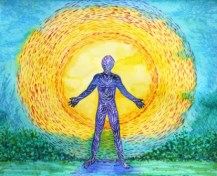 cosmology and practices of the Andean mystical tradition. I am returning to Dawson Church’s book Mind Into Matter in this post to talk about coherence.
 oblivious to how we are making these energy exchanges. They are mostly unconscious. As a result, the chaos of our mental field (reactive emotions, unruly thought processes, lack of focus, diminished self-awareness, etc.) expresses itself outwardly in the condition of our health, our family and social life, our ability to know and express our gifts, and on and on. In Andean terms, we have a lot of hucha (heaviness, slowed life-force energy).
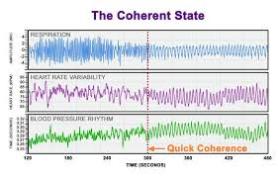 This image from the Institute of HeartMath shows what just a few minutes of a coherence-inducing practice does to biological markers. The baseline measures start on the left and the shift to coherence that occurs after only a five minutes of undertaking a coherence-inducing technique is apparent in waves forms.
 expressed from the field of a coherence energy body/poq’po.
 Science, and a Guide to the Secret Power of the Universe. Aside from my interest in staying abreast of current research into human consciousness and my planning to teach a workshop in September 2019 on supercharging your intuition, I was struck by how this book confirms so much of our practice as paqos—especially that the “secret power of the universe” that Radin mentions in his subtitle is intention. The “beauty teaching” of the Andean mystical tradition is that energy must follow intention. All we need to interact with the universe of living energy is our intention. What we call ayni, Radin calls magic.
 effectiveness with which we manifest anything through ayni—from something as abstract as joyful well-being to something as concrete as a new house—is proportional to our personal power. Our personal power is a state that arises from the coherence of our energy body (more sami, less hucha). In other words, the more sami-filled our poq’po, the more clarity we bring to our ayni and the more effective it is. With less hucha we are able to do more. This focus on llank’ay—doing—is also the magic that Radin talks about.
 identifies as optimal state for psi functioning. Radin writes that the most successful participants in psi experiments (in this case to influence random-number generators, but it applies to all “magical” intention) are those who feel “resonance” with the machines (feeling at one with it, softening of boundaries between the self and other) and who experience “effortless striving,” which is intense desire or focused concentration that is devoid of anxiety. This, to me, is a way of saying being in ayni.
 paqos learn to be in effective ayni in a normal state of consciousness. Still, the mechanisms that Radin sees in play are just like ayni—there is a two-way interchange: you project outward your intention to influence the energy of the universe, and the living energy of the universe reaches back to you and responds. While the laboratory effects of psi abilities are quite small, they are statistically significant to an irrefutable degree.
 the entire material cosmos.
 to declare the primacy of intentions, from the most humble to the most glorious.
 Q'enti Wasi - House of the Hummingbird