
Back in 2015, I wrote a post about the significance of the date of August 1 in Andean mystical practice. I am going to revisit that topic here so that you can prepare for this auspicious day.
August 1 is called Pachamama Day, the day on which the Apus and Pachamama  “awaken” to hear our prayers and accept our offerings. Of course, they are always “awake” and available to us, but on this day they lend an ear in an especially attentive way. In a sense it is a kind of mystical New Year’s Day, one on which paqos undertake personal work and ritual from feeding their mishas to honoring their spirit guides. (As a note of reminder, the word Pachamama, while commonly used to refer to Mother Earth, is really the name for the Mother of the Cosmos. She is the entire material, physical universe. Mother Earth as the planet is Mama Allpa). So, this is the day we set aside special time to be in ayni consciously and purposefully with the universe of living energy and with all the physical manifestations of that living energy, such as the various spirit beings. But most importantly, at a personal level, it is about undertaking a conscious, personal mast’ay, a reordering of the self.
When I was interviewing the Q’ero for my book Masters of the Living Energy, don Julian Pauqar Flores gave me a gift of a khuya, a stone from his misha that I was to place in mine. He explained all the ways the khuya could be used, which I won’t go into here except to say that it has more uses than any other khuya I have. During his explanation, he mentioned the August 1 date, explaining this day of awakening along with a simple but powerful incantation that paqos can say to renew themselves. I pass this incantation on to you, with my added ideas, instructions, and explanations for working in ceremony on this auspicious day. You can work the order of the parts in any way you want, and I change it up year to year, but this is a basic framework for working on Pachamama Day.
As the Apus and Pachamama awaken, we, too, can re-awaken or rebirth ourselves. We let go of the past and proclaim our intentions for the coming year. We claim our independence from who we were and declare who we are going forward. We cut the seqes, the energetic cords, to what no longer serves us and project forward toward the realization of our perfected selves. Thus, it is a day when we tap into the energy both of the living universe and of our personal power to nurture our potential to become enlightened, sixth-level human beings. This work involves personal recapitulation, a personal mast’ay (reordering of the self), and the mast’ay of the misha (personal power bundle).
You can start with a wachay, a rebirthing or recapitulation practice. As with all our of work, it is invisible energy work, done using your intention to move energy and  undertake a mast’ay, a restructuring or reordering of the self.
First take a moment to feed yourself and your poq’po with sami to settle and empower yourself. Then, to do a wachay, you use intention to release your hucha (heavy energy), working from the present moment back to the moment of your birth. This process, as you can imagine, can take some time. Don’t rush it. Seek quality and clarity in your energy work. Working back from the present moment, you draw sami into your poq’po while releasing hucha down to Mother Earth, also using your intention to cut the seqes (energetic cords) to anything you feel you need to release or disconnect yourself from—emotions, events, people . . . whatever has felt heavy to you. Honor what you have learned, yet also let what is finished be finished both emotionally and energetically. You can choose not to carry this hucha any longer, and Mother Earth is happy to accept your hucha as a gift of her favorite food. This is not an analytic practice, so don’t get bogged down in reviewing situations or reengaging emotions or memories from the past. Simply note where you feel hucha as you recapitulate your life and at each point release that hucha to Mother Earth.
When you are done releasing the hucha through your personal timeline, it is time to renew yourself and focus energetically on your continuing growth as a human being. This is the work that don Julian described in his interview with me back in the mid 1990s. It is time to state your intentions for the coming year—to configure 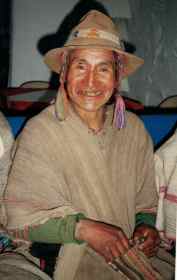 energetically your new inner personal mast’ay. I usually hold my misha while I do this part of the ceremony.
Sit quietly and mull over what you “intend” for yourself in the coming year. Be clear-eyed and sober about this. Distill your intentions down to the absolute most important essentials. Then stand, holding your misha, and declare aloud to the living universe the incantation that don Julian gave me: “I am what I speak, not what I have spoken.” Then speak aloud your essential intentions for the next year. Speak aloud with clarity who this new you is: your expanded personal capacities and qualities, how you want to serve in the world, the kind of relationships you choose, and so on. You are stating that from this moment forward you are renewed, you are reformed, you are revitalized, you are realized in a new way.
Once that part of the ceremony is done, you can elect to “reintroduce yourself to yourself,” since you are a newly organized you at the energetic level. Sit quietly with your misha and drop into your poq’po. Be alone with yourself and establish a relationship with the renewed you, the potentially more consciousness and developed you. Get to know yourself and perceive the state of your poq’po at that moment. Take all the time you need.
Because you have “reordered yourself,” at least in potential through your stated intentions, you now need to work with your misha, the bundle of sacred objects that connects you with the lineage of paqos and with your own growth as a paqo. The misha represents your personal power—as it is now. Since you have just released and restructured yourself, it is likely that your misha must be renewed and restructured as well.
The misha is a great eater of hucha, so take a moment to release more hucha from your poq’po into the misha. Then connect your munay (love) with your misha, honoring the lineages of paqos in which you work; any spirit beings, such as an Apu, you feel connected with; or any or all of the seven teqse paqos, or universal paqos/spirit beings. They are Taytacha (Father God/Jesus Christ/Divine Masculine), Mamacha (Mother Mary/Divine Feminine), Tayta Inti (Father Sun), Mama Killa (Mother Moon), Tayta Wayra (Father Wind), Mama Unu (Mother of the Waters, as in hail and rain, not lakes and rivers), and Mama Allpa (Mother Earth). Then sit with your misha and honor how it has served you as a representation of your personal power and a hucha-cleansing bundle. Then open your misha and undertake a  mast’ay, a new ordering of the contents of your misha.
Your misha is a living thing—it represents your personal power. As you grow and change, so does your misha change to reflect who you are. August 1 is a day to open the bundle, connect with the khuyas inside (sacred objects), and feel what kind of changes are necessary to reflect your current state. Some khuyas may be ready to leave your misha. Maybe none will, but commonly you will find that some will. Put them on your altar or return them to nature with gratitude. You might also find that other objects want to be added to your misha. They reflect your progress on the path or important events and relationships that have had meaning for you since the last time you opened and reorganized your misha. Place these new khuyas into your misha with your attention and affection. Remember, misha is the Quechua word for “sign” or “symbol.” Your goal is to have a misha that reflects the current state of your being, of your personal power. When you are finished with the mast’ay of your misha, then “feed” the khuyas, sprinkling them with pisqo (a Peruvian alcohol), wine, water . . . whatever. It is the intention that counts. Your ayni matters more than the outward form of the ceremony. When you are finished, fold the sacred bundle back up in its covering cloth.
You may end the ceremony here, or you may want to offer a despacho. Actually, you can incorporate the despacho at any point in the ceremony. You may offer one after 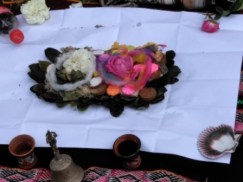 the wachay, to mark the cleansing of hucha and release of any heaviness from your personal past. Or after the incantation and statement of your intentions, honoring your commitment to be a “new you.” Or at the end, to mark the conclusion of the entire mast’ay and honor the spirit beings. Decide what feels right for you. Ceremony should never be robotic. There are no absolutes, especially in method. The Andean path is one of ayni, and ceremony is best seen as the externalization of your internal state, not of following some schematic touted by others. That’s why I say you can do this series of rituals in any order and, really, any way you want. Find what is true for you—that approach is why we call this work the Andean sacred arts. In any case, Pachamama Day is the perfect time not only to reflect on your gratitude for the knowledge offered by the masters of old and through the grace of God and the Spirit Beings, but also to purposefully work your energies as a growing, evolving paqo and human being.
Notes: Photo of mishas copyright Lisa McClendon Sims 2018. Also, this is the last post for about a month, as I am off to Peru.
 under your will) and llank’ay (action in the world). To monitor my own state of being in reference to these three powers, I try to rotate through them, spending a few months working on each one, seeing where I am deficient and acknowledging where I am sufficient. As part of my recent work with yachay, I checked on my related power of qaway, which amounts to “seeing reality as it really is.” That means perceiving the world stripped of my own projections, beliefs, misconceptions, and so on. As part of this practice, I realized I really have no idea what the state of the world is. I feel concern for my own country and our apparent backsliding in our political and cultural maturity, and I certainly am aware that there are conflicts and wars, climate change, racial and gender inequalities, famine, disease, poverty—the list of human challenges seems endless. It’s hard to remain positive. . . However, I had no real yachay and qaway (accurate and clear-eyed) sense of the world. Then, metaphorically speaking, a book fell into my lap. . . . Hans Rosling’s Factfulness. There is a lot of carefully vetted data in this book about both our challenges and our triumphs as human beings and societies.
 ago, there are still more than 800 million people living in extreme poverty. There is so much work to do. . .
 rapidly, the kids can help tend them, and there is always a market for them and their eggs. I love the relative simplicity of chickens as a partial antidote to both poverty and low nutrition. I donate flocks of chicks. So does billionaire Bill Gates, who has heralded raising chickens as one of the quickest and most long-lasting ways to improve the condition of millions of impoverished people. Gates supports the same organization I donate to: Heifer International (www.heifer.org). You can give a struggling family somewhere in the world a flock of chicks for $20. The return on such as small investment is incalculable.
 went from being a drugged-out partying nightclub promoter to building one of the most effective organizations for providing millions of people access to clean water. His yachay is impressive! As is his llank’ay (action) and munay (love).
 hands: one for helping yourself, the other for helping others.”
 humanitarian Elie Wiesel in his role as professor. There is so much in this book, titled Witness: Lessons from Elie Wiesel’s Classroom, that resonates with the fourth-level of consciousness according to the Andean tradition. It is especially applicable right now in US history because the current administration—all branches of our government: executive, congressional, and judicial—display so many qualities that are not third level, never mind fourth level. Wiesel warns us about and urges that we not turn a blind eye or a deaf ear to what is happening around us, in the US and around the world. With the rise of extremist politics, especially the “alt right” and “white nationalism,” and with the growing demonization of anything that is “other,” Wiesel’s warning are more pertinent than ever.
 atrocities to the Inka, the indigenous North Americans, and so many other peoples? To the unspeakable genocides of Nazi Germany, Rwanda, Bosnia, or Cambodia, among others? How can we bear to make real the suffering in Yemen and so many other countries that is occurring as I write and as you read this? How do we respond when we see children torn from their parents’ arms at the southern border of the United States and processed into a bureaucratic system that has few or no mechanisms for ever returning them? As Wiesel’s student Ariel Burger asks, how can we “become custodians of memories that are not our own?” One of Wiesel’s many answers is as follows: “Our connection to the past is weak; it may be distant, at a remove. All we can do is tell the story, and we must. But in order to tell the story, we first must hear the story.”
 don’t I owe you my honesty?”
 Wiesel tells us that this kind of madness may be the appropriate response to facing evil, suffering, and injustice. He says, “. . . if you look away from suffering, you become complicit, a bystander. Silence never helps the victim, only the victimizers. If you do look, you risk madness. Faced with a choice, madness is the better option. It is a better option because at least you will not be on the side of the killers.” He elaborates, “We study madness in order to learn how to resist. Madness holds the key to protest, to rebellion. Without it, if we are too ‘sane’ by the standards of our surroundings, we can be carried along with the world’s madness.”
 terms of the current state of the US political system. We are witnesses to the actions of an executive branch that are unlike anything we have experienced in the past. We are witnesses to the decay, and perhaps even incremental dissolution, of our constitutional republic with its precious checks and balances. But other countries have gone through what we are now experiencing. We would do well to heed Wiesel’s words. Here he is speaking about Nazi Germany, answering questions about evil and the common person’s betrayal of his or her values, about those who blindly support those in power and those who watch their leaders go against their values but do nothing. He says, “Those who intend evil do not want others to ask these questions, and the bystanders who watch the evil happen avoid such investigation. This is the front line of the battle against fanaticism. The fanatic believes he has all the answers, and he has no questions. I have only questions, so I am their enemy. Questions save us from the certainties that lead to fanaticism. To be human is to ask questions, to ask why, to inquire, to interrogate each situation in a search for the truth, the truth of how we must act. We must face such questions rather than turn away from them; we must unmask and confront evil rather than reduce it to something comfortable. It is not comfortable to name and confront evil, but we cannot be too attached to comfort if we want to make the world better.”
 supporting a candidate, casting a vote. Before we can do any of those things, though, we must look and listen to see what is right in front of us and name it for what it is, and then lift up our hearts and voices if need be. We may feel small in the face of events, we may feel nameless in the vast sweep of history, and we may feel overwhelmed by the enormity of the problems of our times. We can choose any number of options to contribute good to the world, but the one thing we cannot ever allow to take hold within ourselves is apathy. A paqo engages life with khuyay, passion. Passion does not have to be grandiose, only sincere. Every day we can make a difference if we cultivate our munay and share it. We can, as Wiesel says, echoing so many other wisdomkeepers throughout history, simply “touch one person every day with compassion.”
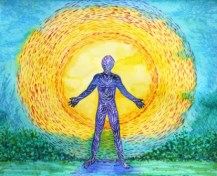 cosmology and practices of the Andean mystical tradition. I am returning to Dawson Church’s book Mind Into Matter in this post to talk about coherence.
 oblivious to how we are making these energy exchanges. They are mostly unconscious. As a result, the chaos of our mental field (reactive emotions, unruly thought processes, lack of focus, diminished self-awareness, etc.) expresses itself outwardly in the condition of our health, our family and social life, our ability to know and express our gifts, and on and on. In Andean terms, we have a lot of hucha (heaviness, slowed life-force energy).
 This image from the Institute of HeartMath shows what just a few minutes of a coherence-inducing practice does to biological markers. The baseline measures start on the left and the shift to coherence that occurs after only a five minutes of undertaking a coherence-inducing technique is apparent in waves forms.
 expressed from the field of a coherence energy body/poq’po.
 Science, and a Guide to the Secret Power of the Universe. Aside from my interest in staying abreast of current research into human consciousness and my planning to teach a workshop in September 2019 on supercharging your intuition, I was struck by how this book confirms so much of our practice as paqos—especially that the “secret power of the universe” that Radin mentions in his subtitle is intention. The “beauty teaching” of the Andean mystical tradition is that energy must follow intention. All we need to interact with the universe of living energy is our intention. What we call ayni, Radin calls magic.
 effectiveness with which we manifest anything through ayni—from something as abstract as joyful well-being to something as concrete as a new house—is proportional to our personal power. Our personal power is a state that arises from the coherence of our energy body (more sami, less hucha). In other words, the more sami-filled our poq’po, the more clarity we bring to our ayni and the more effective it is. With less hucha we are able to do more. This focus on llank’ay—doing—is also the magic that Radin talks about.
 identifies as optimal state for psi functioning. Radin writes that the most successful participants in psi experiments (in this case to influence random-number generators, but it applies to all “magical” intention) are those who feel “resonance” with the machines (feeling at one with it, softening of boundaries between the self and other) and who experience “effortless striving,” which is intense desire or focused concentration that is devoid of anxiety. This, to me, is a way of saying being in ayni.
 paqos learn to be in effective ayni in a normal state of consciousness. Still, the mechanisms that Radin sees in play are just like ayni—there is a two-way interchange: you project outward your intention to influence the energy of the universe, and the living energy of the universe reaches back to you and responds. While the laboratory effects of psi abilities are quite small, they are statistically significant to an irrefutable degree.
