
In this United States this week, we will celebrate the Thanksgiving holiday.  It is a holiday founded upon sober reality (the newly arrived colonists were asserting rights to a land already populated for millennia by others, and the new colonists were suffering terribly) and an unlikely gesture of compassion and cooperation (the Native Americans freely helped those they saw suffering even after being abused by earlier colonists and explorers). An article on History.com explains:
“Throughout that first brutal winter, most of the colonists remained on board the ship, where they suffered from exposure, scurvy and outbreaks of contagious disease. Only half of the Mayflower’s original passengers and crew lived to see their first New England spring. In March, the remaining settlers moved ashore, where they received an astonishing visit from an Abenaki Native American who greeted them in English.
“Several days later, he returned with another Native American, Squanto, a member of the Pawtuxet tribe who had been kidnapped by an English sea captain and sold into slavery before escaping to London and returning to his homeland on an exploratory expedition. Squanto taught the Pilgrims, weakened by malnutrition and illness, how to cultivate corn, extract sap from maple trees, catch fish in the rivers and avoid poisonous plants. He also helped the settlers forge an alliance with the Wampanoag, a local tribe, which would endure for more than 50 years and tragically remains one of the sole examples of harmony between European colonists and Native Americans.”
These Native Americans acted toward the colonists with ayni (reciprocity), munay (love and will), and sami (their finest light living energy). Our nation’s first tragedy is that ultimately future colonists did not do the same.
Today, as we approach Thanksgiving, we can use Squanto’s and others’ examples to bring awareness to our ayni and to how we are spreading our sami. And we can bring awareness to our blessings, express gratitude for them, and act from munay so that everyone feels the grace of Taytacha (God/Creator/First Cause) and shares the bounty of the Kawsay Pacha (the universe of living energy).
Below I provide you an opportunity to express thankfulness for what you have learned and for how you are capable of continued development to the most glorious human being possible.
Ayni
Ayni is reciprocity, a feedback loop between you and Taytacha/Kawsay Pacha. Ideally, it is an authentic exchange of giving and receiving, a gesture of love through the selfless impulse of generosity and empathy. The exchange may be of any kind: energetic, intellectual, emotional, physical. It can take any form, from encouragement, support, time, money or effort, to a smile, a hug, a helping hand, a kind word, or a selfless gesture.
Ayni Blessing
I give because I have so much to give.
I receive because I acknowledge my own worth,
and have an open and humble heart.
In ayni I am a vessel, filling and emptying in a ceaseless exchange
of all that serves the greatest good and the highest order.
Pachamama/Mama Allpa
Mother Earth carries us all on her back and gives selflessly to support our needs. She never grows weary, although she can grow angry. She wants to nurture us—that is the nature of her being. As the primary feminine spirit in the Andes, Pachamama is honored in countless ways each day. The indigenous people spill a little of whatever they are about to drink onto Pachamama, as an offering and a thanksgiving. They do the same with food before they eat. They are aware of her and know that she is aware of them. Pachamama is the primordial Mother of us all. We, and all the creatures of the world, are her offspring, feeding from her breast. Her sami (light living energy) is the milk that sustains and nourishes life.
Pachamama Blessing
The Earth is my mother.
She birthed me and provides me great bounty.
For this I give thanks.
All her creatures deserve my respect.
I am part of the Great Web of Being
and I strive to live in harmony within the cycle of life.
Despacho/Haywarisqa
A despacho is an offering, usually of thanksgiving, that is made of natural items, from flower petals to candy and other food items to stones and shells. It is the great teacher of ayni and always represents a tawantin: wholeness, harmony, completeness. My definition of the despacho is the externalization of your internal state. It is an offering of the self.
Despacho Blessing
I give thanks for this day and for my life.
I am grateful for all that I have, all that I am, and all that I can be.
I honor the difficulties that have moved me
beyond what I thought I was capable of.
I give thanks for the sweetness of life I have tasted and acknowledge
all the sweetness I have missed, ignored, wasted, or denied myself.
I accept the guidance that is available to me from all sources.
I know that I am an integral part of the Universe. I am never alone.
Sami
Sami is the refined living energy from which all things in the material world are made. It infuses the cosmos and our being. It is the light living energy that drives all things and imparts the fullness of well-being. Sami is not light as in visible light, but as a quality of the highest vibration of being—of the lightness of being. Still, it lends itself to the loftiest of metaphors. It is the nectar of the universe that you can freely eat, pollinating yourself so you can flower fully as a human being. It is the water of the universe that dissolves your self-perceived impurities and washes away your heaviness. It is the light in your eye, the glow from your Inka Seed that reveals your Spirit, and the light that illuminates even the darkest path you may have to walk.
Sami Blessing
I open myself to the light living energy,
tasting the sweetness of the universal nectar
and drinking in the living water of the cosmos.
I accept the goodness, abundance, love, and wisdom
that is freely available to me.
I share all these blessings with others in greater measure.
I do not keep myself small. I do not make others small.
I am a being who can grow to express the very qualities of God.
I will walk in light and I send forth my light, for I am a being of light.
Munay/Taqe
Munay is the choice for love. It is the partnership of love and will. Taqe is the joining of energies, an action and process that is propelled by the energy of munay. One of the names for God in the Andes is Hatun Taqe Wiraqocha: The Great Joiner God. This quality of God can become one you cultivate in your own life. You can best work the energy of bridging divides when you are respectful, open, inquisitive, inclusive, cooperative, non-judgmental, and in integrity yourself. These are the qualities of self that generate your will to express love—to practice munay. Munay is not about befriending someone, agreeing with someone, or even liking someone. But it is acknowledging that no matter how different you may be from the other person, that person has inherent worth, for God loves that person. You are not to play judge and jury, but to strive to express equanimity or, at the very least, neutrality. You can’t fake munay, but you can cultivate it. A good way to start is through embracing taqe.
Munay/Taqe Blessing
I see the beauty in myself and others.
I celebrate our similarities and honor our differences.
I am an instrument of peace, harmony, cooperation and good will.
Through my words and actions, I am an example
of these qualities to my children and others.
I choose to heal divisions both within and without myself.
Everywhere I look I find—and take—opportunities
to build bridges rather than erect barriers.
I am a joiner of energies.




 teaching from a paqo about it. But as I contemplated this question, I came to see a possible Andean mystical approach to forgiveness.
  tat—before forgiveness occurs, then you are restricting the possibilities of what can occur. You might be keeping these possibilities limited and small. As so many psychologists tell us, forgiveness is not dependent on atonement by the person whom you feel has harmed you. It’s not even about that person making amends. No matter how wronged you feel, you are not judge and jury in relation to the other person. Well, perhaps you are if you are operating only at the level of the material world. But in terms of the spiritual or metaphysical realms, forgiveness is a change in yourself, not any kind of compensatory action by the other person. Why is this so? Because, according to so many philosophers, forgiveness is an act of grace—for the self and the other. Grace is not something that is earned or deserved. It is not something you bestow on the other, some kind of absolution. It is a state of being you cultivate within yourself that creates space for release and completion. It is a choice about your preference for the condition of your own inner landscape. Grace is the condition through which you will discover your own power of munay: that your love—or forgiveness—is an energy subject to your will.
 change the past, and surely not the reality of the pain that caused you to reject the other person or be rejected by him or her, but the universe provides you a clean slate in every moment. The word forgiveness means “to give,” not “to get.” It is something you give yourself. Like munay, it is a choice. Although reaching a state of genuine forgiveness may take time, you only have to practice in this moment, and the next moment, and the one after that. In your progression, you likely will experience a lessening of emotional intensity and a gradual lifting of heaviness. You may move from loathing to resentment, then to regret, and to disappointment, and to sadness. Eventually you may feel an acceptance of the reality of the situation that is stripped of the cloak of emotion: what happened happened.
 From the kawsay pacha (the immaterial realm of Creator, which is beyond all imagining, beyond space-time and dimensionality) comes the Pachamama, the Mother of Space-Time, which is the material, physical world. Kawsay is the living energy, and the most refined form of kawsay is called sami. It’s ancient name is llanthu kawsay, or light living energy. Sami is light not as in visible light but in terms of quality: as lightness, refinement, the finest vibration of living energy. So it imparts a lightness of being. The distinction here is: kawsay is living energy; sami is light living energy.
 You are working with these spirit beings, not with their physical elemental manifestation of water/rain, soil/natural world, light/ heat, air pressure/air movement. You work with them just as you would any other spirit being, such as an apu (spirit being who lives in a mountain), by developing a personal relationship with them. Their natures differ, and you can learn from their unique powers. Father Wind is flexible, changing, moving. Father Sun is illuminating, revealing, enlightening. Mother Earth provides everything to us. She is fecund, productive, empowering, strengthening, stabilizing. Mother Water is refreshing and revitalizing, cleansing and transformative.
 this. They insisted they do not work with “star beings” and did not seem to even understand the questions they were being asked about this topic.
 we have tawantins within us as well. Our three human powers—munay, or love under our will; yachay, or knowledge and thoughts; and llank’ay, or action—are a tawantin because llank’ay can be broken down into two factors: khuyay, or passion; and atiy, or measuring your personal power in the moment, discerning proper timing for action, and bringing your impulses under your will. So our three human powers are actually four—they form an inner tawantin.
 who become life-long guides: our Itu (male nature spirit being) and Paqarina (female nature spirit being).
 Andean mystical tradition, there are four factors in the growth of a relationship, forming the overarching framework of increasingly sami-filled interactions. The four-fold progression starts with munay, developing a mutual respect and affection. Then comes ayni, when your munay deepens so that you are beyond the needs of the self and truly see the other person for who they really are (and vice versa, with the other person reciprocating). Reaching ayni is the true beginning of a relationship, which can then take you to the stage of development called masintin-yanantin. This is the stage where you begin to work through the dynamics of your individual similarities and differences, more fully taking back your projections, expectations, and so on to harmonize the interactions without judging or trying to change the other person. Despite your differences, you both act in ways that benefit the other. Your similarities amplify your munay and ayni, and you can achieve harmony as your differences become supportive and complementary. Finally, you can reach tawantin, where you are each being who your really are, fully appreciative of the other as an individual, and aware that there is almost a third body in the relationship: the energy/poq’po of the relationship itself.
 about highlighting a troublesome issue but about placing blame, usually on someone else. Criticism, or more accurately critique, on the other hand, is a healthier approach to resolving issues. Critique is a objective, unemotional airing of a grievance. You are specific about a single issue instead of making sweeping generalizations, you suggest specific changes that can be made, and you are realistic about both your role and the other’s role in the difficult dynamic.
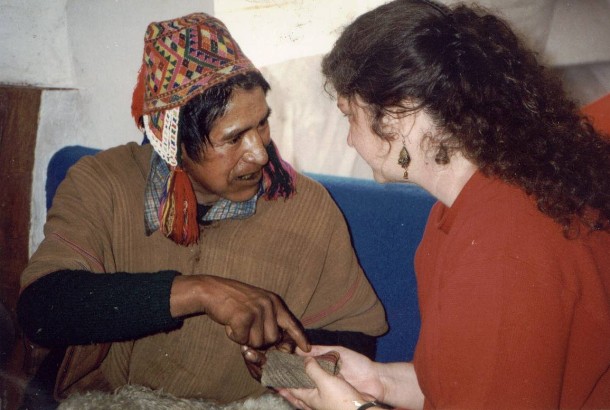 Respect grows out of caring, consideration, listening, finding worth in others, and remaining open to ideas and values that are different from yours.
