
There is no end. There is no beginning. There is only the passion of life.
— Federico Fellini
Khuyay is passion. It is passionate love, but not necessarily romantic love. It is, according to Juan Nuñez del Prado, the link between two people whose relationship in life takes on the character of a life-enhancing cosmic dance.
 Khuyay is the energy that links lovers. It is the connection between a beloved teacher and student. It is the bond between parent and child. It defies easy definition or description, because it cannot be manufactured but it is within our control.
Khuyay is a passion informed with munay—it is the ayni relationship of munay. Because munay is love grounded in will, khuyay is both a feeling and a choice. It is not passive, but active. Khuyay is the art of life as well as the action of life. Because it involves action, it is one of the primary expressions of the lloq’e, the left side of the Andean path. (Yachay is a primary goal of the right side.)
As paqos, we seek a life infused by khuyay. We want our relationships— or at least a few of our core relationships—to be partnerships of khuyay. We want to be taken care by others and we want to care of others. We want to be nurtured and we want to nurture. We want to go deep into the experience of the mystery of others and we want others to go deep into the mystery of ourselves. We want to be seen, honored, valued, appreciated, and celebrated not only at the level of our basic human needs but at the level of our creativity, wisdom, joy, and spirit. And we want to see, honor, value appreciate and celebrate others in the same joyful way.
Seem like a tall order? It is! Which is why the energy of khuyay emerges most often far into the process of self-evolution (energetic evolution)  that begins with rimay, expressing the true self; kanay, having the energetic power to know and be your true self; and atiy, having the energetic power to manifest and live as your true self. Only when we have accumulated this kind of personal power can we express the fullness of khuyay—a life infused with passion—because “true” passion presupposes being your “true” self.
Khuyay as passion means engaging life as who you really are. But it is not necessarily happiness. It doesn’t mean everything becomes perfect, that you live life without doubt, disappointment, challenge, and even struggle. It does not free you from your humanness, but helps you express it despite circumstances. According to Juan Nuñez del Prado and his Andean teachers, while khuyay is not happiness, it can be the beginning of happiness.
Happiness is a state of mind. One moment we are happy, and the next moment something happens that makes us unhappy. Happiness tends to be transitory. Khuyay is an energetic stance, not an emotional one. It is having munay for life itself, so it always chooses a “live and let live” attitude. When we feel disappointment or discouragement, we can marshal the energy to lift ourselves up. When we feel misunderstood, we can seek reconciliations not blame. When we feel betrayed, we can hate the act but not the actor. When we feel repelled by those wildly different from ourselves or whom we deem hurtful or even evil, we can choose to forgo condemnation even as we choose not to condone them or their behaviors.
Khuyay is munay and passion under our control. This is where we have to delve deeper into consciousness, for in psychology we can talk about both conscious choice and unconscious choice. It is said that our consciousness is like an iceberg, with one-tenth of it above the water line and thus knowable, and nine-tenths below the water line and thus less knowable or even unknowable. The part of consciousness below the water line of the observing self is the unconscious, which informs most of our beliefs, actions, thoughts, and feelings. Falling madly in love at first sight feels largely unconscious. It feels like an energy outside ourselves is in control and we are being swept into its flow. There appears to be a primal energy, something that is generating our impulse as a kind of Platonic first cause.
Here is where will/choice comes into play. Despite our immersion in that wild energy flow that appears to be outside ourselves, we can step back and be witness to ourselves. We can place ourselves inside the scope of our own introspection. In other words, we can become conscious of this impulse. We can bring awareness to ourselves, and through that awareness choose a response. Using the example of passion as falling madly in love at first sight, we can bring our awareness to the impulse to mediate it. We can temper our feelings and behavior. We can ask if it is healthy or wise. We can slow it down or even ignore it. We can seek to test it, explore it, reject it, dive fully into it, or take a host of other actions. The point is that energy must not master us; we must master it, even as we remain open to the richness and surprise of both human and cosmic play.
Khuyay, to my mind, is the difference between pleasure and wisdom. Deepak Chopra talks about this difference in his book The Future of God (pages 108-117). He says, quoting Eastern spiritual texts, that wisdom is the “pathless path.” It is hard to define it and there really is no roadmap. It’s a matter of faith that wisdom exists and can be attained. The way to attainment is self-awareness. The same is true of khuyay, the passion of life.
In terms of khuyay, physical passion is fleeting whereas energetic passion (khuyay) is enduring. Both depend on the self, but are also beyond the self. In this way, khuyay is about passion at the macro level of life itself. It helps us gain a larger perspective, one that allows passion to infuse the scope of our lives even while we are experiencing ennui or unhappiness  during individual hours of our lives.
We can no more force ourselves to feel passion for life than we can force ourselves to feel love. But we can learn to generate the impulse both toward khuyay and munay by consciously cleansing our energy body so that we are more truly ourselves. The work of rimay, kanay and atiy are part of the training in the chunpis, the belts of power and the mystical eyes, which are called ñawis. These are deep cleansing practices that help us divest hucha and fill ourselves with sami. Sami helps foster greater self-awareness. Greater self-awareness makes the choice for love and passion more attainable and sustainable. When we bring consciousness to our relationships, we can choose empathy, nurturing, kindness, openness, playfulness, and other life-enhancing emotions and actions that strengthen the bonds of the relationship and, perhaps, even evolve it into one of khuyay. Having khuyay relationships makes all the difference both to our moment-to-moment happiness and, more importantly, to the joy that spans the scope of our lives.
 hangs out in the upper room with a view. But in the Andean tradition, putting spirit first is like putting the cart before the horse. The body matters immensely as does the mind—they are inseparable, since the mind is a function of the physical brain. In the Andes, the mind is associated with the soul. The soul is the sum of your lived experiences, your culture, your beliefs, and so on. The soul is different from the spirit, which is your Inka Seed, your connection with divinity. The spirit is perfect. The body and soul are subject to the influence of both sami and hucha.
 body. You are acknowledging a non-material aspect of your body: its energy counterpart. But notice that word—counterpart. You have two bodies, a physical one and an energetic one, and they are not separate.
 your ñawis, and so on.
 living energy, of the universe. Our aim is not to imagine or intuit that we are pushing the kawsay, but to actually perceive the flow of energy. Perception comes through your senses, through a visceral experience, so that you know without any doubt you are actually achieving your intention.
 abilities—both mystical seeing and mystical sensing. The more hucha you have, the less you can perceive and see reality as it really is, because you may be projecting a lot of unconscious “stuff” out into the world. Therefore, use saminchakuy to cleanse your bubble.
 misha. The misha contains only sami, so it is a deep repository from which you can freely draw. Place the misha on your uma (top of your head) and bring its sami into your poq’po. Through it, you will be drawing on the experience of a long line of powerful paqos and the deep ancestry of the Andean tradition. When you work with the misha, you are never alone. Allow the ancestors to help you, and they will.
 learn to “taste” them—taking them into his qosqo but perceiving an actual physical taste.
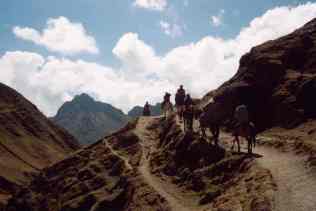 bowl of a glacier more than 16,500 feet above sea level. We traveled on horseback for four days, and the ride was difficult and even frightening, especially the narrow, precipitously steep trails and drop-offs over the cliffs that led to hundreds of feet of nothingness. As unnerving as parts of the trail were, most of my hucha was created by my fear of horses. As a city girl growing up outside of Boston, the only time I had been around horses was during a visit to a farm. Not knowing any better, I walked behind a tethered horse and the next thing I knew I was on the ground, having been kicked in the forehead. I survived that encounter, but I was not so sure I would this trip to Q’oyllurit’i. I almost didn’t go, but my desire to attend this most sacred Andean festival was stronger than my fear of having to ride a horse to get there.
 from flying over the horse and smacking into a stone outcropping when my horse slipped going down some wet Inka stone steps; a badly injured knee from another mishap on day two. In some kind of selfish divine justice, I didn’t fall off on the third day—someone else took a tumble instead. Then on day four . . . well . . . let’s just say that because of Latin machismo, and against my vigorous protests, the guides insisted I stay mounted when it was clear I needed to get off that horse. The horses could not climb one portion of the trail that was a huge stone Inka stairway, the steps very deep at the bottom and a struggle for the horses to get up on. Plus, there was a shallow but wide crevasse at the base of the steps. Everyone dismounted and climbed.
 re-establish equilibrium in my poq’po.
 physically threatened. If you are hiking and cross paths with a bear, you probably will feel fear. You are reacting physically and naturally to a potentially significant threat to life and limb. Your emotion is in perfect ayni with the circumstances. Hence, this fear may not generate hucha, although the whole experience may upset your energy. The life-threatening aspects of my trip did not themselves cause hucha. That fear was a normal, appropriate response to circumstances.
 formation. Its sami is grounding, steadying, vigilant, “rock solid.” If you feel you are stuck and can’t seem to move in life, perhaps you might pull sami from the clouds, which are always moving and full of life-giving and life-sustaining water. Your only limitation is your imagination when it comes to drinking in the sami of the natural world and cosmos. And your primary responsibility is to do the practices that release hucha and help re-establish coherence in your poq’po. Take it from me: I know how difficult it is to remember to do the practices when you really need them! But better late than never. . .




 Q'enti Wasi - House of the Hummingbird