When I teach the Andean mystical tradition, one of the most important concepts concerns the nature of energy, and it seems to take a lot of “unlearning” for many people to grasp that kawsay is beyond moral overlay. There is no good energy or bad  energy, negative or positive energy, angelic or demonic energy within the kawsay pacha itself. There is nothing contaminating about kawsay to extract from your own or another person’s energy body (poq’po). If you have enough personal power (ayni), there is no need to protect yourself from energy and, thus, the chunpis, or energetic belts, have nothing to do with protection, even though some still perpetuate that misunderstanding. In the kawsay pacha, energy is just energy, just like an electron is an electron and a photon is a photon. I want to extend this discussion now to talk about the nature of evil and how we can view it from the perspective of Andean mysticism.
Let’s start with a review of kawsay. Kawsay is the living, animating energy of the immaterial universe. From it, the material universe arose, including this human world. As I pointed out in the paragraph above, kawsay is beyond moral overly and is not dualistic. So there is no good or bad or positive or negative kawsay. Kawsay is always and only the First Cause life-force, the animating force of all beingness, and so from that perspective is nourishing and beneficial; it is the force from which all things are created and that drives evolution on the material realm and in the realm of human consciousness.
Kawsay has a core kinetic dynamic—its nature is to move unrestricted through the cosmos. We want to evolve consciously so that we can be perfect absorbers of kawsay and perfect radiators of it. It is interesting to note that a precursor to the word “Inka” was “Enqa,” which one anthropologist says means a person (an  enlightened or nearly enlightened being) who perfectly absorbs and radiates energy on behalf of the community. All humans have the capacity to be Enqas/Inkas—perfect mediators of kawsay, allowing it to flow in to nourish us and to flow out again to continue to move through the universe. A metaphor is the rain cycle: water droplets flow through the atmosphere, fall to earth, are absorbed by the earth to fuel plant growth, and then the plants respire and the water condenses and rises again, and so the cycle goes. Nothing is trapped; it is absorbed, fuels life, and flows on.
Here’s the rub in this scenario: Humans have the dubious distinction of being the only creatures who can slow down kawsay. While we are meant to perfectly absorb and radiate kawsay, we don’t because we are not sufficiently evolved in our consciousness. Our life-negating emotions, thoughts, words, and actions cause kawsay to slow when it hits the skin of our energy body. It’s like our filter is clogged and so some energy flows through us, some gets slowed from its natural state, and some even gets blocked or stuck as it tries to move through us.
The ancient mystics of the Andes of Peru understood this energy dynamic and have words for it. Llasaq kawsay is this slowed kawsay, which can feel heavy to us or, rather, makes us feel heavy emotionally, physically, spiritually. Llasaq kawsay literally means “heavy living energy.” Today, we call this heavy energy hucha. The ancients had a different word for the most refined, flowing kawsay—llanthu kawsay, or, literally, “light living energy.” The more modern word for this is sami.
Don’t let the fact there are two words for human interaction with kawsay (sami and  hucha) fool you into thinking this sets up a dichotomy for kawsay itself. It does not. Kawsay moves along a spectrum, from sami (unrestricted flow) to hucha (slow or stuck energy) in relation only to humans. Hucha is still kawsay, only slow moving. Learn to improve your ayni (energetic reciprocity, capacity to absorb and radiate kawsay) and you reduce your hucha and/or stop creating it. And, if you can’t yet turn hucha into sami, then give it to someone who can, like Mother Earth or a skilled paqo, both of whom “eat” hucha and return sami (or, in other words, get slow energy moving again).
I review all this information so you can understand that hucha is not bad, dirty, negative, or contaminating. Nor is it associated with evil. Because so many metaphysical traditions have a concept of evil, some people new to the Andean mystical system not only have a hard time understanding hucha simply as slow kawsay, but they resist the rejection of the concept of energetic evil.
I am no scholar of the Andean tradition, but I have looked into the question of evil in relation to Andean mysticism and would now like to share my musing on the topic as it connects to our understanding of kawsay as practitioners of Andean mysticism.
Did the Inkas have a concept of evil, of the devil or Satan? How would a paqo within the mystical system view these same concepts?
Among the Inkas, there was a god called Supay, who was seen primarily as the God of Death, although he was also known as the Ruler of the Underworld (ukhupacha).
Another association, based on his reign in the underworld, is as the God of Minerals. As such, he was especially associated with miners, who conducted rituals to keep Supay appeased and themselves safe in the dangerous environment of their work.
As the God of Death, Supay represented human mortality. As Ruler of the Underworld, he was said to command demons, which were the spirits beings who  inhabited the underworld. But from what we know of the “underworld” according to the mystical system, these were probably not demons as we think of them in the Westernized, Christianized sense. The people of the lower world—the ukhupacharuna—don’t know ayni. They are unable to participate in the core energy dynamic of the cosmos—energetic reciprocity. Thus, as mystics, we can see them as devoid of knowledge rather than as demonic in nature.
This underworld also had more benign and even benevolent associations: for example, with Mother Earth and with the ancestors, both of which were sources of nourishment and even wisdom for the people.
It was through the Christianization that came with the Spanish Conquest that Supay morphed from the God of Death and ruler of the ukhupacha to the Devil or Satan. His underworld realm became associated with the land of the fallen and wicked—in other words, with Hell. But this Christainized concept of the ukhupacha is in direct conflict with everything the mystical system says about this lower world. The people there are not evil, just uneducated in the ways of ayni. They are not condemned in a hell, they actually are living in a place of regeneration. The ukhupacha is not a place people go to be imprisoned, but to be set free! They go to the ukhupacha to learn ayni. It is a place whose very nature is one of potentiality and rejuvenation.
If we trace the origins of certain words—such as Satan and the Devil—we will also see that those root meanings have been filtered through the lens of third-level  understanding. (There are seven levels of consciousness; most of the world currently is at the third level). The Hebrew Bible was first translated into Koine Greek, and the Koine Greek word for what came to be translated into “Satan” was kategoro, which means to “categorize” or to create a “division.” The Greek word for “Devil” was diabolos, which means “accuser” or “slanderer.” I think you can immediately see that the meanings of these words are a far cry from “evil.” It is interesting that when I asked several paqos about the devil or fear of evil, they said that the devil or evil is that which divides us or separates us—separates us from knowing ourselves and from knowing and being cooperative or empathetic with others. Their understanding is closer to the Koine Greek meanings than to the codified Christain meaning of Devil and Satan.
Their view reminds me of the two core relationships of energy and of the human interaction with kawsay: masintin and yanantin. Masintin is when we touch “similar” energies. Yanantin is when we touch “dissimilar” energies. Both dynamics are in relation to your own energy state, not to some universal, independent state of being. Touching energy that feels “like” or “unlike” your own is a far cry from
labeling an “unlike” energy evil or even harmful. Certainly we can understand a “devil” (as a slandered or accuser) as someone who does not (at least at that moment) know or act from ayni. That is a far cry from their being evil.
I understand that people do unspeakably horrible, even “evil” things. This moral evaluation is an ethical, spiritual, or social determination. It varies from culture to culture. But from an Andean perspective, such people are not in the clutches of a universal evil energy or entity. They are just deeply, deeply out of ayni. They are “divided” from their true nature as a divine, cosmic being and even perhaps from their true nature as human beings in social relations with others. They are heavy in  the heaviest way. . .
The paqos I have asked all have said that when we come across something heavy, we either leave it alone or we use our personal power to decrease that heaviness (hucha) and increase lightness (sami). Every single one of the them has expressed the opinion that fear is a projection from ourselves outward onto a person or thing. We humans create heaviness, and we project our fear out into the world to divide, categorize, and label that which we do not yet have the personal power to understand or deal with. When we realize this, we save ourselves from wasting our energy. There is nothing, energetically speaking, to protect yourself from. Don’t be foolish—run from a person who is acting from extreme heaviness and threatening you. But don’t fool yourself into thinking that that person’s state of being and action is evidence for a fundamental, organized, independent evil energy of the kawsay pacha. Instead, understand it is the mindset and actions of someone lower down of the qanchispatañan, the stairway of the seven steps of consciousness in the human world.

 As paqos, we are on a path of conscious evolution and that starts with our resacralizing our relationship with nature. We are hummingbirds feeding on the sami (nectar) of the living cosmos. These poems are like sami to me, and I hope they are to you as well.
 means “superior.” During the Inca Empire, it was an honorific title for those who governed the tawantinsuyu and for high-ranking members of the military. In the mystical vocabulary, it refers to any highly valorized spirit being. Therefore, an apu is not just a mountain, but any high-level sacred being, such as the teqse apukuna—the universal spirit beings. There is a hierarchy to these apukuna. For the universal spirit beings it is, from “lowest” to “highest,” Mama Unu, Mother Water; Mama Allpa, Mother Earth; Tayta Inti, Father Sun; Tayta Wayra, Father Wind; Mama Killa, Mother Moon; Mamacha, Holy Mother Mary; and Taytacha, Father Jesus Christ.
 levels of consciousness.
 Not all mountains are apus—inhabited by a spirit being. We know a little something about how apus go from being just a mountain to becoming an apu through the story of the great late paqo Manuel Pinta, who was the master of the master of don Benito Qoriwaman and don Melchor Desa. Their primary teacher was the renowned paqo don Julian Chhallayku, and his teacher was don Manuel Pinta. Don Maneul Pinta is now an apu!
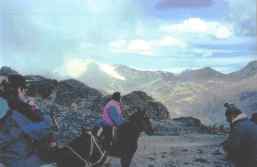 have any other information about how that might occur.
 permission to work with the apu and listen for an answer. It might not come right away, and could arrive in myriad ways, from a visual sign to in inner feeling. It is said that often an apu will answer you in your dreams.
 king with him the next day, through a translator, he told me to “throw [my] seqes up to the apus and I will meet you there and give you much information.” I can’t say that I ever felt that actually happened, but the many difficulties of arranging the Q’ero interviews back in 1996 were swiftly and easily overcome, and our interviews were incredibly productive. During those interviews don Mariano provided extensive information. So, perhaps the seqe we had established together in 1994 pulled us through the years to 1996 and the actual exchange in person that resulted in such a rich trove of information. In a similar way, you can throw your seqes to the apus and form a bond that might result over time in a relationship.
 word itself is Sanskrit for “wheel” or “disk.” Traditionally, there are seven of them, aligned along the spine from the root of the body to the top of the head. They are centers where energy and matter meet, facilitating the flow of the life-force energy. The chakras are aligned with major nerve plexuses and organs of the body, and each is associated with a color and with various human emotional traits and states of consciousness, which we will discuss briefly later.
 spine. For the three upper belts, the ñawis are at the front of the body. For the lower belt, it is at the back of the body, near the base of the spine.
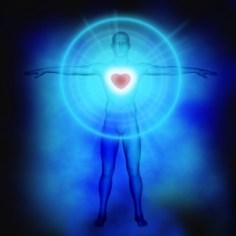 associated with the sacral and solar plexus areas; it is around the entire trunk of the body at the belly area and the eye is usually located below the navel). The belt around the chest/heart level is gold and associated with the sun. The belt at the throat is silver and linked with moon and wind. The quasi fifth belt for the two physical eyes and the seventh eye is violet. However, it is not really a violet band of energy. The color of the belt is that of your two physical eyes. It is sometimes, for ease of reference only, called the violet belt because at the end of the karpay you pull violet light into your poq’po through the seventh eye. But you move that violet light through your entire poq’po and body, not just through this eye area of your head.
 higher cognitive and emotional capacities, such as insight, creativity, and love. The three lower chakras are associated with our more physical and instinctual selves, including survival, self-image, social bonds, power, family, and the like. The elements and senses of the belts are usually identified as follows: the root chakra with earth and sense of smell, the sacral with water and taste, solar plexus with fire and sight, heart with air and touch, throat with ether and hearing, third eye with light and perception, and crown with spirit and being.
 history. Let’s look (in grossly simplified terms) at what a few of those philosophers have to say so that we can see how the Andeans sit alongside these giants of thought.
 He ascribed to this energy a “logos,” or a rational structuring principle that controlled, arranged, and ordered the cosmos. He was a major proponent of the ontological philosophy of “becoming,” believing that while the Whole is ordered, beneath it everything is always changing, moving, in flux and flow. In this sense, he, like Anaximander, saw “becoming” as arising in relation to space and time. He also articulated a law of transformation, which some misunderstand as a law of opposites, by which things flow from one state—for example, hot—to their counterpoint—cold. Unlike Anaximander, Heraclitus believed in a creator.
 itself. In one of its many senses, the Wu cannot be separated from nature, because it is a metaphysical or transcendent “first principle” that cannot be separated from that which arises from it. This immanent creative force both underlies and infuses nature. It also is always changing, giving rise to the concept of yin-yang. Yin-yang is the polarity aspect of nature and being, where things are inseparable but complementary in their relation to each other, such as the polarity of male-female and light-dark. Bringing balance to the two poles creates harmony.
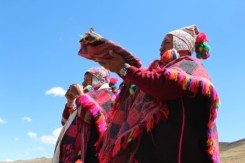 pacha. It is the primordial “living” energy from which all matter arises. It is First Cause, the immaterial and infinite moving energy and the energizing principle that fuels creation and evolution. From it arose all matter—called the Pachamama, which is the entire material universe, including space and time. In fact, the word pacha means both space and time, as inseparable aspects of the one Pachamama. Like Heraclitus, Andeans believe that there is a creator, one of whose names is Wiraqocha, which means something like “foam of the sea,” the sea perhaps being the vast expanse of the flowing energy of the cosmos. Kawsay, as this living energy, is beyond human moral overlay. There is not good or evil energy, not angelic or demonic energy. Energy is just energy.
 energy there are really only four core energy dynamics, and they are pairs of polarities: light/refined energy and heavy energy (although lightness and heaviness run along a spectrum) and compatible and incompatible energy (in relation to your own energy body, the poq’po). Awareness of these flows helps us to manage them and, thus, to avoid creating hucha (heavy energy) and to increase our sami (refined or “light” energy).
