
As I travel around the country teaching, I hear over and over how angry, worried, upset, even sick to their stomachs people are with President Trump and his  administration and how much fear they feel imagining what the next four years holds for our country.
I say, take a deep breath. Calm down. Let’s look at the situation from the perspective of a paqo.
Let me say upfront that I did not vote for Trump, and I don’t support most of his platform or approve of many of the people he has surrounded himself with in his staff or Cabinet. But from a perspective larger than that of his personality and his administration’s policy, I am rather upbeat about what his election means for our country.
It’s out with the old and in with the new. A renewed activism on the part of the people—and let’s admit it, for the past few decades most of us have been missing in action on the political front. A renewed time of caring what happens in politics—at the local, state and national levels—instead of apathy or the “let someone else take care it” or  “there’s nothing I can do” attitude many of us have shared. A renewed time of self-reflection to determine personal opinions, beliefs, and boundaries. A renewed sense of civic duty and purpose. A renewed demand that our elected officials have to give up partisan power plays for a return to good old-fashioned statesmanship.
The times, they are a’changing. . . And Trump is the alarm clock that has rudely awakened many of us from our peaceful and rather oblivious slumber—perhaps just in time!
If collectively we are individually and collectively awakening to a renewed sense of civic duty, we had better pay attention to how we wield our power. I propose that it’s never been so important to integrate our political beliefs, words, thoughts, actions and emotions with our Andean work as paqos. Here’s why:
The Tariypay Pacha
According to Andean prophecy, we are living in the midst of a cosmic transmutation, a period during which we can individually—and collectively—consciously evolve. But a chick isn’t born without cracking its eggshell; a snake doesn’t grow without shedding its skin, and a butterfly doesn’t exist unless a caterpillar first unmakes itself. In other  words, change isn’t easy. And during change, there can be a messy transition as the old morphs into the new.
So, if as paqos we strive to “see reality as it really is,” we have to start by perceiving that we are in the midst of potentially messy change. We need not resist this change, but see it for what it is—an opportunity to remake ourselves. We are at the cusp of—or, rather, in the midst of—an opportunity for significant conscious evolution, with a stress on the word conscious.
The Quechua noun and adjective hamutaq applies here. It means to be a thinker, one who can reason and reflect. For me it means we would be smart to apply our reason to what’s happening around us, but not to forget to reflect on ourselves.
I remember something author and change agent Marianne Williamson said: You can’t march for peace if you have war in your heart. When I see people at all these town hall meetings with their elected officials roiling over with anger, shouting, and fist-waving, I think of her words. I also think of something Wayne Dyer said: “When you  squeeze an orange, what do you get?” Orange juice, of course. Exactly what you would expect. In other words, the quality of your “beingness” is commensurate with the effect you can have in the world.
So a potentially insightful question to ask yourself is, “What do you get when Trump squeezes you?” Anger so rampant that reason can’t gain a toehold? Worry so deep that hope or optimism is flagging? Hatred or rejection of Trump and others that exactly mirrors (when stripped of your self-righteousness) what you perceive to be their problem? Activism so strident that it becomes an excuse for acting out rather than reaching out?
You certainly can have an opinion. But you have to take responsibility for how you express it. Are your actions and words adding hucha to the situation? How can you redirect your passion so that you increase sami? The answers to those questions really start with your state of mind and energy. So practice hamutaq to shift your inner world and more positively help change the outer world.
The Individual and Collective Shadows
It is no surprise that anger, and even hatred, are rearing their potentially ugly heads. If you step back and look at this from a larger perspective, what you see happening is a collective evolution, and as Carl Jung said, the “gold is in the dark.” To heal emotionally, one way—a very powerful way—is to descend into your shadow self. It’s the place within where you stuff everything you reject, dismiss, ignore, dislike. To be whole you have to own not just your light but your shadow. We usually don’t dive into our shadows unless forced to. Donald Trump can be the impetous for many of us to  dive into—and begin to own up to and heal—our shadows. He can be seen as the perfect foil to force us to inquire about and explore our individual and collective shadow.
We have to do our shadow work—for our individual and collective evolution and for that of our planet. After all, with technological connectivity and economic and humanitarian globalization, we are a bunch of caterpillar nations that are morphing into a collective butterfly. So let’s thank Donald Trump! If we understand how he can serve our conscious evolution, we will celebrate the dark night of the soul we are being forced to traverse, individually and together. Hopefully, with self-reflection, civility, and creativity, we can eventually emerge into the light all the better for our difficult journey. All mythic journeys involve a hero/heroine and his/her nemesis. Both are equally necessary. Don’t lose sight of that. . .
The Seven Levels of Consciousness
According to the Andean tradition, there are seven levels of human consciousness. Most of the world is at the third level, and we as paqos hope to operate most of the time at the fourth level. But if I had to place Donald Trump on the stairway of seven steps, I would say he is at the second level. (If you don’t know the levels, see my post of May 11, 2016, “Birds of Consciousness.”)
As a paqo, you know that when you are interacting with someone, or devising a strategy to communicate with someone, it pays to know or discern as best you can what level of consciousness they are at. You cannot reason at the fourth level with someone on the second level. It’s like talking French to a Hindi speaker. So don’t waste your energy. You would be better off trying to deeply understand where that person is—and where you are—and acting from the level you are on rather than descending to the other person’s level (as so many protestors are). Better yet, find a fourth-level way to communicate at the second level so that person will hear and understand.
Same goes for tactics. In our activism, if we are fourth level, our activism should display that. There is no place for attack rhetoric, insults, outbursts fueled by frustration, or violence in word, thought or deed at the fourth level. Resistance can be non-violent, communication powerful but respectful, emotion tempered by virtue and compassion, and action for change motivated by community-building rather than enemy-bashing. Civic vigilance doesn’t have to descend to second-level political us-versus-them judgments. The best defense is a great offense—at the ballot box. Resolve to work to encourage fourth-level people to run for office, and then get out the vote for them.
Hucha and Sami
Don’t hate the hucha you feel while creating more of it. Generate sami.
In terms of Andean prophecy, the condor was the totem of the old times, when there was an extravagance of hucha. The condor, after all, is the eater of hucha. It has plenty of work to do.
 For the new times, the totem has changed to the hummingbird, which is a producer of sami. While there is still plenty of hucha around, the focus has shifted from eating hucha to making sami—and that’s a seismic shift.
If you are having trouble dealing emotionally with Trump, understand that you are in touch with an incompatible energy. Incompatible energy is not bad, but it can increase the probability of creating hucha. But that hucha creation is not a given. Start by divesting your own energy body of hucha. Then return your focus to sami—focus on creating sami, not increasing the hucha, as you express your political views.
What does not creating hucha look like? Well, for starters, it means being a hamutaq: a thinker as well as a doer. In the mystical system, a hamutaq is one who uses discernment in determining not only what’s “out there” but also what’s “in here.” A hamutaq considers both what is happening out there in the world that is affecting the self and others, but also owns how his or her own actions (and words, emotions) affect the self and others. It’s vision coupled with personal responsibility. It is not knee-jerk reactive. It is “feel what you feel, then act from a higher place.”
This stance doesn’t mean you turn a blind eye or mute your voice. Absolutely not. But a hamutaq values virtue over vitriol. Compassion and consensus over conquering. Bridge-building rather bridge-burning. It’s about being a chakruna—one of a group who, rather than tearing down bridges, seeks to build them between traditions or groups. You don’t only engage with those with whom you have a common cause, but you simultaneously work to find common ground with the people you can hardly stand being around and who can hardly stand being around you.
 Working to increase the sami in an already hucha-filled field doesn’t mean you won’t be distressed by the words and deeds of Trump and Bannon and others when they espouse discriminatory and even hateful views or try to pitch lies and half-truths as policy. But it does mean that you don’t do similar things—such as shout vile slogans or get emotionally overheated by your own rhetoric. The stance of the paqo is that we do a personal mast’ay—we organize ourselves. And once we do, then we can contribute to the collective mast’ay. A mob cannot create a state. But a group of individuals who are doing their own inner work—and doing it as a paqo within the field of the Taripay Pacha—can come together and fuel an incredible transformation in the public body.
We can be paqo protesters! God knows we need our voices to be heard. We just have to remember that our emotions can fire us up, but a fire can just as easily burn a house down as heat and light it. . .
 on the kawsay pacha—the world of living energy—is impressive in its relevance to modern science. For instance, the word pacha means, among other things, both space and time as two aspects of one field, just as modern physics discovered with the fourth dimension, that of the space-time continuum. The kawsay pacha is an immaterial energy field, but from it arises the landscape of space-time—the Pachamama, which is the material world.
 poq’po, or energy body. Thus, the practices of the Andes are all about refining the state of our energy body—our poq’po, or personal energy bubble—and aligning our energy with our intention. We must be conscious of how this dynamic interplay works. This is why I say so often that a paqo is someone who is on a path of conscious evolution.
 what to do, why you are doing it, and perfecting your technique. If you are true to the practice, you should see improvement in your well-being quickly. Furthermore, the practices—from saminchkauy and saiwachakuy to hucha mikhuy to despachos—are not complex, but, in fact, are rather simple and, certainly, direct, even as the cosmovision that underpins them has an impressive level of richness and comprehensiveness. The practices are ones that use intention to move energy, so there is no long learning period of complex techniques. The primary “technique” is perfecting your ayni exchange and the various methods of becoming conscious of those exchanges and using them to improve the condition of your energy body can be taught quickly. In fact, I would say that one of the biggest surprises to those new to the tradition are just how simple (but not simplistic) the core practices are.
 gloriously and fruitfully—as a paqo. Thus, it is a path of power but not of ego.
 practices, you can be a Buddhist paqo, a Christian paqo, a Jewish paqo, or any other kind of paqo. You can practice the Andean techniques without having to give up Reiki, holotropic breathwork, meditation, yoga, Wiccan or shamanic techniques, or any other set of practices you keep in your metaphysical toolbox.
 cloth or weaving, perhaps on the table or a bed. In the mystical tradition, it refers to bringing order, organization, or structure to something. When you make a despacho, you are doing a mast’ay. When you arrange the khuyas in your misha, you are doing a mast’ay. But you don’t only bring order to things outside yourself. You can apply mast’ay to your own beingness. When you bring greater organization to the inner self, everything in your life is affected in positive and productive ways. The inner mast’ay furthers your awareness and, thus, your potential for conscious evolution as a human being.
 good student and learn well), but you must ultimately make it your own.
 and Andean ones, such as Qoyllurit’i. There are rituals to honor the animals and herds, and the planting and harvesting of crops. There are ceremonies for coming-of-age and joining the community as an adult instead of a child. But unlike these, the mystical ceremonies, no matter what their formal outward appearance, ultimately must embody your own state of consciousness and ayni. They rely on your making an intimate and personal exchange with the kawsay pacha, not a rote one.
 the gift wrapping of the self. They are concerned only with the contents of the self.
 splinters and the wounded aspect of the self goes into hiding. Soul retrieval is just what the term implies—the process of coaxing the split aspect of the self to return and integrate back into the self.
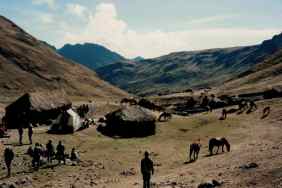 I recently was in Peru and had a chance to talk, over a three-hour dinner, with two anthropologists about many subjects, including both soul retrieval and “secret knowledge” among the Q’ero. One of them has been living among and gathering information from the most respected and reliable paqos in Q’ero. Still, I was not provided much information, really only a few minutes of our hours’ long visit, but what I was told is intriguing.
 is in the paqo’s intent and munay, not in any ceremony. That’s all I ever knew about soul retrieval for almost twenty years.
 complex methods. Or, more accurately, the practices moved from “informal” to “formal.” You try the informal, and quickest, method first, and if that doesn’t work move to the more formal methods. I received only the broadest outlines, but my interpretation is that the calling back of the soul by whispering in the ear is the first approach—the most informal—of practices for a soul retrieval. Another first-line practice is to throw the coca leaves to try to divine what has happened, why the soul split, and how best to recover it.
 hearing about it provoked myriad feelings. I felt humbled by how little most of us who are not native to the mountains of Peru actually know about the tradition. I marveled at how deeply connected to nature and energy the paqos are. I felt chagrin that so much misinformation is flying around the Internet about Andean soul retrieval (at the very least, as regards claims that certain practices are Andean when they clearly are not). I felt honored to have learned this information. And, despite the incredible Italian food and wine I was consuming, I felt hungry for more information, for renewed contact with the paqos, and for an even deeper understanding of the tradition. So, ever the student, my practice continues, as does my learning.
 rivers, lakes, and caves. Andean practice is rooted in developing ayni relationships with others, including the beings of the spirit world and nature. Three of the most elemental relationships you want to establish are with your guiding star, itu, and paqarina. Over the years, I have not been able to amass a lot of information about this aspect of the path, but what I have been able to learn is sufficient for our practice as paqos. So if you have not yet met and opened a dialogue with these three most personal and intimate tutelary spirits, I invite you to do so now.
 your guiding star. Today, having done the lloq’e training—the left-side work of don Melchor Desa, as taught by Juan Nuñez del Prado and his son Ivan—I know that the Andean tradition works very much from choice. In the lloq’e training, you work with eight helper spirits. They don’t choose you, you choose them. With one exception, the process is the same with your guiding star. There is no magic to it, except the magical pull of connection you feel with one particular star. Don’t discount that attraction. Introduce yourself and invite the being of that star to be your guiding spirit. Then open a dialogue over time.
 through which we will one day return to our celestial home. I haven’t heard that from any paqos directly, but it sounds compatible with other aspects of the guiding star that I have heard firsthand.
 a problem, because everything in the material world has a poq’po (energy bubble) and can be thought of as an energy being—including buildings. This means the hospital building in which you were born could be your itu! I admit that doesn’t sit well with a lot of people, especially those who are inspired by nature. But that’s part of our work. If everything is an energy being, then the hospital in which you were born is more probably your itu than is a mountain this is 100 miles away.
 have to be the Atlantic Ocean—and that felt like a stretch.
 ! They have energy bubbles and are energy beings in their own right.
 Q'enti Wasi - House of the Hummingbird