
Often, it’s not about becoming a new person, but becoming the person you were meant to be, and already are, but don’t know how to be.
—Heath L. Buckmaster, author
I am continually asked about the chunpis, especially by students of teachers other  than Juan Nuñez del Prado, who learned about them differently from the teachings of this lineage. Although I’ve written about them several times before, let me do so again as clarification and review. I’ll do so as an overview for those of you who want a quick “cheat sheet” about them.
Before I begin, however, I urge you to read again, and take to heart, the quotation that leads this post. If you want a concise statement of what the chunpis are all about, this quotation says it perfectly. The chunpis energetically encompass not only who you are right now, but who you have the potential to be—a fully realized human being.
- Chunpi literally means “belt” in Quechua. There are four primary chunpis, and they are commonly referred to as the belts of power. They are not belts of protection, as there is nothing to protect yourself against. In terms of the kawsay pacha—the cosmos of living energy—energy is just energy, beyond moral overlay. It can’t hurt you. Because of our emotions, thoughts, actions and so on, we can slow kawsay down, creating hucha, which detracts from our well-being. But hucha is not bad, negative, threatening, evil or anything of the kind. People can be negative, threatening, evil, but this is different from seeing kawsay, the living energy, as such. To deal with hucha, you do saminchakuy (or hucha mikhuy) to get that slow energy moving again at its natural speed.
- The chunpis do not exist in your energy body (poq’pq) until you “weave” them in the karpay called the Chunpi Away (pronounced chun-pee ah-why). They can fade over time if you don’t work with them regularly.
- The chunpis each contain a ñawi, a mystical eye, as do others parts of the body,
 such as the palms, soles of the feet, and top of the head. The ñawis are in place at your birth. However, they are “awakened” in a karpay called the Ñawi K’ichay (pronounced nyow-wee key-ch-eye), which is done at the same time you weave the chunpis.
- The chunpis are belts of power because they have energetic potential. They fuel certain capacities within you. The work of the chunpis is to grow in these capacities. Growing in these capacities increases your personal power to be in more perfect ayni with the kawsay pacha and to live with greater joy, success, and integrity in the human world.
- There are four main belts: the black belt (yana chunpi) around the hips and the lower trunk of the body. This belt confers the capacity of atiy, the power to take action in the world. It has to do with measuring your personal power at a specific point in time and with ascertaining right timing for taking action, among other things. The red belt at the belly/qosqo (puka chunpi) confers the capacity of khuyay, of acting with passion and focused engagement in the world. It is the place, therefore, of your kinetic power. The heart level chunpi is the qori chunpi, the gold belt. There is no hucha in this belt, so it never needs to be cleansed. It confers the power of the feelings (as opposed to the emotions, which are at the belly), and specifically of munay (love and will). Because it is the belt within which lives the Inka Seed, this belt also confers the capacity of kanay, to be who you really are and to live that in the human world. In fact, kanay is the main capacity of the qori chunpi. The throat belt, the qolqe chunpi, or silver belt, confers the capacity of rimay, of speaking with power and of creative expression of all kinds. You don’t weave the belts just to weave the belts! You work the energies there: the primary work of the chunpis is growing in these capacities and consciously evolving as a human being.
- These four belts are the primary ones. However, we sometimes say, for convenience sake, that there is a quasi violet belt that covers the head at the level of the three eyes—your two physical eyes and the seventh eye in the middle of your forehead (what other cultures call the “third eye.”) I won’t go
 into why we call it the violet belt, but you need to know that violet is not the actual color of the belt. The color of the belt is the color of your physical eyes. The capacity of the three eyes is qaway, visionary or mystical seeing and knowing.
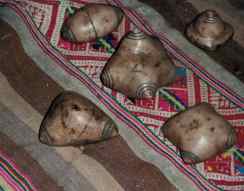
- The karpays for weavng the belts and awakening the mystical eyes is usually done with mullu chunpis, a set of five stones, like those pictured. However, they are not necessary. You can do the karpays using only your intention (which is true of all the practices of the Andes, or else we are turning objects into fetishes).
The work with the chunpis is quite extensive, as the chunpis are the focus of some of the chaupi training and are heavily involved in the lloq’e work. But the main work of the belts is individual, based on your intention. Like all the work of this tradition, intention is what moves energy. It is your intention that helps you access and work the energies of the belts, and it is your intention that allows you to begin using the capacities each confers so that you can grow and transform.
All of the practices of the Andean tradition—including the chunpis—are directed toward this goal of becoming the most consciously evolved human being you can be so that you can live your divinity while here in physical form in the very human world. The capacities of the chunpis cover major aspects of being: speaking with integrity and power, cultivating compassion and love, knowing who you are and not being afraid to live your individual power, being able not only to form clear intentions but also to carry those intentions out through action, effortlessly and successfully.
If you are not working with the chunpis in these ways, then you are missing a core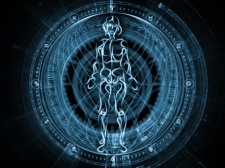 part of the teaching of the Andean path. Always remember, as a paqo you want to not waste your energy. You want to be super efficient and super effective in your ayni—your energetic engagement with the cosmos of living energy. Once they are woven, the chunpis are part of what I call the “energetic anatomy” of your poq’po. There is nothing in your physical body that doesn’t contribute to the core purpose of keeping you, as a physical organism, alive and healthy. The chunpis as part of your energetic anatomy serve fundamental and necessary purposes as well, integrating both your physical and energetic selves to so that you can excel at both the “action” of life and the “art of being” in life.

 space-time continuum, introduced in his theories of relativity in the 1920s, suggested the same fundamental truth about the complementarity of space-time. Now, because of quantum mechanics, quantum electrodynamics, and efforts to discover what the “beginning” is (before the Big Bang; at the level of the Planck constant), some scientists are grappling with what “reality” means and is. The paqos belief/teaching that we are each the center of the universe goes hand in hand with their belief that one of the goals of being a paqo is to “see reality as it really is.”
 cosmic consciousness. One of their conclusions is that “Cosmic consciousness mirrors the observer’s state of being. There is no privileged point of view, even though in the past religion claimed to have a privileged point of view while today’s science does the same. But each story is provided with evidence to support it, because our state of being interacts so intimately with reality that observer, observed, and the process of observation are inseparable.” As they say later in the discussion, “the whole system participates.” [Italics in original.]
 were scanning the entire garden. The words we use—“tasting” the “flavors” of energy—obviously are metaphors for discerning the different qualia of the material world.
 doing so, also contribute to the evolution of the cosmos.
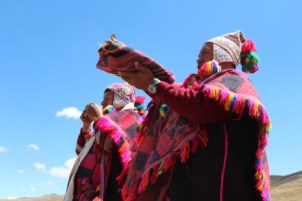 and self-aware than the rest of us. While many of them have mastered incredible energetic practices, they are human beings with failings, foibles, and personality conflicts. They are working the practices to become more self-aware and to further their own conscious evolution, just as we are. They are models for us, but, for the most part, we put them on a pedestal reluctantly. We respect and even honor them, but we would do well not to fall into a hero-worship mode.
 don Manuel Q’espi, who was once the kuraq akulleq of Q’ero, was actually booted out of paqo school when he was a young man! High in the mountains where the Chua Chua and Totorani rivers meet, there was a paqo school that ran every year for the month of August. The year Juan attended was the same year don Manuel attended. The headmaster was the famous Q’ero master don Andres Espinosa. Apparently don Manuel and don Andres had a falling out and don Andres kicked don Manuel out of the school!
 Of all the paqos I knew personally, I spent the most time with don Mariano Apasa Marchaqa, which doesn’t mean I got to know him well, as most of the time he was simply inscrutable. It was impossible to read his face, and thus I was usually left in the dark about what he might be feeling. Overall, his demeanor was dignified but a bit stand-offish. He wasn’t someone you approached spontaneously, giving a big hug. Even though his face
 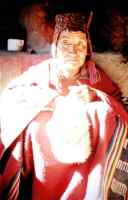 usually was a blank slate, every so often he would break into a smile and, to use a cliché, the room would light up. He also had an oblique sense of humor. I remember during the interviews for my book he looked up at one point and said, with seriousness and great humility, something to the effect of: “If I had known that one day I would be here talking to you, I would have listened better to my father and grandfather when I was a child. I wasn’t interested then. Their stories and teachings went in one ear and out the other.”
 their faces and body language! They were so unsure of themselves, exuding nervousness as Lida laid out plates and cutlery. They watched carefully as we used knives and forks, and then they, clumsily, tried to use them. My heart went out to them. I wished they had had the confidence to just eat with their fingers, so they could really enjoy the meal. None of us would have cared. (I was able to commiserate with their unease because I had felt it many times myself when with the paqos, especially the few times I was in the Q’ero villages. I didn’t know the proper way to do things or what was expected of me.) I have to laugh at something that happened when the lunch was over. One of the Q’ero, I think it was don Julian Pauqar Flores, got up, opened the screen door to the back covered patio/garage area, and stepped out to relieve himself in full view of the rest of us. He didn’t appear tentative at all when it came to that aspect of his comfort!
 The most playful paqos I ever met were the youngest ones—don Juan Pauqar Espinosa and don Augustine Pauqar Qapac. Don Juan has passed on, but he was as mischievous as a six-year-old, always ready to play and quick with a joke (which, because of translation, I mostly missed at the moment and had to play catch up later). Don Augustine appeared to be shy, but what a prankster he was. I understand from people who know him today that he is much less playful. Maybe that’s what age does to you! But when he was a young man and I was interviewing him, he would slip words like “breast” and “vagina” into our mutual Quechua-English
 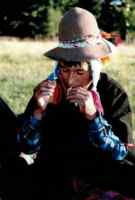 language lessons. It cracked him up as we repeated the words before the translation was given and we knew what they meant. Both don Juan and don Augustine were also game for adventure and to learn anything new. There was a foosball table in the courtyard of the place we stayed in Urubamba during the book interviews, and after a little instruction, they played game after game. And they were wildly competitive with each other!
 have been heavily influenced by outsiders and by practices from other traditions. Some of them are less than particular about explaining what is authentically Andean and what is not. That’s all well and good depending on your preferences. I, for one, prefer to be educated about what is part of the tradition and what comes from beyond it, because as Juan has stressed (based on the teachings from his masters, especially don Benito Qoriwaman, who was not Q’ero), in order to be a fourth-level paqo, you must know your lineage, and that includes the lineage of the practices.
 major teachings (as I have been taught them through the lineage of which I am a part).
 as a paqo is to become conscious of your state of mind and being, and then to take action to go beyond circumstance and recover your awareness of joy. You may still not like what is happening to you, but by recovering joy you will be able to put circumstance into perspective. We all experience pain and heavy emotions, but we can, as mythologist Joseph Campbell said, “Find a place inside where’s there joy, and the joy will burn out the pain.” And as musician Carlos Santana wisely said, “If you carry joy in your heart you can heal any moment.”
 national or global action. It’s become cliché to say that we can only give to others what we first give to ourselves. But that is a core truth.
 the name given to the earth, although planet Earth has her own name, Mama Allpa. As part of our practice as paqos, we learn to pull sami from the cosmos to empower ourselves, but usually we don’t learn a lot of specifics about working out in nature. In this post, I will share some of the ways you can work with the beings of nature.
 beyond the formal spirit beings and talk about interacting with nature in general.
 “journey” back into your lineage. I had an amazing experience doing this is Peru during the Hatun Karpay Phaña. It doesn’t matter if you can verify what you see, feel, and come to know. The experience itself, if it is real enough, will convince you that the trees are doorways to your personal ancestry. And don’t forget that they might link you to the lineage of paqos as well.
 yanantin exchange, where you touch dissimilar energies within yourself and help move them toward a japu—a perfect integration. Maybe you will work with the male and female aspects of yourself or maybe with aspects of your life that are keeping you from well-being: perhaps seeking to turn fear into love, or to transform work that feels like drudgery into work that is joyful, or even to turn financial lack into prosperity. A chaupi is a good place to work any two energies that seem to be in conflict within you. Offer one aspect to one stream and the other to the other stream, then connect with the energy of transformation at the chaupi point where the two streams become one and use your intention to transform the energy of the yanantin into a japu. Then, as all paqos do, expect results in your life!
 Through a cave, you can energetically connect to the spirit “totem” of the underworld, the anaconda/snake. And you can travel go back even further in time to touch the energy of the original Andean lower-world spirit totem, the frog. Ask them to work with you to regenerate yourself and help you consciously evolve.
 Q'enti Wasi - House of the Hummingbird