
Our dramas are an indestructible part of who we are. No matter what we do or how hard we try, we cannot get rid of them. The only choice we have to make is whether we are going to use them or they are going to use us.
—Debbie Ford, The Secret of the Shadow
If you view the spiritual realms through rose-colored glasses, then a life still plagued  with disappointments, difficulties and challenges must mean you are doing something wrong. You are not deserving enough, evolved enough, energetically coherent enough, or sufficiently clear enough in your intention to create a life of love, passion, fulfillment, joy, abundance, or whatever a “perfected” life looks like to you.
Well, no, not really. . .
As a paqo, you certainly know that the kawsay pacha is overly abundant and you can manifest what you want according to your capacity for personal power and the clarity of your ayni exchanges. But like all of us, you are still human—and not a sixth-level human yet. As a third- or fourth-level human being, you are far from perfected. As a paqo, you have energy practices to reduce your heaviness—including emotional dramas and life’s challenges—to a minimum, but you still have them. As a qawaq, you can use your physical and mystical vision and perceptions to learn to see reality as it really is, and that means owning the disappointments, difficulties, strife, and even traumas that you experience. After all, if you don’t see them, you can’t put your practices to work to shift them (or rather, to shift your own energy).
Being a dedicated paqo means using what you know. Once you “see” (qaway), then you can understand (yachay) and act (llank’ay). You can do saminchakuy, saiwachakuy, hucha miqhuy, call on the assistance of a helper spirit, and use many other practices to improve your inner and outer reality. But “seeing” is the foundation stone upon which all your practices rest.
What is there to “see” about the difficulties in your life? Certainly not personal failure. Rather, personal opportunity.
Debbie Ford, in her book The Secret of the Shadow, likens each of us to a recipe. You have different ingredients—traits and life experiences—in your recipe than I do. My ingredients are perfect for me, as yours are for you. From a spiritual viewpoint, each and every ingredient is necessary to your living your life mission and fulfilling your promise in this life. Therefore, if you can see everything as necessary to your being who you really are and growing to the fullness of being, then you will reject nothing. You will shift your perspective and embrace life’s challenges (inner and outer) as opportunities to more deeply understand yourself and evolve your consciousness.
Author and human potential guru Napoleon Hill concurs with Ford. He wrote, “Every adversity, every failure, every heartache carries with it the seed of an equal or greater benefit.” Finding the benefit is what escapes most people. They just can’t see what good can come from pain or trauma. But from a spiritual perspective, there is always a compensatory benefit or gift.
In your work as a paqo, what Ford and Hill are talking about is the energy dynamic of yanantin. Yanantin energies are dissimilar energies. Good-bad, male-female, friend-enemy, boss-employee, conservative-liberal, and so on. While many people see only opposition, as a paqo you learn to see complementarity. Yanantin does not mean “either-or” but “both-and.” By examining the yanantin energy of your difficulties and challenges (admittedly, this often is easier from hindsight), you can follow Ford’s and Hill’s advice to see the drama or trauma for what it is—something hurtful or challenging or painful—but also to seek the compensatory gifts—the hidden opportunities—in the difficulty. Let’s look at a few examples.
As a young boy, your father drilled into you that boys can’t be sissies. You had to be  tough, take your lumps like a man, not back down from a challenge, always push ahead. As a result, you learned to be bold, outgoing, even a risk taker. The yanantin dynamic may play out in myriad ways. We’ll look at one possibility. The downside is that your father’s programming may have caused you to incorporate untrue, unrealistic, and unhealthy beliefs about manliness into your unconscious that hamper your emotional growth and take a lot of self-work to transform. The compensatory gift is that as an extrovert and a risk taker, when you chose sales as a profession, you persisted, met every challenge, and used your competitive edge to be among the top salespeople in your company. In this context, your emotional trauma as a child translated into professional gifts as an adult.
Here’s another example. You are a busy, passionate person involved in all kinds of activities, from family to volunteering. You are outward directed and don’t want to waste a moment. Then you come down with an autoimmune disease and are in pain, can no longer work, and must rely on others in a way you never did before. One aspect of the yanantin energy is that you suddenly lose your health and even your sense of a vibrant, independent self. Life as you knew it (and your sense of self as you knew it) is over. The other aspects of the yanantin are the compensatory gifts that your new situation bestows: You pay more attention to your body and to what you eat and how you move; you learn to be humble and not only to give but to receive; your capacity for empathy for others deepens; and you learn to be still and go inward, to appreciate the small, quiet moments.
As is true for each of us, you create hucha for yourself when you see only one side of the yanantin energy dynamic—usually the loss, pain, failure, hurt, etc. Your challenge, as is true for most of us, is to enlarge your vision and understanding to see that a yanantin always involves twoness: the bad and the good, the loss and the gain, the “punishment” and the “reward.” If you can work both sides of the yanantin, you can reach a place of wholeness. This harmonization of yanantin energy is called a japu, wherein no hucha is created.
By working the whole yanantin, you can even be the generator of your own transformation. You can move closer to achieving not only a restoration of harmony, but also of wholeness—no matter what is happening. Without that bullying father, you may have never developed your gift of perseverance and persistence. Without that disease, you might never have learned greater empathy and humility, appreciation for simplicity and inner stillness. In the yanantin dynamic, if you can achieve japu, you are holding a scale of justice, with the two scales equally balanced.
Do you have to learn your lessons and gather your gifts through strife or sickness? No. But, seeing things as they actually are, as a human being you are not yet a perfected being and none of us is living in a perfected world. At the level of your eternal spirit, you are a perfected, divine being. But in this third-dimensional, material world in the body of flesh and blood, you are an imperfect human being. The core spiritual yanantin of the sixth level or seventh level of consciousness is: god in the human, human as god. However, here in the Pachamama—in the material  realm—we must deal with the level of consciousness we are actually at, which is third or fourth level.
But we don’t have to be victims. We can be victors! Whatever feelings and experiences you need in your “recipe” will come to you in a way that allows you—if you choose—to continue developing toward the completeness and wholeness that is encoded in your Inka Seed. As Ford writes, when you understand each “painful event as the perfect ingredient to make your recipe complete, you will witness the magic of transformation. You will bless what you formerly saw as a curse. You will watch as the horrid becomes holy.”
 As we work to evolving our consciousness to the fourth level, we can’t help but reframe our views about what it means to be a human being, revise our beliefs and values, and generally act in the world in more efficient, practical, and impactful ways. And if we strive to achieve the level of a teqse paqo—a universal paqo—we refine our capacity for yachay (knowledge), llank’ay (ways of acting) and munay (expressions of love and of our highest feelings). It’s not too hyperbolic to say that we seek to live our godliness. So, in this post I would like to explore what we can learn from how Andeans named God and understood certain characteristics of godliness.
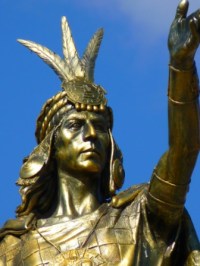 “one who joins,” let’s take a look at the other great being of the cosmic world: Satan. Under the influence of Christianity, many Andeans now believe in and talk about the devil and sin. However, in the past, they may not have. See my blog post “Evil and Andean Mysticism” (April 24, 2017) for a discussion of the closest figure I could find in the Andean pantheon of spirit beings to the Christian devil. His name is Supay. He actually was the guardian god of miners and of minerals and was associated with the underworld (ukhupacha) and so came to be associated with mortality and thus death. But he was not a personification of evil. However, it appears this is the figure the Spanish Chroniclers morphed into an Andean devil, wrongly as far as I can tell.
 Hebrew Bible was first translated into Koine Greek, and the Koine Greek word for what came to be translated as “Satan” was kategoro, which means to “categorize” or to create a “division.” The Greek word for “Devil” was diabolos, which means “accuser” or “slanderer.” I think you can immediately see that the meanings of these words are a far cry from “evil.” Mostly, if we rely on these root meanings, the devil is our adversary because he is the one who seeks to cause us to divide or separate ourselves from our true nature—our godliness.
 how you decide which leaders, spiritual and political, to support or not. What a shift in understanding what is going on in our world today.
 a bit of both extremes. Being frightened or intimated can motivate you to change, discovering and then living your life purpose. Feeling inspired yet peaceful can foster trust in yourself and God that you are indeed on a journey of personal fulfillment. We humans tend to be motivated both by “fleeing from” and “being drawn toward.” Movement is still movement, even if it is one small step instead of a giant leap. And if you are not yet embracing and living your purpose, then move you must.
 precious than guiding the growth of a child’s mind, heart, and spirit? Your purpose might not be about getting your name in lights, but about bringing light to others. Maybe it’s playing music—not in a concert hall but in a retirement home or at a winery. Your music might be the means for you to live a mission of bringing pleasure to others. If you know what your mission is, you can be living it no matter what the outer circumstances, as the following story illustrates.
 least allowing for the possibility that) there are no mistakes. Nothing in your life—the triumphs and the tragedies—is extraneous or wasted. Everything has served to make you who you are right now and to prepare you for realizing your life mission.
 people, learn new things, think different thoughts, cultivate different feelings, shift your beliefs. Sweep the dust of sameness from your mind, heart, and actions. Life is made up of life experiences (both inner and outer), and even within the scope of your own community there are no doubt amazing things happening and inspiring people to meet. One of my favorite quotations about remembering to drink with gusto from the fountain of life is from Henry de Montherland: “There is only one way to be prepared for death: to be sated. In the soul, in the heart, in the spirit, in the flesh. To the brim.” So don’t wait! Start savoring life now.
 right now. Your mission in life is rooted in the present, in the spiritual realization expressed by Manning in the quotation at the start of this article: “no one else can do what I am doing in exactly the way I do it.” Your mission is found in the singular combination of skills, attitudes, feelings, and experiences that come together only in you. As writer Val Uchendu states so simply: “When you apply that gift you possess that comes so easily to you and can be used anywhere, anytime to help someone else; maybe your family, your community, your city, state, country or the world in general . . . that is your PURPOSE.”
 here—with knowing (perhaps even discovering for the first time) the state of your being. As you learn to be ruthlessly realistic about who you are right now, you also hold an inner vision of the self that is encoded in your Inka Seed: your already perfected self. So yachay is a yanantin: a complement of the differences. At this very moment you are both an imperfect human being and a perfected divine spirit. As you take the necessary steps toward greater growth by doing a clear-eyed (qaway) self-inventory, allow yourself to be inspired by the advice and insight of these eloquent teachers.
 value “doingness.” Llanka’y is action, and khuyay is passionate engagement. The key to transformation is to realize that it is not only what you do, but also how you are “being” as you do whatever you are doing. You take responsibility for your thoughts, words and deeds; you seek to be cooperative instead of competitive; you give thanks for your bounty and share it; and on and on. You also learn not to stuff your days with mindless doing, but to take rest so that you can restore yourself. Sitting and admiring the flowers in the field is “doing” something. The counsel of the following wisdom-speakers may prompt you to consider all the ways that you can practice llank’ay.
 under your will. Not the emotion of love, but the choice for love: To think lovingly, to act lovingly, to be love. That doesn’t mean you wear rose-colored glasses or cloak yourself in sentiment. It means you are conscious of your thoughts, words, and deeds and purposefully choose a response that produces the least amount of hucha. Munay is not about moving from your head to your heart, as some New Age philosophy advises. It means integrating them. Or, more accurately, it means integrating your three human powers, allowing each to flower within and to guide you through life. To put it another way, it means that your yachay (thoughts) and llank’ay (actions) are fully alive within you and fully expressed through you, but that they are always illuminated by your munay (love). Let these inspirational thoughts guide you toward that integration.
 the space-time continuum. They have their own bubbles. The Andeans position time differently in space than we do. They say the past is in front of you because it is known. You have six ñawis (mystical or energetic eyes) facing forward: the qosqo, sonqo, kunka, paña, lloq’e and qanchis ñawis. These are, respectively, the eyes of the belly, heart, and throat; the left and right physical eyes; and the seventh eye (what some traditions call the third eye) in the forehead. Therefore, you have full view of your past. It is known. That’s why following the seqes, or energetic cords, that stream out from you through your personal past is called following the Path of Knowledge. By following these seqes through your past, using qaway (mystical seeing, which means seeing reality as it really is, without projection or illusion), you can learn from your past, extracting its wisdom. You may not be able to change your past, but you can change your relationship to it, including healing past trauma.
 you will express, which gifts and skills you will use, what you will do with your time, who you will interact with, and the like. Even though the future is the pacha of potential, the reality is that for most us, our future will look similar to our present. We are creatures of habit. We remain fairly fixed in our personalities, needs, desires, and so on. We wear the same types of clothes, eat the same limited variety of foods, follow the same paths to the places we frequent, socialize with the same people, maintain the same beliefs, cling to the same expectations, follow the same career path for decades, etc. Writer Steve Almond says, we “choose the stories by which we construct reality.” Since our stories remain fairly fixed, so does the future we pull toward us from that creative flux of potentialities.
 was going to put all my knowledge into practice, especially my knowledge of and experience with the energetics of the Andean path. I was intent on manifesting the future of my dreams, at least as regards to how I earned a living. I wasn’t going to wear rose-colored glasses, but was going to be both practical and visionary in my approach. I sent out résumés, networked, and took on small freelance jobs. But I spent most of my time working the energetics.
 money. Since I am primarily a writer, and have worked as an editor for publishing companies and done other types of professional creative work in the field, I at first imagined my future as a writer. (I told you! We are creatures of habit! That’s why our future looks so much like our present and past.) While mulling over the possibilities of what this future might look like, I realized—from past experience—that my most creative imagining would be far less glorious than what the creative mind of God could conjure up for me. So I changed my intention. Instead of identifying a concrete kind of job (writer), I focus on the qualities of the job I wanted. I’d let God figure out which job fulfilled all those qualities.
 And I kept perceiving a single seqe—just one from the infinite field of potentiality—streaming to me from the future that encoded all of the qualities I sought. I kept cleaning the chaupi point of this seqe where it entered my poq’po at the siki ñawi. (The future is behind you so the seqe could come in anywhere on your bubble, but I felt it coming into the mystical eye at the base of my spine, since this is the only ñawi we have in the back and it looks toward the future.) I tried to be as conscious as possible of all the ways I was stuck in self-defeating stories and so creating hucha and obscuring the energy of this seqe from flowing freely through me and empowering me. I dealt with doubt, fear, low self-esteem, worry, and many other hucha-inducing emotions and stories. I cleaned and cleaned this connection point to my poq’po using saminchakuy.
 Prado (who didn’t know about the grand experiment I was engaged in) he said, out of the blue, “You know, after me and Ivan [his son], you know the Andean tradition better than anyone in the world. I would like you to open a US school.” My reactions, in a fraction of a second, were several, but my most powerful reaction was, “I couldn’t possibly!” I immediately thought of all the reasons this couldn’t be: I didn’t have a place to teach, no building or grounds, no organization, and so on. Opening a school immediately felt overwhelming.
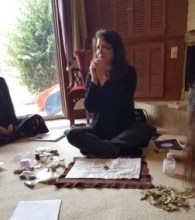 previous six or seven years—I had been living it like never before—and it totally changed how I approached teaching. I felt a huge passion for sharing the tradition. The requests kept coming and I kept showing up to teach, accruing more than 94,000 air miles over the next two years. When that kind of travel became exhausting, I started teaching online. And the rest, as they say, is history.
 Q'enti Wasi - House of the Hummingbird