
Back on January 30, 2017, I posted a blog that talked generally about the concept of mast’ay (See “Ceremony as Personal Mast’ay”). Today, I want to apply the concept of mast’ay specifically to the misha (mesa in Spanish) and despacho.
In that 2017 post, I described mast’ay as follows: “Mast’ay is a Quechua word that in  daily life refers to unfolding and spreading out a cloth or weaving, perhaps on the table or a bed. In the mystical tradition, it refers to bringing order, organization, or structure to something. When you make a despacho, you are doing a mast’ay. When you arrange the khuyas in your misha, you are doing a mast’ay. But you don’t only bring order to things outside yourself. You can apply mast’ay to your own beingness. When you bring greater organization to the inner self, everything in your life is affected in positive and productive ways. The inner mast’ay furthers your awareness and, thus, your potential for conscious evolution as a human being.”
If you take that definition and description at face value, then you will understand why I explain to my students that the making of a misha and a despacho are each an act of mast’ay—of organizing the self, of expressing who you really are. As I explain it, the misha and despacho are practices that externalize your internal state.
It must be so, because both the misha and, especially, the despacho are grounded in ayni—in reciprocity (your energetic interchanges with spirit beings or the kawsay pacha at large). Ayni is a reflection of your internal state—of your very state of being. Ayni isn’t ayni if it isn’t the totally and completely authentic flow of your personal energy to the kawsay pacha.
That’s why I tell my students that as a paqo, you don’t create a misha or a despacho by rote. If you slavishly follow instructions taught to you by someone else, you are  being robotic. You must develop your own way of doing things, because your ayni offering must be true to you—and there is no one else in universe like you. You are a unique Drop of the Mystery. You are who you are because of your unique life experience and path, your feelings and emotions, your beliefs and so on. Your despacho and misha must reflect you alone. They must express your ayni, which by its very nature has to be exclusively yours and not dependent on someone else’s belies or rules.
You might learn what the misha means and how to use it. But the khuyas you choose to go in it must be reflective of your own inner “structure” and personal “energetic organization”—your mast’ay. The last thing you want to do is make your misha a collection of trophy stones from sacred sites or teachers. No! All kinds of things will go in your misha—stones, trinkets, and other items that represent the milestones of your self-development, of your life, of your important relationships, of your very beingness.
No one has followed the same life path you have. No one sees and feels and understands the world exactly the way you do. No one has experienced exactly what you have. Therefore, your misha can be like no one else’s, both in what it contains and how you organize it when you work with it open. While you may have learned to place certain stones in certain positions and so on, you have to stop and ask yourself: “Is this how I want to organize my misha? Is this true to me and the meanings I superimpose on the mast’ay of my misha?” If your answer to either question is “No,” then it’s time to express your personal artistry while working with and organizing your misha.
Furthermore, you are growing, changing human being. You are not static in experience, form, or energy. The same goes for your misha. If it is an externalization of your internal state, then it must change as you change. Items you put it in years ago might no longer be representative of your current state of ayni. New items might be necessary to represent who you have become. Typically, we work with the mast’ay of our misha at least once a year, on the Andean “new year’s” day of August 1. We “feed” our misha and reorganize it (reconsider its mast’ay). For example, one year while I was doing this I realized that there two stones I had put in my misha decades ago but no longer had any connection to. Although I knew they came from sacred sites in Peru, I couldn’t remember which sites. These stones were absolutely meaningless to me. I understood that they were no longer khuyas; they were just stones. Those two stones came out of my misha.
Understanding your personal mast’ay also is crucial to making a despacho. The 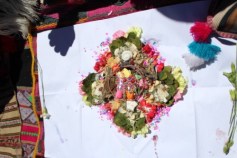 despacho is the most common way you will externalization your ayni and internal state. It absolutely cannot be a robotic performance in construction or use. It must be truly authentic to your state of being and intention. Thus, a despacho doesn’t have to contain certain items, it doesn’t have to be organized in a certain way, it doesn’t have to be offered in a particular manner. The one certainty is that it has to be representative of your ayni in the moment you are making it and offering it.
A despacho also doesn’t have to be pretty or symmetrical. If you are angry, make an angry despacho. If you are depressed, make a despacho that gives that depression to the spirits as an offering. These might be “ugly” looking despachos. They might break all the “rules” you learned. Fine! All that matters is that your despacho—your communication with the spirit beings, the kawsay pacha, with God—be true to you in that moment. As with a misha, to make a despacho you have to first know yourself, then be clear about your intention, and then express who you truly are and what your intention truly is.
Think of making a misha or despacho as being an artist. All artists learn to use  certain tools—oils, pastels, watercolors—and learn the rules for painting a portrait or landscape (color mixing, perspective, etc.) but then they break from the rules or apply them in their uniquely original way. They create their own art. They express their own style. You can have ten artists painting the same still-life and each finished painting will look different. It’s the same with making a despacho and constructing or using your misha. Your internal state is unique, and so your external offerings will be as well.
One of my early teachers, Américo Yábar, once said to me and some other women I was with: “Waste your time. Waste your money. But don’t waste your energy.” To be as blunt as Americo was, I would counsel you that making and offering your despacho or constructing and organizing your misha according to anything but your unique personal internal mast’ay is a waste of your energy.
 There are three primarily ways: as a result of conflicted and life-negating emotions, a lack of self-awareness, and a loss of integrity in your thoughts, words, and deeds.
 I have devised this example precisely because it relates an event that seems innocuous: going to an art gallery. Even seemingly simple or mundane events and interactions can cause problems if you are not conscious of your energy dynamics. One variation of the scenario creates hucha, and the other two don’t.
 walked in. What’s that about? Why am I feeling such a strong negative reaction to her as a person? Am I feeling jealous? Jealous? I am! I have to admit it. Why?”
 You have the self-awareness and self-control to monitor your emotional dynamics and so begin to explore the charge behind your hostile feelings. When you do, you discover at least part of what you are feeling is a result of your projection of unrealized dreams onto another person. You realize that while there is nothing wrong with having an opinion and you are at liberty to dislike something or someone, something more is going on. You have no objective evidence or personal interaction to justify your feelings about the artist, and that’s a clue that your shadow self (the hidden, rejected, denied aspects of yourself) is involved. This process of self-reflection allows the hostile feelings to dissipate, thus guarding against your creating hucha.
 have a clue that your feelings are arising from your shadow self and so are not truly well-formed, objective opinions or reactions. If you have an emotional reaction and then it passes—you can let it go easily—then you’re okay. But if those feelings linger, you need to pay attention. You have exposed a soft spot in your shadow and that information has irritated it. That irritation has presented itself as projection—usually of negative emotions—onto others. Through self-reflection, you can aspire—as paqos do—to be a person who “sees reality as it really is.” In this case, you see that your opinions have become embroiled with emotions about yourself and really have little or nothing to do with the other person. That person or situation simply became the trigger for that shadow emotion. When you realize this, then you can deal in a healthy way with those feelings and not create hucha.
 In the Andes, as in many wisdom traditions, there is a saying that “As above, so below.” In the Andes, one of the ways this plays out is in the mirroring of the pachas outside the self with the pachas within the self.
 bubble the world without and the world within. Don Benito’s work—the right-side, mystical, yachay-focused work—is concerned with the universe outside yourself, the God without. Don Melchor’s left-side, magical, and llank’ay-focused work is concerned with the universe within yourself , the God within. The chaupi work of don Andres Espinosa is about generating and being self-sufficient in munay, which is the human power of the kaypacha and integrates all three pachas into a whole.
 self. You can perceive it as the pacha linked to the energy of your Inka Seed that is your purest energetic state, which is one of perfect ayni. It is your potentiality as an enlightened being. It is your spirit, your divinity.
 discerning them, perceiving their state. Are they available to you? Are they hidden from you? Are you comfortable in each? Just sit with whatever you feel and perceive. This is a process of discovery. It is an invitation to get to know yourself and your poq’po better—touching in with non-judgmental curiosity. Don’t rush the process of getting to know yourself!
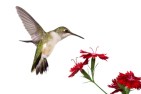 brought this coherence to your energy body, you can take time each week to reinforce this joining, and over time you will eventually feel the flowering of the self—the expansion that is taqa. As I have written about in past blog posts, as paqos we seek to become like flowers in the garden of Wiraqocha, attracting the hummingbird to drink from our munay nectar. This is an exercise that can help you to become such a flower.
 The Andean metaphysical god was called Wiraqocha. Another name for God is the Taytanchis, which means Our Father. Although referred to as male, Taytanchis is beyond gender, for Taytanchis is the living God, the Great Mystery, the Inscrutable One. It is the first cause of creation. From it arose the immaterial realm of living energy, the Kawsay Pacha, and the material realm, called the Pachamama. This is the realm that includes all the matter of the cosmos, including the galaxies, stars, planets, and all of life. It is from Taytanchis that we all come and to Taytanchis that we all will return.
 poq’po is private. As my teacher Juan Nuñez del Prado says, your poq’po is the one thing in this life that is wholly yours, that you alone own. No one can enter your poq’po uninvited (consciously or unconsciously), not even God. As a result of that fundamental energetic truth, as Juan says, this is where the evangelical Christians get it right—you must invite God into your life (poq’po). Until you do, the Taytanchis cannot act as a direct living energy in your human life.
 choice. Having given you free will, Taytanchis will not trump that will. So, you must purposefully invite Taytanchis into your human life and physical being.
 becoming a fully developed human being, meaning a fully enlightened person. We are already perfected because we are Drops of the Mystery of the cosmos of living energy and our enlightened self is held within each of us as a potential in the Inka Seed. However, we do not live that potential—yet!
 tend to be doers and thinkers. We are what we do. We are skilled at abstract thinking. We value knowledge, and see it as the solution to so many of our problems.
 heart. There is never any need to “clean” them, as they are pure sami. Still, we have to work consciously to activate our Inka Seed and to connect our Inka Seed and heart into an integrated system in order to stimulate our development and fuel our evolution. Integration is the purpose of this modified exercise. And it is a way to not only connect these two most important energetic structures within, but to generate copious amounts of munay in the process. As you feel that munay spread through the self, you receive a taste of the purity and power of self-love.
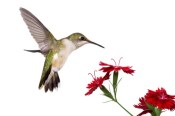 You can do this exercises many times as you need to so that you can actually perceive the flow of munay within and throughout the self. When you experience this sweetness, you will finally understand the metaphor of the paqo as exuding a nectar that draws the hummingbird. The hummingbird is the totem of the upper world, the hanaqpacha, and of God. When the hummingbird feeds on your nectar, you are deeply connected with God.
 Q'enti Wasi - House of the Hummingbird