As we prepare for a new year, I have decided to focus this post on providing inspiration for you in your work as a paqo by using quotations to highlight universal truths about self-transformation and to align these truths with the Andean concept of the three human powers.
The ultimate goal of our work as paqos is to evolve our state of consciousness so that we can discover who we truly are and live as who we truly are. Our divinity is encoded in our Inka Seed, as is our life mission and all the capacities we need to carry out this mission. Our practices—especially the foundational practice of saminchakuy—are energetic techniques to achieve this goal, and they are aligned with one or more of the three primary human powers. By distilling the ambitious, and perhaps overwhelming, goal of self-realization down to working your three human powers, you will be better able to manage your inner work.
I wish you a magical holiday season and new year of glorious growth.
Yachay
Yachay is both intellectual knowledge and mystical perception. Your work starts  here—with knowing (perhaps even discovering for the first time) the state of your being. As you learn to be ruthlessly realistic about who you are right now, you also hold an inner vision of the self that is encoded in your Inka Seed: your already perfected self. So yachay is a yanantin: a complement of the differences. At this very moment you are both an imperfect human being and a perfected divine spirit. As you take the necessary steps toward greater growth by doing a clear-eyed (qaway) self-inventory, allow yourself to be inspired by the advice and insight of these eloquent teachers.
Bruce Lee warns you that you must start with a deep dive into the self, mining the veins of both the coal and the gold of the current self. “To become different from what we are, we must have some awareness of what we are.”
You can be ruthlessly clear-eyed without being judgmental about yourself. As Carl R. Rogers points out: “The curious paradox is that when I accept myself just as I am, then I can change.”
The number-one challenge of “doing spiritual work” is that you start and then lose focus, until eventually other things take over your time and energy. Your practices and self-inquiries fall by the wayside. Confucius provides the crucial counsel that change takes time and requires perseverance: “It does not matter how slowly you go so long as you do not stop.”
While you keep your eyes of the prize of personal evolution, Publilius Syrus reminds you to honor the value of each step forward, no matter how small. “Do not despise the bottom rungs in the ascent to greatness.”
Hecato enlightens us with a definition of progress, especially at the beginning stages of transformation. “What progress, you ask, have I made? I have begun to be a friend to myself.”
As Josei Toda explains, and as our Andeans masters also tell us, our goal is not to rise above our humanness, but to fulfill it. “Enlightenment, or true happiness, is not a transcendental state. It is a condition of broad wisdom, boundless energy, and good fortune wherein we each shape our own destiny, find fulfillment in daily activities, and come to understand our ultimate purpose in life.”
Llank’ay
While we value “beingness,” we also know that here on the human plane, we also  value “doingness.” Llanka’y is action, and khuyay is passionate engagement. The key to transformation is to realize that it is not only what you do, but also how you are “being” as you do whatever you are doing. You take responsibility for your thoughts, words and deeds; you seek to be cooperative instead of competitive; you give thanks for your bounty and share it; and on and on. You also learn not to stuff your days with mindless doing, but to take rest so that you can restore yourself. Sitting and admiring the flowers in the field is “doing” something. The counsel of the following wisdom-speakers may prompt you to consider all the ways that you can practice llank’ay.
William Arthur Ward reminds you about the importance of becoming conscious of how you overlay objective reality with your personal judgments and emotional tones, which then direct how you act in the world: “The pessimist complains about the wind; the optimist expects it to change; the realist adjusts the sails.”
Herbert Otto counsels that growth means change, and all change involves creativity. “Change and growth take place when a person has risked himself and dares to become involved with experimenting with his own life.”
What does it mean to “experiment” with your life? It means having the courage and fortitude to leave the known and head out into the unknown. As Billy Cox advises, “Life will only change when you become more committed to your dreams than you are to your comfort zone.”
But dreaming, hoping, affirming—while necessary to fuel action—are not enough, because, as Arnold Glasow wisely points out, “An idea not coupled with action will never get any bigger than the brain cell it occupied.”
According to Andean cosmovision, the kawsay pacha is overly abundant and you can manifest anything you want in proportion to your personal power and the clarity of your ayni/intention. If you are like most of us, you keep yourself—and your thoughts and actions—small. It’s time to enlarge your notion of yourself! As Thomas Edison proclaimed, “If we all did the things we are capable of, we would astound ourselves.”
Munay
Of all the three human powers, munay is the most transformative. Munay is love  under your will. Not the emotion of love, but the choice for love: To think lovingly, to act lovingly, to be love. That doesn’t mean you wear rose-colored glasses or cloak yourself in sentiment. It means you are conscious of your thoughts, words, and deeds and purposefully choose a response that produces the least amount of hucha. Munay is not about moving from your head to your heart, as some New Age philosophy advises. It means integrating them. Or, more accurately, it means integrating your three human powers, allowing each to flower within and to guide you through life. To put it another way, it means that your yachay (thoughts) and llank’ay (actions) are fully alive within you and fully expressed through you, but that they are always illuminated by your munay (love). Let these inspirational thoughts guide you toward that integration.
We start at the foundation of love. You can only love others in proportion to how you love yourself. As Rumi says, “Your task is not to seek for love, but merely to seek and find all the barriers within yourself that you have built against it.”
As you focus on cultivating munay, an early step is to begin retraining your thoughts and behaviors to see lightness instead of darkness or the upside instead of the downside. Queen Catherine 1 has identified a good starting place for shifting your perspective of others and what is happening in your relationships: “I praise loudly; I blame softly.”
Many people confuse munay (sacred love, which is given freely) with chall’ay (an agreement to make an exchange, as in a mercantile purchase). As Sri Sri Ravi Shankar reminds you, love is not an emotional bargain: “In love, you don’t expect anything. If you want something in return, don’t call it love.”
If you undertake the path toward love, be prepared for challenges. Gloria Karpinski offers these wise words: “Once we start paying attention to what’s happening in our own environment, we begin to see that the universe is giving us all sorts of clues about our path. If we believe in love and we are making a commitment to being love, there’s a good chance the universe will send us thirty people in a row whom we don’t love. Our assignment: Love those thirty people.”
Finally, as you learn to be a grander, more gracious and loving human being, don’t forget to take a reality check. Ram Dass has a surefire way to gauge your progress in your quest to “be love”: “If you think you’re enlightened, go spend a week with your family.”

 the entire material cosmos.
 to declare the primacy of intentions, from the most humble to the most glorious.
 with disappointments, difficulties and challenges must mean you are doing something wrong. You are not deserving enough, evolved enough, energetically coherent enough, or sufficiently clear enough in your intention to create a life of love, passion, fulfillment, joy, abundance, or whatever a “perfected” life looks like to you.
 have different ingredients—traits and life experiences—in your recipe than I do. My ingredients are perfect for me, as yours are for you. From a spiritual viewpoint, each and every ingredient is necessary to your living your life mission and fulfilling your promise in this life. Therefore, if you can see everything as necessary to your being who you really are and growing to the fullness of being, then you will reject nothing. You will shift your perspective and embrace life’s challenges (inner and outer) as opportunities to more deeply understand yourself and evolve your consciousness.
 tough, take your lumps like a man, not back down from a challenge, always push ahead. As a result, you learned to be bold, outgoing, even a risk taker. The yanantin dynamic may play out in myriad ways. We’ll look at one possibility. The downside is that your father’s programming may have caused you to incorporate untrue, unrealistic, and unhealthy beliefs about manliness into your unconscious that hamper your emotional growth and take a lot of self-work to transform. The compensatory gift is that as an extrovert and a risk taker, when you chose sales as a profession, you persisted, met every challenge, and used your competitive edge to be among the top salespeople in your company. In this context, your emotional trauma as a child translated into professional gifts as an adult.
 the yanantin energy dynamic—usually the loss, pain, failure, hurt, etc. Your challenge, as is true for most of us, is to enlarge your vision and understanding to see that a yanantin always involves twoness: the bad and the good, the loss and the gain, the “punishment” and the “reward.” If you can work both sides of the yanantin, you can reach a place of wholeness. This harmonization of yanantin energy is called a japu, wherein no hucha is created.
 realm—we must deal with the level of consciousness we are actually at, which is third or fourth level.
 As we work to evolving our consciousness to the fourth level, we can’t help but reframe our views about what it means to be a human being, revise our beliefs and values, and generally act in the world in more efficient, practical, and impactful ways. And if we strive to achieve the level of a teqse paqo—a universal paqo—we refine our capacity for yachay (knowledge), llank’ay (ways of acting) and munay (expressions of love and of our highest feelings). It’s not too hyperbolic to say that we seek to live our godliness. So, in this post I would like to explore what we can learn from how Andeans named God and understood certain characteristics of godliness.
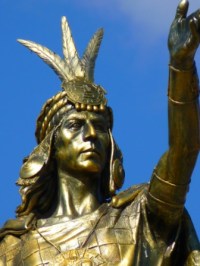 “one who joins,” let’s take a look at the other great being of the cosmic world: Satan. Under the influence of Christianity, many Andeans now believe in and talk about the devil and sin. However, in the past, they may not have. See my blog post “Evil and Andean Mysticism” (April 24, 2017) for a discussion of the closest figure I could find in the Andean pantheon of spirit beings to the Christian devil. His name is Supay. He actually was the guardian god of miners and of minerals and was associated with the underworld (ukhupacha) and so came to be associated with mortality and thus death. But he was not a personification of evil. However, it appears this is the figure the Spanish Chroniclers morphed into an Andean devil, wrongly as far as I can tell.
 Hebrew Bible was first translated into Koine Greek, and the Koine Greek word for what came to be translated as “Satan” was kategoro, which means to “categorize” or to create a “division.” The Greek word for “Devil” was diabolos, which means “accuser” or “slanderer.” I think you can immediately see that the meanings of these words are a far cry from “evil.” Mostly, if we rely on these root meanings, the devil is our adversary because he is the one who seeks to cause us to divide or separate ourselves from our true nature—our godliness.
 how you decide which leaders, spiritual and political, to support or not. What a shift in understanding what is going on in our world today.
 a bit of both extremes. Being frightened or intimated can motivate you to change, discovering and then living your life purpose. Feeling inspired yet peaceful can foster trust in yourself and God that you are indeed on a journey of personal fulfillment. We humans tend to be motivated both by “fleeing from” and “being drawn toward.” Movement is still movement, even if it is one small step instead of a giant leap. And if you are not yet embracing and living your purpose, then move you must.
 precious than guiding the growth of a child’s mind, heart, and spirit? Your purpose might not be about getting your name in lights, but about bringing light to others. Maybe it’s playing music—not in a concert hall but in a retirement home or at a winery. Your music might be the means for you to live a mission of bringing pleasure to others. If you know what your mission is, you can be living it no matter what the outer circumstances, as the following story illustrates.
 least allowing for the possibility that) there are no mistakes. Nothing in your life—the triumphs and the tragedies—is extraneous or wasted. Everything has served to make you who you are right now and to prepare you for realizing your life mission.
 people, learn new things, think different thoughts, cultivate different feelings, shift your beliefs. Sweep the dust of sameness from your mind, heart, and actions. Life is made up of life experiences (both inner and outer), and even within the scope of your own community there are no doubt amazing things happening and inspiring people to meet. One of my favorite quotations about remembering to drink with gusto from the fountain of life is from Henry de Montherland: “There is only one way to be prepared for death: to be sated. In the soul, in the heart, in the spirit, in the flesh. To the brim.” So don’t wait! Start savoring life now.
 right now. Your mission in life is rooted in the present, in the spiritual realization expressed by Manning in the quotation at the start of this article: “no one else can do what I am doing in exactly the way I do it.” Your mission is found in the singular combination of skills, attitudes, feelings, and experiences that come together only in you. As writer Val Uchendu states so simply: “When you apply that gift you possess that comes so easily to you and can be used anywhere, anytime to help someone else; maybe your family, your community, your city, state, country or the world in general . . . that is your PURPOSE.”
