
I was asked recently about forgiveness, both forgiveness of others and of the self. What might the Andean mystical tradition say about that? I had never thought about this topic before in relation to the tradition, and I had never received a  teaching from a paqo about it. But as I contemplated this question, I came to see a possible Andean mystical approach to forgiveness.
Of course, we start with our energy practices. Our core practice is saminchakuy: working on the self to release any hucha, including the heaviness of feeling betrayed, wronged, hurt, rejected, or whatever emotion you carry about the situation that has caused you to discern the need for forgiveness. No matter how culpable the other person may be, as paqos we always start with ourselves. So you would seek to master your own energy body and diffuse the heaviness of your own emotions.
Another go-to practice is hucha miqhuy. This is the deep cleaning not only of your own hucha, but of the relational hucha you are feeling between yourself and the other person. You can clean that person’s poq’po using hucha miqhuy, but I see the power of hucha miqhuy more about relational energy—the flow of energy between yourself and the other—so you would focus on digesting the flow going from yourself to the other: the hurt, disruption, shutting down or cutting off in your ayni flow with the other. It is your own perception of the relationship that is imprinted in this betwixt and between energy, so take responsibility for it by cleansing it of its heaviness.
Understanding is always a plus, so there is a place for the analytic, especially since contemplation and understanding can help shift your emotions. They can help transform how you are looking at the situation and your expectations of what needs to happen for you to either feel forgiven or to sincerely forgive someone else.
First, focus on the ayni. Although you can only take responsibility for your half of the relationship, by keeping your focus on ayni you will come to realize that forgiveness is not chhalay: it is not transactional. It is not so much about you and the other as it is about yourself, especially if you are being transactional. If you have expectations of what must happen—a tit for tat—before forgiveness occurs, then you are restricting the possibilities of what can occur. You might be keeping these possibilities limited and small. As so many psychologists tell us, forgiveness is not dependent on atonement by the person whom you feel has harmed you. It’s not even about that person making amends. No matter how wronged you feel, you are not judge and jury in relation to the other person. Well, perhaps you are if you are operating only at the level of the material world. But in terms of the spiritual or metaphysical realms, forgiveness is a change in yourself, not any kind of compensatory action by the other person. Why is this so? Because, according to so many philosophers, forgiveness is an act of grace—for the self and the other. Grace is not something that is earned or deserved. It is not something you bestow on the other, some kind of absolution. It is a state of being you cultivate within yourself that creates space for release and completion. It is a choice about your preference for the condition of your own inner landscape. Grace is the condition through which you will discover your own power of munay: that your love—or forgiveness—is an energy subject to your will.
By cultivating your munay, you will be able to move to the inner state of being that is forgiveness as defined by so many modern health experts and ancient widsom-keepers: “Forgiveness is a conscious, deliberate decision to release feelings of resentment or vengeance toward a person or group who has harmed you, regardless of whether they actually deserve your forgiveness.” So forgiveness starts with making a choice. But you can’t fool yourself. You cannot pretend, through actions or words, that you have forgiven when you are really still harboring resentment. Qaway is the capacity to see reality as it really is. The reality may be that you have not yet reached the point of genuine forgiveness. No problem. Use your tools to continue working on your energy, because it’s healthier at all levels to keep your heaviness conscious and work on it then to drive it underground or hide it from yourself.
Forgiveness also is the restoration of a sense of inner peace. You can’t  change the past, and surely not the reality of the pain that caused you to reject the other person or be rejected by him or her, but the universe provides you a clean slate in every moment. The word forgiveness means “to give,” not “to get.” It is something you give yourself. Like munay, it is a choice. Although reaching a state of genuine forgiveness may take time, you only have to practice in this moment, and the next moment, and the one after that. In your progression, you likely will experience a lessening of emotional intensity and a gradual lifting of heaviness. You may move from loathing to resentment, then to regret, and to disappointment, and to sadness. Eventually you may feel an acceptance of the reality of the situation that is stripped of the cloak of emotion: what happened happened.
Every small step, every slight shift in your energy will eventually result in the release of your heaviness and the restoration of your equilibrium. As Confucius said, “To be wronged is nothing, unless you continue to remember it.” You may always have the memory, but you can—through your energy work and conscious choice-making—reframe that memory. By doing both, you deflate the heavy power of the memory of the past wrong and re-inflate it with life-affirming sami. Sami, among its many meanings, refers to the essence of a thing. Feeling wronged and holding a grudge restricts your energy and dims your essence. Forgiveness opens you back up, allowing your full essence to flow freely again.
 From the kawsay pacha (the immaterial realm of Creator, which is beyond all imagining, beyond space-time and dimensionality) comes the Pachamama, the Mother of Space-Time, which is the material, physical world. Kawsay is the living energy, and the most refined form of kawsay is called sami. It’s ancient name is llanthu kawsay, or light living energy. Sami is light not as in visible light but in terms of quality: as lightness, refinement, the finest vibration of living energy. So it imparts a lightness of being. The distinction here is: kawsay is living energy; sami is light living energy.
 You are working with these spirit beings, not with their physical elemental manifestation of water/rain, soil/natural world, light/ heat, air pressure/air movement. You work with them just as you would any other spirit being, such as an apu (spirit being who lives in a mountain), by developing a personal relationship with them. Their natures differ, and you can learn from their unique powers. Father Wind is flexible, changing, moving. Father Sun is illuminating, revealing, enlightening. Mother Earth provides everything to us. She is fecund, productive, empowering, strengthening, stabilizing. Mother Water is refreshing and revitalizing, cleansing and transformative.
 this. They insisted they do not work with “star beings” and did not seem to even understand the questions they were being asked about this topic.
 we have tawantins within us as well. Our three human powers—munay, or love under our will; yachay, or knowledge and thoughts; and llank’ay, or action—are a tawantin because llank’ay can be broken down into two factors: khuyay, or passion; and atiy, or measuring your personal power in the moment, discerning proper timing for action, and bringing your impulses under your will. So our three human powers are actually four—they form an inner tawantin.
 who become life-long guides: our Itu (male nature spirit being) and Paqarina (female nature spirit being).
 Andean mystical tradition, there are four factors in the growth of a relationship, forming the overarching framework of increasingly sami-filled interactions. The four-fold progression starts with munay, developing a mutual respect and affection. Then comes ayni, when your munay deepens so that you are beyond the needs of the self and truly see the other person for who they really are (and vice versa, with the other person reciprocating). Reaching ayni is the true beginning of a relationship, which can then take you to the stage of development called masintin-yanantin. This is the stage where you begin to work through the dynamics of your individual similarities and differences, more fully taking back your projections, expectations, and so on to harmonize the interactions without judging or trying to change the other person. Despite your differences, you both act in ways that benefit the other. Your similarities amplify your munay and ayni, and you can achieve harmony as your differences become supportive and complementary. Finally, you can reach tawantin, where you are each being who your really are, fully appreciative of the other as an individual, and aware that there is almost a third body in the relationship: the energy/poq’po of the relationship itself.
 about highlighting a troublesome issue but about placing blame, usually on someone else. Criticism, or more accurately critique, on the other hand, is a healthier approach to resolving issues. Critique is a objective, unemotional airing of a grievance. You are specific about a single issue instead of making sweeping generalizations, you suggest specific changes that can be made, and you are realistic about both your role and the other’s role in the difficult dynamic.
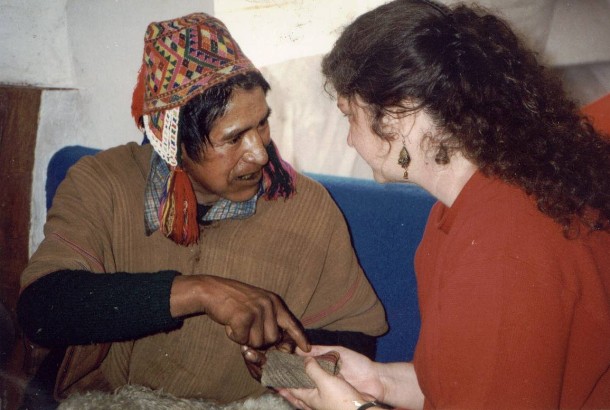 Respect grows out of caring, consideration, listening, finding worth in others, and remaining open to ideas and values that are different from yours.
 into the subject and offer my own perspective, I need to define and explain a few relevant terms.
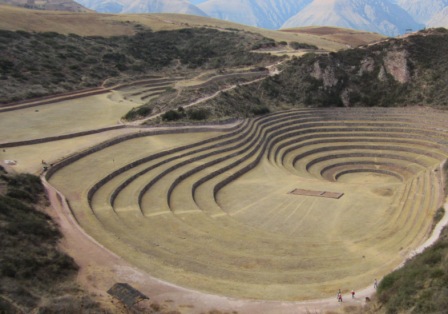 about salka: “Bridge Between the Worlds,” September 30, 2016.) My teacher don Juan Nuñez el Prado has discussed salka in relation to the Inkas. Very briefly, salka generally was thought of as wild in the sense of underdeveloped or undomesticated. The Inka were all about organization and improvement of what was wild, out of control, or unhelpful in nature. They did not seek to dominate nature, but to work in partnership with nature to undertake a process called mast’ay. Mast’ay means to structure, reorder, reorganize. Nature left to itself provided a harsh and unforgiving environment for humans to live in. It was difficult to thrive. As human culture developed, including the introduction of farming and domestication of animals, nature was remade in a way that was more organized and less wild. The Inkas perfected the art of irrigation and water rerouting, and of terracing mountainsides to grow crops, and such. They were reducing the wildness of nature and bringing greater organization to it for the benefit of human well-being. So, in this sense salka is a step down on the evolutionary path. Nature in its wildness is not amenable to human life; nature made more domesticated is. That’s the very general metaphor and actual process of human physical and cultural evolution. (We have gone to an extreme today, dominating and even destroying nature.)
 Impulses in and of themselves are not negative or bad. Impulses can be seen simply as the energy to do something. But hidden salka impulses can be the content of your shadow self, the repressed energies you keep hidden from yourself and that drive you without your conscious awareness. There is little personal power involved in that kind of impulse energy.)
 world.
 principles and practices of Andean mysticism. It took a while for me to get to it, but here it is. These are the precepts and energy dynamics that I think are absolutely core to the tradition through the Inkari and Waskar lineages in which I was trained. Of course, there are others aspects of the tradition I could have chosen, but these are, to my mind, absolutely fundamental to living the tradition. It’s impossible to order them from most important to less important, because everything is integrated. So this list should be understood as horizontal in nature of importance rather than as a vertical hierarchy.
 reduce hucha and increase sami, you will increase your capacity for ayni, come to better know yourself, and can more easily and swiftly evolve toward your fullest expression of self.
 perceptual eyes, but also as full perceptual organs. Each allows us to develop a different human capacity: qaway, the ability to see holistically and to understand reality as it really is rather than as you would like it to be; rimay, expressing your human powers, especially how you communicate your thoughts and feelings; kanay, knowing who you really are and developing the personal power to live as who you really are; munay, love and compassion beyond the needs of the self offered with awareness and purpose; khuyay, passionate yet mindful engagement in the world; atiy, knowing the state of your personal power and using it well and at the right time, and also bringing your impulses under your will.
 Q'enti Wasi - House of the Hummingbird