
Where is the body in the hierarchy of the term “body-mind-spirit?” For many people on a mystical or spiritual path, the body is relegated to the basement of the spiritual house. Mind occupies the first floor, while spirit  hangs out in the upper room with a view. But in the Andean tradition, putting spirit first is like putting the cart before the horse. The body matters immensely as does the mind—they are inseparable, since the mind is a function of the physical brain. In the Andes, the mind is associated with the soul. The soul is the sum of your lived experiences, your culture, your beliefs, and so on. The soul is different from the spirit, which is your Inka Seed, your connection with divinity. The spirit is perfect. The body and soul are subject to the influence of both sami and hucha.
The Andean tradition, while a training in mysticism, is about being fully human. It is not about leaping beyond the human. Therefore, everything you do relates in some way to that most human part of yourself: your physical being, including your mind/soul.
All of your energy work goes through the body. All of your mystical senses are extensions of the body. The chunpis, or belts of power, are located in the body. Their eyes, or ñawis, are located in the body. All the other “eyes,” such as the uma (top of the head), chakis (point in the sole of each foot) and makis (point in the palm of each hand), are in the body. The seqes, or cords of energy that you send out to interact energetically with the world, come from the body. The pouyu—the gap where spirit enters and informs you—is part of the body. Your Inka Seed, which is your connection with your divinity, is in the body.
You can see that the body is very important in the Andean practice. So, here’s my question: How much attention do you pay to your body as you practice as a paqo?
As you study and practice as a paqo, you are in essence retraining your  body. You are acknowledging a non-material aspect of your body: its energy counterpart. But notice that word—counterpart. You have two bodies, a physical one and an energetic one, and they are not separate.
Since the “thing” that drives energy, according to the Andean tradition, is intention, your mind is also a vital aspect of your practice. There is no intention without a brain and mind. Nor is there focus, attention, concentration, each of which are crucial to your energy practices. Your end goal is conscious evolution—with a focus on the word “conscious.”
Therefore, you have to attend to your body-mind-spirit equally if you are to evolve in your practice as a paqo and your growth as a human being. I was recently reading Deepak Chopra’s new book, The Future of God, and as I read the following, I was struck by its relevance to our practices as paqos:
The brain cannot shape itself; it functions as a mechanism for processing what the mind wants, fears, believes, and dreams about. By becoming more conscious, you automatically begin to lead your brain where you want it to go. . .
Your brain, despite its marvels, requires basic training when you learn any new skill, and finding God is a skill. New neural pathways must be formed, which will happen automatically once you put focus, attention, and intention behind it.
His reasoning about the brain’s part in finding God applies to your practice as a paqo learning to consciously evolve, push the kawsay using only intention, and live with well-being and joy. All of your energy practices both arise from your intention brain/mind and affect it (changing it, repatterning it). And practice makes perfect! Sometimes you are deep in touch with the kawsay pacha and sometimes you feel separate from it. Deepak Chopra calls the kawsay pacha the “subtle world,” and he wisely counsels: “Until the subtle world becomes your home, you can’t help but come and go. Repetition and practice are part of the learning curve.”
So, practice! Saminchakuy, saiwachkauy, hucha mikhuy, sensing through  your ñawis, and so on.
But to what end? Yes, you want to live in the subtle world, but Andeans don’t talk about leaping beyond the human. So as a paqo you are striving to express the fullness of your humanness, which goes far beyond what scientific material-realism tells us is possible for us. That’s why we call what we do mystical. But it is not non-human. It is a natural part of who you are and how you can be in the world and the kawsay pacha. And while you are here in human form, the pinnacle of your practice is to reach the sixth level of human consciousness—that of the Christ Consciousness or Buddha Nature. (The seventh is somewhat fuzzy, for while it is still human, it is the human-god/god-human, and we have no idea what that could be. Or, at least, we have no description of it from the Andean masters.)
It’s time to invite your body and mind/soul into that upper room with a view, where your spirit lives. These three aspects of the self are a trinity—three in one, one in three, individual yet inseparable. Together they are “who you really are.”
 living energy, of the universe. Our aim is not to imagine or intuit that we are pushing the kawsay, but to actually perceive the flow of energy. Perception comes through your senses, through a visceral experience, so that you know without any doubt you are actually achieving your intention.
 abilities—both mystical seeing and mystical sensing. The more hucha you have, the less you can perceive and see reality as it really is, because you may be projecting a lot of unconscious “stuff” out into the world. Therefore, use saminchakuy to cleanse your bubble.
 misha. The misha contains only sami, so it is a deep repository from which you can freely draw. Place the misha on your uma (top of your head) and bring its sami into your poq’po. Through it, you will be drawing on the experience of a long line of powerful paqos and the deep ancestry of the Andean tradition. When you work with the misha, you are never alone. Allow the ancestors to help you, and they will.
 learn to “taste” them—taking them into his qosqo but perceiving an actual physical taste.
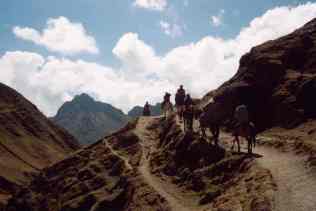 bowl of a glacier more than 16,500 feet above sea level. We traveled on horseback for four days, and the ride was difficult and even frightening, especially the narrow, precipitously steep trails and drop-offs over the cliffs that led to hundreds of feet of nothingness. As unnerving as parts of the trail were, most of my hucha was created by my fear of horses. As a city girl growing up outside of Boston, the only time I had been around horses was during a visit to a farm. Not knowing any better, I walked behind a tethered horse and the next thing I knew I was on the ground, having been kicked in the forehead. I survived that encounter, but I was not so sure I would this trip to Q’oyllurit’i. I almost didn’t go, but my desire to attend this most sacred Andean festival was stronger than my fear of having to ride a horse to get there.
 from flying over the horse and smacking into a stone outcropping when my horse slipped going down some wet Inka stone steps; a badly injured knee from another mishap on day two. In some kind of selfish divine justice, I didn’t fall off on the third day—someone else took a tumble instead. Then on day four . . . well . . . let’s just say that because of Latin machismo, and against my vigorous protests, the guides insisted I stay mounted when it was clear I needed to get off that horse. The horses could not climb one portion of the trail that was a huge stone Inka stairway, the steps very deep at the bottom and a struggle for the horses to get up on. Plus, there was a shallow but wide crevasse at the base of the steps. Everyone dismounted and climbed.
 re-establish equilibrium in my poq’po.
 physically threatened. If you are hiking and cross paths with a bear, you probably will feel fear. You are reacting physically and naturally to a potentially significant threat to life and limb. Your emotion is in perfect ayni with the circumstances. Hence, this fear may not generate hucha, although the whole experience may upset your energy. The life-threatening aspects of my trip did not themselves cause hucha. That fear was a normal, appropriate response to circumstances.
 formation. Its sami is grounding, steadying, vigilant, “rock solid.” If you feel you are stuck and can’t seem to move in life, perhaps you might pull sami from the clouds, which are always moving and full of life-giving and life-sustaining water. Your only limitation is your imagination when it comes to drinking in the sami of the natural world and cosmos. And your primary responsibility is to do the practices that release hucha and help re-establish coherence in your poq’po. Take it from me: I know how difficult it is to remember to do the practices when you really need them! But better late than never. . .




 to someone with whom you have deep differences; it displays as compassion for someone whom you judge as suffering due to his or her own choices and actions; it does not condemn; it is not about preaching; it is not holier-than-thou, although it also is not devoid of opinion, ethics and morality. But munay always extends the benefit of the doubt. It errs on the side of kindness, charity and empathy. Because munay is love grounded in will (choice), it is not so much a feeling as it is action. Even if you do not feel loving toward another person, you act with loving–kindness. Ideally, however, munay is the perfect coherence of both feeling and action. It is, like Christian agape, the model for humanity.
 Q'enti Wasi - House of the Hummingbird