Global Summit on Spiritual Awakening


Larger Banner

I welcome you to join me and the dedicated team at Shamans Directory for the free “Gathering at The Cosmic Fire Summit,” which unfolds over five days: 07-11 October 2024. The summit brings to the world an impressive array of shamanic, mystical, and earth-based healers, teachers, and wisdom-keepers to share their insights about what awakening means and how we each may follow the call to live a conscious, joyful life in alignment with our own Spirit, and with Nature and the living universe.

Every year Shamans Directory—a nonprofit, online global directory created to bring shamanic, mystical, and earth-based healing, wisdom, and medicine to the world’s doorstep—gathers some of the most respected wisdom teachers to sit with you at the, “one fire” and share the “one medicine.” Their yearly global summit is an opportunity to meet some of these teachers and practitioners and become more empowered through their gracious offerings. And it’s all free!

The more than 40 honored wisdom-keepers who will be speaking this year include elders from Original, Indigenous, and First Nation Peoples, and Western-born shamanic and mystical practitioners from across the continents. They have dedicated their lives to forwarding the world’s living lineages to us in our time and forward for the benefit of future generations.

I am pleased to be one of the featured presenters, speaking about “Awakening What’s Within You,” and offering a more than 5,000-word article describing the “Seven Signposts Along the Spiritual Journey” as my free summit gift to you. During my talk and in this article, I identify seven common features of a spiritual awakening and journey, from the Call to the Crisis to the Disengagement to the Reconnection. At some point during our journey, we will find ourselves at one or more of these stages of awakening, so knowing about them may help us move with more grace through the difficult stages and propel us more purposefully through all the stages.

The offerings during this summit are impressive in their scope and inspiring in their content. This list is a sampling of the speakers and their subjects: 

  • Grandmother Jyoti Ma – Cosmic Fire 2024 Opening Ceremony
  • Sandra Ingerman – Practicing Shamanism in a Modern Day World
  • Elio Geusa – From Plant to Spirit: The Shipibo Path to Spiritual Awakening
  • Heather Ash Amara – Wild Willing Wisdom: When to Paddle, When to Rest, and When to Jump Naked into the River of Life
  • Don Jorge Luis Delegado – The Inka: The Culture of Light
  • Yeye Luisah Teish – OriVisions: Understanding Universal Consciousness through a Cultural Lens
  • Doña Agustina Ccapa Champi and Doña Monica Q’espi Flores – Ñust’as and Ñust’a Paqos: The Female Wisdom Lineage of Q’ero
  • Wolf Marinez – Ceremony and Life: The Source of a Continual Waking Up
  • Karen Ward – Ancient Irish Goddess Wisdom: Preserving the Lineage for Us Today
  • Patricia Aywan Lehman – Sophia Rising: Opening Our Hearts to Awaken the Wisdom Within
  • Christina Allen – Every Initiation Is a Death and a Rebirth
  • John ‘Crow’ MacKinnon – First the Sleep, Then the Awakening
  • Magaly Quispe Singona and Nelida Vilca Huaman – Choosing to Walk the Medicine Path
  • Joan Parisi Wilcox: Awakening What’s Within You
  • Renee Baribeau – From the Eye of the Storm, Embracing Dismemberment for True Healing
  • Lei’ohu Ryder – Weaving a Rainbow of Aloha: Departing on the Sacred Journey of Light
  • Elizabeth B Jenkins – Phantia Qolla: The Feminine Mystical Wisdom of the Q’ero
  • David Cumes – Connecting with Primal Indigenous Wisdom: The Original Medicine which Will Never Change

And this list includes fewer than half of the presenters. You won’t want to miss any of the rich, insightful offerings that are focused on helping each of us step into the light and walk with illumination.

Each day of the seminar, nine interviews will be featured (pre-recorded). Once you register, they are available for free for two days from the time they aired. If you would like to have lifetime unlimited access to the videos, there is a modest fee of $55 USD.

To register for The Shamans Directory’s free Gathering at The Cosmic Fire Summit, follow this link:
https://www.gatheringatthecosmicfire2024.com/

Please help spread the word by letting others know about this amazing summit.

See you there!

P.S. These yearly global summits are created through the love and hard work of the Shamans Directory team (https://shamansdirectory.com/). The Shamans Directory is a non-profit online platform to provide searchable access to a global array of shamanic, mystical, and earth-based practitioners, healing services, and educational and training opportunities. If you have not already visited or joined Shamans Directory, I urge you to consider doing so.


Letting the Future In

There is a famous quotation from Graham Greene’s novel The Power and the Glory that is the impetus for this post: “There is always one moment in childhood when the door opens and lets the future in.”

Take a moment to probe into the depths of your memory. Which moment from your past stands out as the one that more definitively than any other event “let the future in”?

Consider that moment, that insight, and now ask yourself: “Was the future that arose from the energy of that event one that has uplifted and inspired me or derailed or stymied me?” In other words, did that occurrence push you on track or off track from where you hoped to go in your life?

In the Andean tradition, we might assess our answer to that question in terms of our Inka Muyu, the energetic Inka Seed that represents our Spirit. Our Inka Seed holds within it the fullness of our physical and metaphysical capacities and thus the potential to live the most authentic and unique expression of ourselves. Did the moment that opened the door to a certain kind of future bind you closer to your Inka Seed or distance you from it? Your answer is one worth spending some time both appreciating and investigating.

The word “future” comes from the Latin futurus, which is itself based on the roots fu—grow or become—and esse—to be. When we examine a past occurrence that was pivotal to letting “the future in,” what we are doing is examining who we have become and why we have become the person we are now. We cannot change the past, and we may not want to if we are accepting of who we are now. On the other hand, if that occurrence deflected us from a future we once imagined, longer for, or planned, then there may be nothing more important than acknowledging how our past has adversely influenced the conditions of our present life. Doing so is not to blame ourselves or others, or to wallow in regrets. Rather it is to understand, no matter how dimly or brightly, that the acknowledgement itself of the importance of that past moment resets the clock so that this moment, rather than that past moment, can be the door that opens to a new future. That is the beauty of the future: it unfolds from the now.

Of course, it is not easy to reframe the past, especially if the moment that derailed us from living more fully from our Inka Seed was a difficult or even a traumatic one. We drop into our feelings and call upon our willpower to marshal the intent to do our inner work. The aphorism “If not now, when?” applies. As C.S. Lewis famously said of the relationship between past and future, “You can’t go back and change the beginning, but you can start where you are and change the ending.” There are no shortages of aphorisms, inspirational quotations, and advice about how to change our lives. But, as they say, talk is cheap. To move forward, we connect with our atiy—the energy of “I can do it!”—and our khuyay, our passion for change and growth.

We also bring our attention to our qosqo ñawi, the mystical eye of our belly and the center of our power. This is the energy center from which we most attach to the world. Our attachments to the past often are anchored in our unconscious, and so we may not even be consciously aware of how and why we are attached to something or someone from our past. We might swear we are over “it.” But deep in the shadow of our psyche that event or relationship is influencing what we allow as possible for ourselves. What I know from my own experience and that of others is that if we are not happy with who we are nowOld Ways sign AdobeStock cropped_92015208 and what our life is like right now, we will never see a brighter future without first looking into the dim shadows of our past.

Being courageous enough to take a good long look at our wounds or regrets does not mean we revive them or relive the past. Working energetically, rather than psychoanalytically, we can “meet ourselves anew” by seeing that wound both as part of our beingness and as a being unto itself. Dr. Lewis Mehl-Madrona, a pioneer of narrative medicine, suggests that when we do this kind of inner work, we are encountering our wound as a being who helps us acknowledge the energy of that wound while also allows us to maintain an objective distance from it. In the following quotation, he is talking about illness. I am replacing the word “illness” with the word “wound” in square brackets. “[Our wound] can be conceptualized as one thread that runs through life, just as multiple themes may run through a novel. [A wound] wants to be recognized, for it is not just a theme. It is also a character. It has a life. It has its own story. It has its own spirit. Small miracles can occur when it is recognized. It rejoices when recognized. [A wound] is a kind of person who wants to be encountered.”

We meet our wound as an independent being and allow it to tell its story as the owner of that story. Rather than being ensnared in that story, we listen simply as a witness to and receiver of it. Rather than struggling to set ourselves free from the energy of this past event and our emotional entanglement in it, we listen and hear so that the telling of the story by someone other than us—in this case by the wound itself—might that wound/being to release its attachment to us as we release our attachment to it. In the Andean tradition, this reciprocity is called ayni. What I am suggesting is that we experience this aspect of our past not as an event that has trapped us but one that serves as a springboard to a revisioning of the now and of our future. The process may help us to unleash life-force energy instead of suppress it.

The Andean mystical tradition has practices that ask us to do just that: to light our way forward from a dark or heavy past energy imprint. For example, in the wachay practice we look back at both the light and heavy aspects of our past and release the hold the heaviness has on us through a saminchakuy. We give our heaviness to Mother Earth as a sacred offering. Don Juan has said that wachay, which is a Quechua term that means “to be born,” is the premiere practice for healing our past, for rebirthing ourselves into the now, from which we can walk forward into the future through consciousness choice and will. We Reaching Full Potential Speedometer Tracking Goalbecome the owners of our stories instead of them owning us.

To empower us to look forward and to catalyze a more glorious future, we have a practice called mallkichakuy. In this practice, we send energy ahead of ourselves, to our potential future, and touch our sixth-level selves. A sixth-level human being is one who is enlightened, who is living fully from his or her Inka Seed. Using the energetic image of a mallki, a sacred tree, we catalyze our own growth. We touch the energy of our possible future sixth-level self, fertilizing ourselves for living one day as a more fully conscious person, one who is whole and healed.

In terms of our mystical body, in the Andean mystical tradition our primary power center for action is the qosqo, the belly or navel area. The human capacity that we develop at this energetic center is khuyay. Khuyay usually is described by my mentor, don Juan Nuñez del Prado, as “passion.” It is not passion in the erotic sense, but is instead a force that motivates us to take action in the world—in both the outer world and our own inner world. Khuyay also is the persistence and resiliency to keep trying to do what we want despite any challenges and obstacles that may arise. Khuyay is a life-force energy that helps us keep moving forward.

Don Juan extends the meaning of khuyay to include what we know about psychology, for, he says, khuyay can be thought of as emotional intelligence. The qosqo, as the power center from which we most interact with the world and our fellow human beings, is the center from which we put out all kinds of seqes—energetic cords of connection. As I indicated previously, it is from the qosqo ñawi that we most connect with the world and attach to events, people, values, beliefs, and so on. Khuyay is the quality of our attachments. We can be in relationship with another person in healthy ways, such as from love and friendship, from caring for that person’s well-being and valuing and respecting their autonomy, and so on. Or we can be attached in unhealthy—or hucha-filled (heavy)—ways. We can be controlling and domineering; we can impose our own needs and wants on others, often in the guise of caring for them, helping them, or even loving them. The same dynamic applies to our beliefs and values. We can be attached to a message imprinted in us from childhood, such as “I am not good enough,” or “I am not lovable.” Or we can be attached to the idea (or expectation) of struggle, disappointment, poverty, isolation, so that we keep acting them out or inviting them into our lives.

As we look back at an influential moment in our past that shackled our future choices, hopes, and dreams, we can bring self-inquiry to what kind of khuyay relationship we have with it. Are our khuyay attachments to that particular past inflection point healthy or unhealthy? Are we attached to that moment so strongly and stubbornly (and usually unconsciously) that it actually seems to dominate our present life and portend the quality of our future life? Are we attached to a past wound because it has become an excuse for our not even trying to realize our dreams? Have we straitjacketed ourselves through perpetual pity for ourselves? Even years or decades after the event, are we still seeking an apology, justice, or even retribution? We can benefit not from analysis so much as from energetic insight. What feelings, needs, and desires are energetic cords binding us to our past and thus preventing us from carrying the torch of new light forward to remake our current life and call in the future that we prefer? Energetically releasing these attachments by whatever means we choose can reset our personal timeline. We can reset the clock to “now” and open a new door that lets in a future more aligned with our Inka Seed.

Musing About Kawsay, Sami, and K’anchay: Part 2

In last month’s blog, I discussed some of the qualities, characteristics, similarities, and differences (and mysteries and paradoxes) of the kawsay pacha, kawsay, and sami. I ended by musing about the nature of sami (the light living energy) versus k’anchay (visible light). Here I will become even more speculative as I Green backgroundconsider the mystical implications of k’anchay. K’anchy as visible light is reducible to photons, and the nature of light/photons is an immensely interesting (and paradoxical) study. Taking even a brief look into it can bring us full circle: from the unmanifest realm of the Kawsay Pacha to the manifest material world of the Pachamama and sami and k’anchay, and then back to the immaterial Kawsay Pacha.

The photon is the smallest “packet” or “quanta” of light energy. A standard interpretation among physicists is that light (or the photon) has, like most quantum entities, a dual nature as both wave and particle.* They say it really is not either a wave or a particle until a measurement is made. Or, alternatively, it is a superposition—it is both wavelike and particle-like at the same time until its wavefunction is “collapsed” and it reveals itself singularly as having the characteristics of either a wave or a particle. This quality of being indefinable or essentially unknowable before it is apprehended in some way and takes on distinct qualities is rather like kawsay (the living energy): it is both being and non-being.

Another way that k’anchay, as light or photons, shares similarities with kawsay is that neither a photon nor kawsay has mass, but both have energy. They have energy because neither is ever at rest. Kawsay’s nature is to move unimpeded, and light’s movement dictates the universal constant of motion (in a vacuum): the speed of light, or 186,000 miles per second. As Einstein said, “Nothing happens until something moves.” Currently physicists tell us that theoretically we can approach the speed of light, but nothing that has any mass can ever reach the speed of light. That’s because the acceleration to reach light-speed would require an infinite amount of energy. At the speed of light, there is no space or time. So, there is no duration, distance, or direction of motion. At the speed of light (and perhaps of kawsay), the universe collapses down to . . . what? Nothing that we can define without using metaphysical language. Kawsay and light (from their perspective, rather than ours) exist in what amounts to an unmanifest, dimensionless, atemporal state. Theoretically and mystically speaking, it might be as accurate to say that kawsay and photons are nothing, nowhere, never as it is to say they are everything, everywhere, always.

Another correlation is that Andean paqos say that everything is made of kawsay (or sami as an expressionDNA with light cropped - Pixabay -8346570_1920 of the most refined kawsay) and scientists tell us that everything relies on photon interactions. The paqo view is that without kawsay or sami there would be no manifest world and, thus, no physical life. Scientists reach the same conclusion about the primacy of photons. Without photons there would be no mass. Photons create the electromagnetic force, which means that without them there would be no atoms. Atoms are the foundation of chemical elements. Without chemistry, there is no life. Therefore, without kawsay and without photons there would be no manifest universe.

I have mentioned only a few of light’s/photons’ characteristics (and even paradoxes) from our perspective. But what is reality like from a photon’s perspective?

I first came across this provocative question in a book by astrophysicist Bernard Haisch. His astronomy-focused scientific research had stoked his curiosity about the nature of light. The deeper he probed into the nature of photons, the more he began to stop resisting beliefs he previously would have labelled as outlandish, or even kooky. One of the core beliefs that arose from his thinking about light (photons) is that consciousness must be prior to matter. (See his book The God Theory: Universes, Zero-Point Fields, and What’s Behind It All.) While his question about a photon’s “perspective” blatantly anthropomorphizes photons (as he acknowledges) and must be cast in metaphoric language (as he acknowledges), it nevertheless sets us up for an interesting thought experiment. (He is not the only scientist who has asked the following kinds of questions about the nature of photons.)

Haisch explains that if we look up into the night sky and see a dim object such as a distant star or galaxy, the reason we are seeing it at all is because photons of light from that star or galaxy travel through space and are absorbed into our retinas. Our brains then interpret that flow of electromagnetic energy to construct an image. He uses the example of looking at the Andromeda galaxy. According to clock time, that light takes two million years to travel from Andromeda to our retinas. When the electromagnetic signal is processed by our brains, we see the faint flow of that galaxy.

Now flip the scenario around to the perspective of the photons. What would photons experience?

Haisch writes, “For a beam of light itself, however, things look different. Instead of radiating from some star in the Andromeda Galaxy and racing through space for two million years, every single photon sees Andromeda galaxy NASAJPL-Caltech, Public domain, via Wikimedia Commons 2itself, metaphorically speaking, as born and instantaneously absorbed into your eye. It is one single jump that takes no time at all, according to the theory of special relativity. That’s because, in the reference frame of a particle traveling at the speed of light, all distances shrink to zero and time collapses to nothing. From its own perspective, the photon of light leaps instantaneously from there to here because distance has no place in its existence. We can almost say that the photon was created because it has someplace to land and, in an instant, it jumped from there to here, even across two million light years of space from our perspective.”

Once we fully absorb that scenario, we might ask, as Haisch does, “Is it even possible for a photon to exist if it has no place to go?” This question, he says, is “unresolved in both physics and metaphysics.” But he maintains that “there must be a deep meaning in these physical facts—a deep truth about the simultaneous interconnection of all things. . . .”

Haisch has come to believe that there is an unmanifest realm that is First Cause and that the manifest realm is a subtraction from it. Additionally, he presupposes that there must be a Creator Consciousness—God if you will, although this is an Unmanifest God that is beyond human conceptualization. He further concludes (as do Andeans mystics and the mystics of other traditions, and even some scientists) that consciousness is the driving force of creation, and so consciousness is more fundamental than matter.

Haisch’s speculation makes me think of a line from the song “Sleeping at Last,” by the Palestinian group Saturn: Perhaps “the universe was made just to be seen by my eyes.” Interesting metaphysical speculation. . . . There actually is a lot to say about this idea in terms of the Andean concept of ayni (energetic interchanges, reciprocity) and qaway (clear-seeing, simultaneously apprehending both the metaphysical and physical realms), but space prohibits me from taking you down that rabbit hole except in the most superficial of ways.

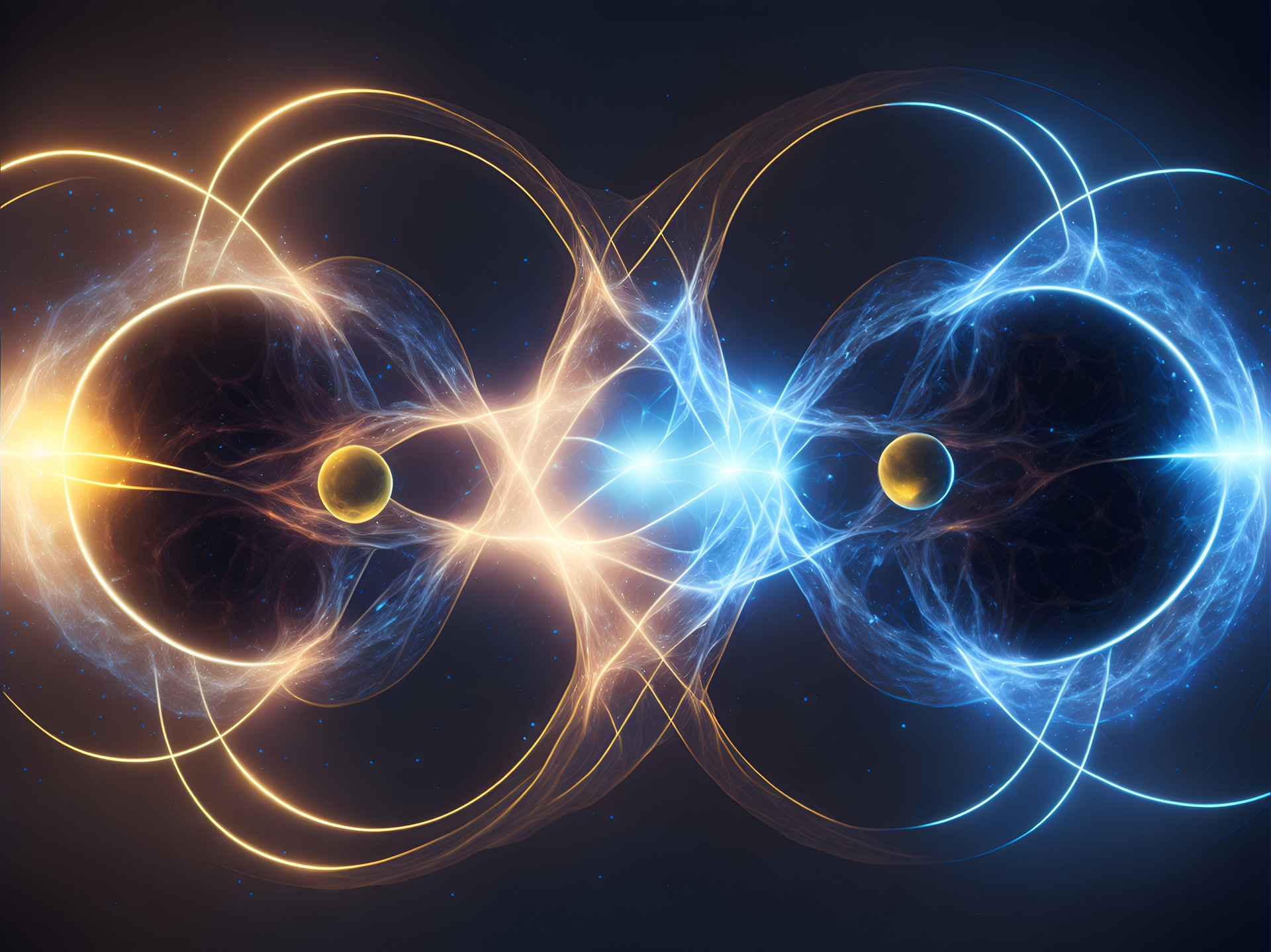
Drawing together the points I have made in these two blog posts and wrapping up all this speculation, we could say, along with other mystics and scientists such as Haisch, that the nature of the unmanifest realm (the Kawsay Pacha) is a creational essence (God, Consciousness, Source, the All That Is) and the creational force is kawsay, or the life-force. The photon is similar to sami in that it is foundational to there being a manifest, physical world. Movement from the photon’s perspective also is similar to the flow of sami andEntanglement - Pixabay - ai-generated-8139010_1920 the relational interaction of ayni (reciprocity, energy interchanges). Both sami and ayni operate in nonlocal ways. Nonlocality means that certain entities are connected (“entangled” in the parlance of physics) in ways that are not subject to the constraints of time and space. Thus, there can be instantaneous correlations between two entities that were once in contact but have become separated. No matter how far apart they are, they can instantaneously respond as a pair even though there is no known type of information-bearing signal passing between them. What happens to one affects the other regardless of whether they are separated by three inches, three feet, three miles, or three light-years.

From the perspective of mysticism, this is true of us. We are, to once again paraphrase Sri Aurobindo, where God-Spirit meets God-matter, and our separation from Creator is an illusion. Through ayni, which is an exchange (and feedback loop) of intention/consciousness, we are in an instantaneous nonlocal and reciprocal relationship with the living universe, with whatever “God” is in the unmanifest and manifest realms. Our ayni in the physical world may also be nonlocal, but until we have reach advanced levels of consciousness (fifth, sixth, and seventh levels), we do not yet have infallible ayni, and so we can at best only influence the material world, not change it or control aspects of it. (We occasionally may be able to change or control something in the physical world, just not consistently; certainly not infallibly, as can those with more perfect ayni. For most of us, it’s hit or miss.)

All of this speculation is just that, of course—speculation. But it is perhaps one reason to admire the way don Juan and don Benito explained who we are as human beings and as metaphysical beings: we are Drops of the Mystery. Perhaps the manifest realm is, as so many mystics say, the way that Creator knows itself. To have any sense of Itself, It must split into an Other. We are part of that Other, while simultaneously being part of the originating Creator. I tell my students that if we think of ourselves in this way, the momentous consequence is that in the flow of ayni, we are the feedback to Creator’s ayni. Ayni is a process of intent, followed by action, followed by feedback. How would you perceive yourself and your life differently if you granted legitimacy to the premise that you (and every aspect of how you are in life) are Creator’s feedback about one aspect of its own True Nature?

Acceding to this premise, we can better understand how the universe was created just to be seen by our eyes. Each of us is the center of the universe! This point of view might motivate us in our mystical practice to learn mastery of the self: to be able to absorb everything in “reality” without rejection so that we can live as a being who radiates the All. In other words, to master ourselves is to perfect our ayni so that someday we achieve the sixth-level of consciousness, that of the enlightened human being. And as a literally “enlightened” human being, as a physical-mystical being of pure sami, each of us would visibly glow with k’anchay.

When we are perfect absorbers of sami and so glow with the light of k’anchy, we would live as what and who we truly are: an aspect of Creator. We would have all the abilities of Creator available to us here in the human world. The Andean prophecy of our creating a “heaven” on Earth allows us to understand that achieving such a state of being requires that we achieve a japu in our yanantin nature. Yanantin means the complement of the differences, which when harmonized creates a Whole or Unity (japu). The Whole in this context means that we realize and live from both our God-nature and our human nature in a perfectly integrated, harmonious way. In the view of science, we would be a superposition: expressing both our wave nature and our particle nature simultaneously.

Many mystical texts and adepts express this same relationship far more poetically. As I have already pointed out, don Juan Nuñez del Prado and don Benito Qoriwaman said, “We are drops of the Mystery.” The Indian mystic Kabir reveals the entangled, nonlocal relationship embedded in that metaphor: “All know that the drop merges into the ocean, but few know that the ocean merges into the drop.” I believe that these musings about the relational energy dynamics of the Kawsay Pacha, kawsay, sami, and k’anchay lead us to this same truth.

*This view about the complementary nature of particles is part of what’s called the Copenhagen Interpretation of quantum mechanics, which was developed by Danish physicist Neils Bohr. It is not universally accepted. In fact, some physicists say it is a misinterpretation of the nature of particles because of the messiness of trying to describe physics concepts in language instead of mathematics. The alternative view is that everything is particle in nature, and the wavelike properties arise only because of probability distributions. Here is one such explanation: “[T]here is no reason to say that quantum entities are ever really waves. Rather, the probabilities of where we will observe them in an experiment can be conveniently determined by the calculus of the Schrödinger equation, proposed in 1926 in response to de Broglie, which is formally analogous to a kind of wave equation. But a wave of what? Not of a physical thing – a density or field – but of a probability. The distribution of these probabilities, when observed over many repeated experiments (or a single experiment with many identical particles), echoes the amplitude distribution of classical waves, showing for example the interference effects of the famous double-slit experiment.” https://www.chemistryworld.com/opinion/a-common-misunderstanding-about-wave-particle-duality/4019585.article

Musings About Kawsay, Sami, and K’anchay: Part 1

The Kawsay Pacha and kawsay. Sami and light. I have thought a lot about these two pairings: about the essence of each member of each pairing, and about their similarities and differences. That speculation leads naturally to musings about the nature of the unmanifest and manifest realms and, of course, ultimately to musing about ourselves. This post is the result of such contemplation and its possible relevance to our understanding and practice of the Andean mystical tradition.

Let’s start with kawsay because metaphysically it is the innate “substance” of everything. The Kawsay Pacha is the realm from which kawsay flows. The Quechua world pacha has many meanings, but in this context means world, realm, space, and time. Kawsay is the animating energy, the creational, life-force energy. Both the Kawsay Pacha (the realm from which kawsay emerges) and kawsay (the life-force) are complete mysteries. We don’t know what they are—they are beyond characterization. Yet, there is something instead of nothing because of them. Andean mystics and those of other traditions tell us that Energy flows cropped Pixabay ai-generated-8496683_1920everything is comprised of this living energy (kawsay), and while we can perceive it, we can never truly know what it is and from where it emerges. 

Kawsay, this creational life-force energy, animates everything but remains as yet beyond our understanding. Some say that if we ever can truly apprehend the nature of “First Cause”—of whatever agency started everything and whatever force, field, consciousness, or intention keeps it going—then we would know the essence of God. When I use the word “God,” I am doing so stripped of religious overlay. It is simply a convenient term I will use in this post for whatever First Cause or the Source is. Although kawsay cannot serve as a synonym for whatever God is, as the life-force energy it has the same ineffable essence as whatever God is.

Andeans were not philosophers and did not have a written language, so we cannot truly know what their general understanding of kawsay was (and is). However, we can look to other traditions to get a sense of how they thought of this “God” realm that is the Kawsay Pacha and this living energy called kawsay. (See my April 7, 2017 post “The Nature of the Kawsay Pacha,” of which this current post is an update.)

The ancient Greeks called this foundational animating energy or essence ylem. They thought of it as an immaterial but primordial force that existed before the formation of the physical universe. They had other names for this essence, such as aperion, which can be translated as “indefinite” or “boundless.” It is the limitless, unknowable, and unobservable Source energy from which everything comes and everything returns. They also thought of it as “Logos,” a rational structuring principle that ordered the cosmos.

In Hindu Vedic philosophy, the nature of the cosmos is found neither in Being nor Non-being, for the primordial Source energy permeates all things, but is not itself those things. In the Chinese Taoist view, the Wu, or “first principle,” is considered Non-being, which is the matrix that is itself beyond any concept of “thingness,” but is the Non-beingness from which beingness and everything physical arises. Yet, Wu cannot be understood as above and beyond the manifest physical realm because it cannot be separate from that which arises from it.

In a similar way, kawsay is the essence of the primordial, foundational “realm” of the Kawsay Pacha. As I already pointed out, the Kawsay Pacha’s very name contains within it the concepts of world, realm, space, and time, so Kawsay Pacha may be translated as the Realm of Living Energy or the Realm of Life-Force Energy. But the Kawsay Pacha itself cannot be characterized by any of the definitions of “pacha,” because each relates to temporality or spatiality. The Kawsay Pacha is outside of space and time. It is an unmanifest, immaterial, infinite, unbounded something that is different from the physical realm of the manifest world and yet not separate from it.* Whatever we say about the Kawsay Pacha distorts it, except perhaps acknowledging that its essence as kawsay—this life-force energy or the living energy—is what creates a manifest world. Everything in the physical universe is comprised of kawsay, although kawsay itself cannot be reduced to any “thing.”

There is a different term for the material cosmos—the Pachamama, which can be translated quite literally as the Mother of the Space-Time Realm. Pachamama also is used to refer to the planet Earth, although as a being in her own right, the Earth has her own name: Mama Allpa. Anthropologist Inge Bolin points out a distinction between these two terms: she says that Pachamama is used by Andeans to impart a sense of earth green energy cropped Pixabay 4075006_1920the sacred to the Earth (and the material cosmos), whereas Mama Allpa is the termed used in the more mundane context of the land in which Andeans plant their crops and upon which their animals graze.

It is the within the realm of the Pachamama that we can situate sami. Sami is the most refined frequency of kawsay, which is the foundational life-force energy. When the Andeans call human beings allpa camasqa, they are calling us “animated earth.” When we work with energy, it is sami that is our focus as the empowering energy of life. It is perceptually experienced as “light” living energy, but not in terms of visible light. It is “light” in that it is the most refined frequency of living energy, and its lightness refers to a sense of weightlessness, not of luminosity. Sami, as I said, empowers us. It lifts us, helping us step up the qanchispatañan (levels of personal development). In contrast, there is a way that human beings—and only human beings—disturb the flow of sami in a way that changes its quality. It comes to feel heavy to us. This is called hucha, which is the name for sami when we slow it or block it and so reduce its frequency or density. Don Juan Nuñez del Prado has said that hucha can best be thought of as sami that has lost some its transformational power. There is much more to say about hucha as a condition of sami, but the focus of this post is sami in its unreduced state, so let us return to considering another of its mysteries.

I am circling back to what I see as a potential paradox in the nature of sami. It used to be a mystery to me that sami as the light living energy is not constituted as visible light and yet visible light is the identifiable characteristic of someone who is running pure sami energy!

As we develop our ayni—our conscious interchanges with the living universe through sami—we evolve our consciousness. This is called stepping up the qanchispatañan, which has seven levels. The sixth level is that of the enlightened human being. A sixth-level person no longer creates hucha. They have perfected their ayni—their reciprocal interchanges with the living universe and so never slow or block sami (in other words, they do not create hucha). Prototypes of sixth-level enlightened beings are the Buddha and Jesus. Enlightened human beings experience an absolute lightness of being—they are pure sami. And, the identifiable characteristic of a sixth-level person is that they glow. Literally glow!

It seems to me to be a contradiction, or at least a confusion, to equate sami with visible light when its essence is about lightness of being. I once asked don Juan about this possible paradox, and he said that sometimes don Benito called sami by a different term—k’anchay. K’anchay has various definitions, most of which are related to visible light: to emit visible light, to be luminous, to glow, to shine, to be bright orExplosion of imagination radiant. Don Juan confirmed that generally sami is equated not with visible light but with an essence of being. However, a person who is a master of sami and so has evolved his or her consciousness would perceptually reveal this lightness of being through k’anchy—by radiating visible light.

Using my common sense, I understood that k’anchy cannot have an equivalence with sami, because k’anchy as white light is part of the electromagnetic spectrum, and, additionally, the visible light of the electromagnetism is itself only one kind of energy. Furthermore, visible light is a further reduction within the larger electromagnetic spectrum, for it is only a tiny portion of it. All of this means that reducing sami to visible light (as k’anchay) severely restricts sami as the living energy, confusing two different kinds and qualities of energy. (I will discuss k’anchy in detail in Part 2 of this post next month.)

The more I thought about this, the more I came to think that this apparent paradox actually reveals an aspect of the brilliance of the Andean sacred tradition. Most traditions valorize the white light. They are traditions whose practices are what would be called “ascending” practices. They focus on teaching us about the most refined states of being and they tend not to teach about or train people in dealing with the heavy aspects of being. Yet our heavy aspects comprise most of who we are as human beings! These ascending traditions tend to reject the bodily or worldly, or they seek to help us leap beyond the physical world and our humanness. Many of them even see the physical world and our humanness as corrupted or degenerate. In contrast, the Andean mystical tradition is a descending tradition. Everything is made only of sami, and our work is to attend assiduously to our humanness so that we can grow and evolve. In other words, we have to attend to our hucha. We are not corrupted or degenerate. IN our true nature, we are Godlike. I like to use Sri Aurobindo’s phraseology to explain this view: this world and human beings are where “God-Spirit meets God-Matter” and “there is divinity in the body.” Instead of seeking to rise above our humanness, we immerse ourselves in it to reveal is sacrality. (See my blog post “Andean Mysticism as a Descending Tradition,” October 3, 2021.)

Using the visible light portion of the electromagnetic spectrum as a metaphor for sami as something that glows, we can parse the radical difference in viewpoints and practices of ascending and descending traditions. From the Andean point of view, we cannot radiate all frequencies of sami (emit visible white light) unless we first learn to be perfect absorbers of every frequency of sami. In other words, we have to master the black light before we can radiate the white light. White light is the reflection of all the frequencies of the visible portion of the electromagnetic spectrum, whereas black light is the absorption of all these frequencies. We cannot reflect all the frequencies of visible light unless we first learn to be black andwhite eclipse - Pixabay 33019_1920perfect absorbers of this energy. That is exactly what the Andean tradition teaches us to do.

Our practices for the most part focus on teaching us not to block or slow any frequency of sami—or, in other words, to not create hucha. Another way of saying this is that they teach us not to avoid hucha. Only humans create hucha, we create a lot of it, and so we cannot avoid it. (Although most of us try to!) Therefore, we must be masters of transforming this hucha (remember, it’s only slow sami) back into its natural state of sami, whose nature is to flow unimpeded. I don’t know of many traditions that stress this type of mastery of incoming energy flows. But this mastery is exactly what we have to achieve before we can be “enlightened” and emit visible white light.

I want to stress this point, because I feel it reveals the brilliance of Andean energy work. In the words of don Ivan Nuñez del Prado, we must be able to “perfectly absorb absolute reality.” That means we have to be able to mediate any and every kind of energy, especially the heavy human energies. We repel or reject nothing. That takes some kind of mastery! I believe that k’anchay—glowing, being able to radiate every frequency of energy—is evidence of that accomplishment: of having achieved the mastery of being in perfect ayni with sami as the living energy in every one of its forms, even as hucha. Radiating white light means we have to become perfect masters of ourselves and our relations with the manifest and oh-so-human world and with the unmanifest Source, which we call the living universe. And that understanding, for me, explains with simplicity and gracefulness the relationship between sami and k’anchay, and the beauty and power of Andean energy practices.

But what about k’anchay as a living energy and as a physical characteristic of an enlightened human being (as actually glowing with visible white light)? Is k’anchay, in its own way, as fundamental to the manifest world as are kawsay and sami? With these questions in mind, visible light soon became the new focus on my musings. In Part 2 of this discussion, which will be posted in July, we will delve into some k’anchay’s paradoxes and mysteries.

*While the Kawsay Pacha is the unmanifest “something” that comes before everything or anything, and hence is the unknowable source of the manifest world, in everyday usage many Andeans also use this term to refer to the manifest realm. In this context, it means the Realm of Life and so can be applied to the physical world.

The Creative Paqo

Don Juan Nuñez del Prado, my primary teacher, calls the Andean tradition the “Andean sacred arts.” Paqos practice the sacred arts. However, art of all kinds flourishes in Andean culture. For example, the Q’ero create intricate weavings, have a distinctive musical style, and rarely pass up an opportunity to sing, yolisa-weaving-compresseddance, and laugh. Creativity—the playful and the sacred—is a part of their sense of sumaq kawsay—living a good and happy life.

This month, I thought I would bring some art to this blog. So, I offer a tawantin of poems. Offering one’s art to the world can feel risky—doing so might stir up all kinds of vulnerabilities—because our art is so personal. To overcome our resistances, we can engage our khuyay—our passion and our motivation to share our passions. As I take a risk here in offering some of my art—in the form of poetry—I hope you will be inspired to unleash the artist within yourself. Whatever your creative expression is, I hope you, too, will take a risk and share your gifts with others.

As I started along the Andean path, one of my first connections was with the spirit of Mama Killa, Mother Enchanted dark forestMoon. That first touch was sweet. I was in awe of how real this connection felt. I guess, so early into my training, I was not expecting to really feel Mama Killa as an actual hanaqpacha being. That awe inspired both respect for Mama Killa and a bit of shyness on my part. Decades later, our relationship changed because I had changed. Energy connections had become a common reality, and I was more in touch with how Mama Killa is a bridge from the hanaqpacha to the kaypacha. I was more in touch with how my physical, human self is sacred in its own right. Under the northern California redwood trees with the moon streaming down here and there through the towering canopy, I felt liberated in a kind of fierce kaypacha moon madness.

Dancing for the Moon
By Joan Parisi Wilcox
© 2024 All rights reserved

Dancing for the moon
is dangerous
now.
My cycles have stopped
and the nimbus of a long-lived life
illuminates a self
unafraid
of fierceness.
No supplicant here.
No shy worshiper of reflected light.
No feet afraid of tangled roots
or eyes seduced by shadows.
You, moon, do not intimidate me
with your shapeshifting ways
and that face cratered by legend and lies.
Although I am an admirer, Moon,
I am no fool.
I have crawled from caution’s womb
and, still somewhat bloodied, set myself
free
to dance in this wilderness
of shadow and sparkle,
with you looking
down,
a bit haughty,
and, no doubt, a bit dazzled.
I know. I know.

ausangate-pixabay - resized gc28f8cf4f_1920Apu means “Lord” or “Honored One.” The giant snow-covered peaks of the Andes certainly command our attention and respect. My studies in the Native North American tradition had also helped me connect with sacred mountains. In the Native North American tradition, I had come across the phrase “sit like a mountain.” I had learned to meditate at age 17, and over the decades in that practice I had sat still—a lot! But the Andean mountains felt different. They did not seem to me to be about stillness. They seemed to be saying, “Move! Grow! Rise up so you can look me in the eye!” These Andean apus both inspired and confounded me. The Andean way is to be fully engaged in life, not necessarily to “sit like a mountain”—solid, resolved, and still. Introspection is a doorway into the self, and so is not itself a fully static practice, despite the many forms it takes that depend on outer and inner stillness. It seems my two practices were at odds, and all of these thoughts came together in this poem.

Sit Like a Mountain
By Joan Parisi Wilcox
© 2024 All rights reserved

Taking inspiration from
a mountain
is delusion,
so far are we
from being
immovable.
No matter what the gurus say,
awareness is not about stillness.
Or, it may be. But it is not only.
The roiling current of Life,
will be diverted,
neither by intention nor devotion.
When we sit like a mountain,
we prepare for the eruption
of our humanness.
In that terrifying moment,
in that molten thrust toward the surface,
when the ground of self displaces image,
and we glimpse the solidity
that gives shape to our center,
only then
do we touch bedrock
and understand the possible
futility
of sitting
still
at all.

Steps of goldI love Mama Qocha, Mother Ocean. The creatures who crawl along her shore and those who fly above her are each inspiring in their own ways. During a solitary walk along the Florida shore at dusk, the dozens of brown pelicans wheeling gracefully and effortlessly through the sky surely were inspiring, although momentarily, as they landed in a flock,  they also became harsh mirrors.

Dusk on the Florida Gulf
By Joan Parisi Wilcox
© 2024 All rights reserved

Three more swift pumps,
then wings extended,
the pelicans sail shadows
over the cresting water.
Close, close as dark can get to light,
they glide in over the silent shore,
until, legs outstretched in thin black lines,
they connect with land.
Once still, they turn their heads away,
up to the rising moon,
as if they cannot bear to see
my heavy, muscled self
struggling over sand.

fire-heart-Pixabay Gloria Williams 961194_1920What’s a collection of poetry without a love poem? The Quechua word munay means both love and will. It is a kind of love that is grounded in reality, yet informed by spirit. It is a kind of love that requires qaway (vision of physical and metaphysical “reality”). Like most Westerners, I learned of love mostly within the realm of romance. Romantic love too often has only a tenuous connection with “reality,” as it tends to be enmeshed with sentimentality, desire, and projection. But after decades of practicing Andean mysticism—and a lot of personal psychological shadow work—my view of love is a lot different today than it was when I first fell in love. Let’s just say my qaway about munay has matured! Although, to confess a truth, despite the claim in this poem, I am still a bit sentimental.

Warrior Love
By Joan Parisi Wilcox
© 2024 All rights reserved

Do not be distracted
by the soft earth
at my surface.
Plunge
deep
to bedrock,
solid as tempered steel,
a ground made safe for your arrival:
where resolved, unyielding
to the dark beasts stalking,
you surrender to the giving way
that is the only real way in.

Do not be seduced
by the tender touch.
Reach
beyond
the shiny things,
distracting as iridescent bird wings,
to the space
made luminous
by the steady spark of feeling
that is just beyond
the grasp of the body.

Do not settle for easy or safe with me.
Do not expect me to love you as a lamb
when I know you are a lion.

Expect a warrior love:
unscripted in its honesty,
fierce in its integrity,
unflinching in its courage,
immune to sentimentality.

Expect a warrior love,
where we drop our masks
and expose ourselves,
one to the other—
raw, radiant, and unafraid—
supplicants to the bounty
shimmering just beyond the horizon
of our still-too-small imagining.