On Being a Paqo

“What does it mean to be a paqo?” “Is it okay to call ourselves paqos?” These are common questions asked by people interested in the Andean sacred arts or who are studying the tradition. They are curious about the different kinds of paqos, how paqos go about their daily lives, what their responsibilities are, and the like. In this post I have gathered together many of these questions and provided my answers to them. The information I provide is my own understanding and knowledge of this tradition, and so nothing I share should be taken as anything more than my opinion.

Question: There are two levels of paqos: pampa mesayoqs and alto mesayoqs. What are the differences?

Pampa mesayoq and alto mesayoq are not designations of “levels,” but simply different kinds of paqos. They practice in similar ways, with a few distinct differences that characterize them as two different types of paqos. Pampa mesayoq can be translated, or understood to mean, the keeper of the earth signs or low signs. Alto mesayoq means keeper of the high signs. Both kinds of paqos share common knowledge, such as of making and offering haywarisqas (despachos), carrying a misha (mesa), healing, and so on. The main difference is that, according to the “old ways,” an alto mesayoq has mystical capacities that a pampa mesayoq does not. For example, alto mesayoqs can “talk” directly to spirit beings, such as an apu (mountain spirit), whereas a pampa mesayoq can only communicate with the spirits indirectly, such as through their misha or dreams. I don’t know if this distinction holds true today, but according to my teacher don Juan Nuñez del Prado, this has always been the main distinction between the two types of paqos.

That said, there is a specific way to think about paqos—both pampa mesayoqs and alto mesayoqs—as having “levels,” because there are stages to their development as paqos. These stages correlate to their accessing and being able to use more personal power. The levels, which are most commonly applied to alto mesayoqs, are: ayllu alto mesayoq, llaqta alto mesayoq, and suyu alto mesayoq. Usually paqos are “in service” to an apu, which is their guiding spirit. The apu teaches them and so helps them develop. All paqos start out in service to an ayllu apu, or an apu whose range of power is limited, such as to a village or town, or a small cluster of them. Hence, they are known as ayllu alto mesayoqs. As they develop their abilities, they may eventually be called by a more powerful apu, usually a llaqta apu, whose range of power reaches wider and farther, encompassing a larger region. Those paqos have reached a stage of development so that their power is equivalent to that of the apu, and so the paqo is recognized as a llaqta alto mesayoq. As paqos continue to learn and grow, they may be called by the greatest of apus, a suyu apu, whose power reaches across a vast region or even an entire nation. Once in service to this highest level of apu, these paqos are recognized as suyu alto mesayoqs.

There are two more stages of growth. After paqos become suyu alto mesayoqs, they might go on to reach the stage of the teqse paqo, or universal paqo. This is a paqo whose power can reach the entire world. Finally, there is the kuraq akulleq, which translates to something like the Elder Chewer of Coca or the Great Chewer of Coca. To my knowledge, at any one time there is one paqo who holds this position. Kuraq akulleq is a title conferred on an exceptionally wise and highly developed alto mesayoq through the consensus of a community. It is not something a paqo calls him- or herself. Rather, it is an honor bestowed by the community in recognition of that paqo’s expertise and experience and how he or she can serve that community.

Q: Who determines what kind of paqo someone is?

I am sure there are many ways to be called to the paqo path, but from what I have heard from the paqos I have interviewed or talked with (through translation), a paqo is called to be a particular type of paqo by an apu, another spirit being who serves as the representative of the apu, or by Taytanchis/God. When a person feels the call, he or she may go to an already established paqo, particularly an alto mesayoq, to discover if the call is real and, if so, what it means. The alto mesayoq may do a coca-leaf reading or consult with his or her misha, the spirit beings, or an apu to determine if this person’s call is to the path of pampa mesayoq or alto mesayoq. Sometimes, the person will intuitively know which type of paqo he or she is being called to serve as. That person has a choice to accept that call or not. For instance, as one paqo told me, when he consulted an established paqo about anomalous (and challenging) events that were happening in his life, the elder paqo told him he was being called to the path of the alto mesayoq. But this young man did not want the responsibility of being an alto mesayoq. If he was going to learn to be a paqo, he felt he would best fit into the role of a pampa mesayoq. And so that is what he trained to become.

Q: Should we call ourselves paqos? What kind of paqo are we training to become?

Although we might call ourselves paqos, what we mean by this is something different from what that title means in the Andes. For most us, we call ourselves paqos simply as a convenient way to indicate that we are learning or practicing the Andean sacred arts. But we are not literally paqos.

Paqo is a term rooted in the Andean culture. Thankfully, this is a culture that freely shares its tradition and practices. So, we are not in danger of cultural appropriation, for the paqos freely share the tradition. Today, they are almost always compensated for their time and expertise. However, payment does not negate the “ayni” (reciprocity) that truly drives their intent. They feel the energy practices are for everyone: we are all human beings and the goal of the work is to consciously evolve our humanness. However, we are at risk of cultural appropriation if we think of ourselves as either a pampa mesayoq or an alto mesayoq. These are not roles applicable to or recognized within our own cultures, and we risk misunderstanding what we are doing as practitioners of the Andean sacred arts if we think of ourselves as being either of those. An exception might be made if we spend time in the Andes apprenticing with a paqo and that teacher confers one of those titles on us. Still, if we come back to our communities, we no doubt will undertake that role in our own culture in ways that are distinctly different from what it looks like in the Andes.

The bottom line is that we are not training to be paqos except in the most utilitarian sense of using the same techniques that Andean paqos do to foster our ayni and fertilize our personal development. Therefore, calling ourselves “paqos” is mostly just a convenient way to talk among ourselves and acknowledge we are learning and practicing Andean energy dynamics. We likely would not use the term outside of our common community of practitioners since it would be meaningless to anyone else. 

Q: What are the duties and responsibilities of a paqo?

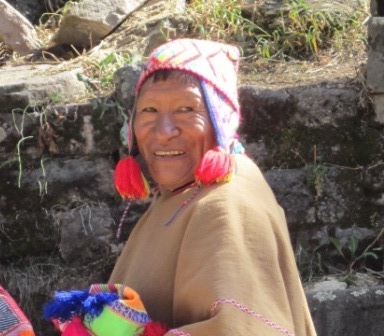
Paqos are first and foremost regular human beings, regular members of their communities. They are farmers, herders, weavers, husbands or wives, parents, friends, and neighbors. Their focus is on the duties and responsibilities that occupy daily life. No paqo whom I ever met is engaged full-time in his or her role as paqo. So, paqos are not spending most of the day communing with the spirit beings or performing rituals. They are going about their mundane daily lives until someone needs them to serve in their paqo capacity. What is that primary capacity? To serve their community.

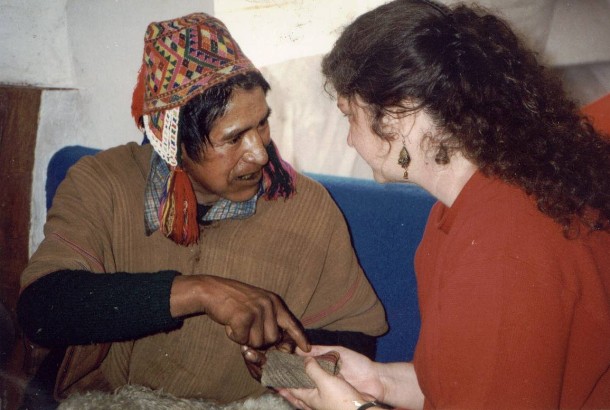
Being a paqo means a person has knowledge and skills (and hopefully wisdom) that are above and beyond those of other community members. Although most Andeans understand and practice ayni and know how to make a despacho and so on, paqos are specially trained. When they are serving in their paqo capacity, they might be doing any number of things. While they may perform a ritual such as a despacho or undertake a healing, mostly they offer advice or solutions to people’s problems, sometimes gaining insight into the problem and the solution by throwing and reading the coca leaves. They may lead life-transition ceremonies such as the hair-cutting ceremony or some other coming-of-age ceremony,. They might lead a festival on a holy day or perform blessings for a wedding or death. Most of what they do is not “mystical” or “shamanic,” but practical. If I were to choose one primary responsibility that a paqo has it would be to foster social cohesion. That in turns helps ensure the well-being of all the members of the community. Don Benito Qoriwaman called the mountain spirits, the apus, the Runa Micheq, the shepherds of human beings. That, too, is the primary duty of an Andean paqo.


What Is an Andean Initiation?

In the Andean mystical tradition, the Quechua word karpay usually is translated as “initiation.” How reliable is that translation? Is that the primary meaning of the word? Just for the heck of it, over the years I have searched this word in various Quechua dictionaries and online translation programs. It never comes up, although recently an artificial intelligence-assisted online translation program returned an answer: its result was that karpay means “tent.” I suspect that is because the Quechua word is close to the spelling and pronunciation of the Spanish word carpa, which does indeed mean “tent.” I also searched spelling variations such as qarpay and qharpay, but if those words appeared, their meanings had no relevance to karpay as initiation. (I purposefully excluded from my online search books, articles, glossaries, and blogs by people who are studying or teaching the Andean sacred arts, as they would likely know the term. I was looking for independent verification of its meaning, and I found none.)

For good measure, in my most recent search I reversed the terms and put the English word “initiation” into a few English-to-Quechua translation programs, and most of them returned the Quechua word qallariy, which was variously defined as “source,” “start,” or “begin.” Ok, fair enough. An Andean initiation opens us to something, such as personal growth or an energetic capacity. But qallariy is not the word the paqos use. 

The failure of this recent search was not surprising, since, as I said, I have done this kind of search before and not found this word. And I knew why. Many years ago, I asked don Juan Nuñez del Prado about its absence, and he explained to me that karpay is a term used only by the paqos within the context of their work in the Andean sacred arts. It does not appear in Quechua dictionaries (as far as we know) because it is not known or used by others.

So, just what are the core meanings of the word karpay? And what is an Andean karpay? We turn to our teachers and the paqos for explanations. This blog post covers the basics, although no doubt there are many other ways to understand the term karpay and carry out a karpay than what I cover in the space allotted here. As always, I focus on the two lineages (Q’ero Wachu and Cuzco Wachu) that I learned through don Juan Nuñez del Prado and on his explanations over the years.

Let’s start with the meaning of the word itself. Karpay can indeed be translated as “initiation,” although that translation provides only a rudimentary sense of the word, which is rich with nuance. There are at least three more expressive definitions of karpay. If we follow a specific sequence of discussing these three meanings, we also will gain an appreciation for what is happening during a karpay.

First, karpay refers to our personal power. We say that our full potential is held within our Inka Muyu, or Inka Seed. Everything that is possible for human beings to express is held as potential in this energetic field. Our work as paqos is wiñay (to germinate) and phutuy (to bloom or flourish): to germinate our Inka Seed, nurture its growth, and bring our human and metaphysical capacities to full flower. Our karpay as our personal power is how much of our Inka Seed potential we have developed and have access to right now. (See my blog post of June 20, 2016, “All About Karpay,” for a specific discussion of karpay as personal power.)

Second, karpay refers to a sharing or transmission of energy between two people or entities (such as a person and a spirit being). Which begs the question, “What energy is being transmitted?” That is the third facet of the definition. What is being shared is some aspect of our personal power, such as our sami or munay. So, the core meaning of the word karpay for paqos means to share their personal power with another person or entity through an energy transmission of some aspect of that personal power. To sum up using the term itself, a karpay (initiation) is the energetic sharing of a particular quality of our karpay (personal power). It is a process somewhat similar to the Hindu practice of shaktipat.

Here’s the rub. During a karpay as an initiation (karpay as verb, we might say), we can only share according to how much personal power we have in the moment (karpay as noun for personal power). If a person is sharing munay during a karpay as an initiation or transmission of energy, that person can only share as much munay as they have developed within. If that person has developed their capacity for love only a little, then they can share only a weak love energy. The same goes for any of our personal powers: if we have a lot of sami available, we can share a lot; if only a little, we can only share a little.

When the sharing is reciprocal—when the teacher shares their energy with the student and then the student also shares their energy with the teacher—it is called a karpay ayni (or sometimes the word order is reversed: ayni karpay). Ayni means interchange or reciprocity. So, a karpay can be either a unidirectional sharing of personal power from a teacher or paqo to a student or other person, or a reciprocal exchange between the two parties.

As I said, a karpay or karpay ayni as a transmission of personal power does not have to involve two human beings. It might occur between a human being and a spirit being or nature being, such as between an apu and a person, or vice versa. The karpay of an apu can, like a human being’s, vary from a small amount of power (as from an ayllu apu) to a midrange level of power (as from a llaqta apu) to an enormous amount of power (as from a suyu apu). Or, a karpay might be a transmission of sami from Creator to a person. There are all kinds of possibilities, but as a transmission or sharing of personal power, any of these situations could be considered a karpay.

So what do karpays among paqos look like in the Andes mountain and Cuzco regions of Peru? I am sure there as many variations as there are paqos, because as a sharing of personal power a karpay can take many forms. I have talked with various paqos who report that during their training they were given karpays that involved being sent by their teacher to spend a night in a cave or on top of a mountain to receive the energies there. Or that they and their teacher went to a specific sacred site or sanctuary and performed certain kinds of energy work there. The most common form of karpay that paqos have shared over the years is the receiving of sami through the immersion in water, such as at the sacred lagoons on the slopes of Apu Ausangate. Karpays tend to be fairly simple in form. That is why I advise people who are working in Peru today to be at least a little wary when a karpay is an elaborate ritual. In the Andes, one of the cardinal rules is to never waste energy. The energy work, even during a karpay, tends to be simple rather than complicated and invisible rather than having much of an outward form.

All that said, there are a few recognized formal ways that karpays are performed or occur. Don Juan has said that according to his paqo teachers, within the overall framework of the tradition there are only five traditional ways to be “initiated” as a paqo. These are the core traditional karpays by which paqos are called to the path or karpays that they receive during their training.

Karpay Ayni: the way of the paña, the right-side practices as taught by don Benito Qoriwaman. The Karpay Ayni takes the form of the teacher sharing their energy with an apprentice and then the apprentice, in ayni, sharing their energy with the teacher. There is another paña karpay form that is unidirectional: the paqo puts his misha (mesa) on the apprentice’s head (or sometimes over their sonqo ñawi or qosqo ñawi) and shares sami with that apprentice to empower them.

Chunpi Away and Ñawi K’ichay: the way of the middle work, the chaupi practices as taught by don Andres Espinosa. The Chunpi Away and Ñawi K’ichay are the joint karpays to become a chunpi paqo (a specialized kind of paqo known for exceptional healing ability, among other abilities). These karpays are done together, and they involve the “opening” of the mystical eyes, the ñawis; and the weaving of the energetic belts, the chunpis. However, it is not really the paqo who is giving this combined karpay. The paqo is pulling up Mother Earth energy, and she is doing the energetic work of the karpay.

Unu Karpay: the way of the lloq’e, the left-side practices as taught by don Melchor Desa. During an Unu Karpay, an apprentice receives the teacher’s sami as transmitted through water. Sometimes hucha is also purposefully released. Often, a paqo teacher will take an apprentice up to the sacred lagoons to do this type of karpay. But it can be done through any source of water.

Kaypacha Qaqya: The extreme left-side karpay is kaypacha qaqya: being struck by lightning and, of course, surviving and being changed. This is one way to be called to the paqo path.

Hanaqpacha Qaqya: A rare kind of this same left-side karpay is being struck by hanaqpacha qaqya, which is to be touched by a metaphorical “lightning” from heaven. As don Juan explained to me, this is not regular lightning, but “lightning” as a white light that comes down from the upper world (from Taytanchis or God) and touches the person, changing them and calling them to the paqo path.

There are other kinds of less formal or traditional karpays. They are more variable because they are used by teachers who happen to do things a certain way. Whatever the form, generally a karpay is some kind of infusion of energy that empowers us in our development. A karpay does not raise us to a new level of personal power; it supports us so that we can better develop through our own efforts. For example, the karpay ayni is the karpay to the fourth level of personal development (which is a stage on the qanchispatañan, a word referring to the stairway of the seven stages of the development of human consciousness). As explained above, usually it is the reciprocal sharing of energy between teacher and apprentice. However, the realization of that karpay to the fourth level comes only when we have our own personal experience of that level of consciousness. That experience might occur soon after the karpay ayni or years or decades later. It all depends on our own developmental process.

To conclude, karpay refers to how much of our personal capacities we have so far developed and thus have available for sharing or bringing to the world. The same word, karpay, refers a form of “initiation” that is a purposeful or even formal sharing of specific aspects of our power to help an apprentice grow on the path or for some other specific reason. It also might be a transmission of energy—usually sami—to us from a spirit being or Creator, or vice versa. At heart, an Andean karpay is an opportunity: it is an infusion of energy that prepares us for growth and even fertilizes our growth. Receiving a karpay or participating in a karpay ayni conditions us to be in more conscious ayni with the living universe, with spirit and nature beings, and with our fellow human beings. Ideally, it helps us develop ourselves so that we can move up the qanchispatañan.

Honoring Mama Allpa

Note: In this post, I refrain from interrupting the flow of ideas with definitions of the Andean practices that are mentioned. If you have been studying the tradition through the two lineages I write about, you will know them. If you are new to the tradition, there are nearly ten years of posts in the archives that you can search for explanations and additional information.earth- Pixabay 5486511_1280

I am closing out this year by writing about hucha, “heavy” energy, and how our practice is to transform our own hucha back into sami, the light living energy that empowers us. Let us end a year that has felt heavy in so many respects—from climate disasters to war and conflict to a spreading politics of cynicism and even violence—by shifting our perspective from feelings to action. Because the good news is that we do not have to deal with our hucha alone. As we close out the year, let us honor Mother Earth, who is always available to assist us.

Of course, we always start by taking personal responsibility for the state of our own energy. We all have hucha, and if we have studied the Andean sacred arts, we have tools to deal with it. When we block or slow down sami—the life-force energy—and so create hucha, we have our core daily practice of saminchakuy. To undertake a deeper clearing of hucha or to reduce hucha we feel between ourselves and others, we have hucha miqhuy. If we are carrying hucha from our personal past, we have wachay. If we have restructured our mystical body by weaving the chunpis (energetic “belts”), we have heightened our capacity to move energy upward through our ñawis, our mystical eyes. As our hucha moves up, it becomes more refined, dissipating its heaviness and regaining more of its lightness. This refinement improves the energetic quality of our wasi: our body and poq’po.

There is one constant in all these practices: Mother Earth. She is called both Pachamama and Mama Allpa. However, I prefer to make a distinction: Pachamama is the Mother of the Cosmos, of the entire created world, whereas Mama Allpa is the sacred being that is the planet Earth. There is a reason Andeans call the Earth by both names, but in the interest of brevity, I will not explain these nuances and will simply state my preference for calling her Mama Allpa.  

Mama Allpa has no hucha. Nor do any of the creatures of the natural world. Only human beings block or reduce the flow of the life-force energy and so create hucha. But Mama Allpa is our greatest ally in dealing with our hucha. She is known as the Great Eater of Hucha. Although ayni—reciprocity, giving and receiving—is the natural law of the universe, Mama Allpa is always ready to receive our hucha without asking anything of us in return. We do not have to earn or deserve her help. Our relationship with Mama Allpa is not one of chhalay, meaning it is not transactional. She does not require a bargain. She gives without condition. She is part of a tawantin that freely sustains all life: the universal spirit beings of the Earth (Mama Allpa), Sun (Tayta Inti), Wind/Air (Tayta Wayra), and Water (Mama Unu). From this tawantin of life-force power we are given our hanchi, our physical body, and they freely sustain us physically and energetically throughout the span of our lives. Of course, if we are sensitive and generous, we always honor these spirit beings and choose to be in ayni with them. But as the foundations of life, they do not require anything of us.

Although I said that only human beings create hucha, it is useful to take a moment to understand that hucha also can be seen as the natural cycle of life. As don Juan Nuñez del Prado explains, the life cycle begins with sami and continues in a long arc of increasingly more robust expressions of sami until a peak pear-Pixabay 3519397_1280is reached. Then the arc curves downward, with a continuing reduction of sami, which we can see as hucha in that it is the slowing of life-force energy. Finally, the physical life force is extinguished. A seed geminates, a seedling grows, a plant flourishes until it reaches the apex of its growth, perhaps flowering and fruiting, and then slowly, over time, it begins to lose life force, until it collapses to the ground and its physical constituents are reabsorbed into the earth. We are in relationship with Mother Earth in the same way. She is one of the tawantin of powers that support and sustain the body in which we exist. When our life force is extinguished, our body returns to her. She asks nothing of us during this cycle of life.

In our hucha-transformation energy practices, however, we understand that we are in a kind of ayni with her. Mama Allpa’s core specialties are life, growth, evolution, change, transformation, support, and empowerment. When we give her our hucha, we are giving her an energy that she welcomes. Don Juan and some of the paqos have said that our hucha is “food” for her—one of her favorite foods! When we give her our hucha through such practices as saminchakuy and hucha miqhuy, she takes that slow life-force energy and performs her magic, returning it to its natural vibrant state. This may seem an unusual or unfair exchange to us with our Western mindset. We think of the things we “excrete” as dirty or negative. But Mother Earth is the great composter—one of her most robust powers is transformation through recycling and redistribution. Dung becomes fertilizer. The decaying wood of a tree revitalizes her soil with nutrients. The dead husk of a beetle becomes components for new life. From this perspective, our hucha is another form of life-force energy. It is only when we forget that hucha is sami (simply slow sami) that we misrepresent Mother Earth’s largesse to us by thinking we are hurting or burdening her by giving her our hucha to transform when we cannot fully do that for ourselves.

As don Juan has said, “Mother Earth is a co-creator with the cosmos. She fuels our evolution. She recycles our hucha, helps propel us forward. She feeds us [through the food she helps us grow, the animals whose lives she supports] and we feed her hucha.” In hucha miqhuy, a similar dynamic is in play. Don Juan says of hucha miqhuy, “We take control [of our hucha] following her example. We learn to recycle energy as Mother Earth recycles things. We become Mother Earth’s ally, helping her to digest human beings’ heavy energy.” In both practices—saminchakuy and hucha miqhuy—our hucha is a form of ayni that we engage in with Mother Earth.

Just about everything in our practice involves Mother Earth coming to our aid and enabling our greater well-being. For example, the energetic belts we weave into our mystical and physical body—the chunpis—are earth energy. It is not the chunpi paqo alone who creates the belts. Neither are the mullu khuyas the chunpi paqo uses to weave the belts responsible for their creation. The chunpis are created through the power of Mother Earth’s sami. Before the chunpi paqo begins the karpay to weave the belts, he or she connects with and pulls up Mother Earth’s energy, and that is what is used to create the belts. As don Juan has said, “The belts are not ‘natural’ [meaning, naturally a part of us], but are an energetic addition that improves us.” That addition is Mother Earth’s energy, the sami of the one who lovingly and without condition sustains us and supports us in cultivating ourselves.

In the left-side work—the lloq’e aspect of the tradition—we even plant our Inka Muyu (Inka Seed) in the earth. Our Inka Seed is an energetic structure and information field that holds within it our full potential. ItEye in Leaves or Earth - Pixabay ai-generated-7783062_1280 is the Self, the core “I” that is both our humanity and our divinity. To use the Hindu terms, it is both Atman (God Within) and Brahman (God Without). We literally use intention to move our Inka Muyu outside of our body and plant it in the earth. Once in the ground, Mother Earth helps fuel our Inka Muyu’s development. We could say she is fertilizing it with her sami. What she is really fertilizing is our capacity for self-inquiry, self-awareness, clarity of intention, and efficiency of action—all the aspects of the self that help us climb the qanchispatañan, the stairway of the seven levels of human consciousness. According to the tradition as passed on by don Benito Qoriwaman, we are under no obligation to develop ourselves. However, if we choose to, we can refine our consciousness and energy until we reach the sixth level of human consciousness—that of the enlightened human being—and even the seventh level—that of a human with godlike capacities. We do not undertake the process of our expansion alone. Mother Earth lovingly helps us.

As we close out this year, I invite you to join me in appreciating—in celebrating—Mother Earth and all she does for us. We honor her. As we go into the new year, no matter what is going on in the world and how much hucha we feel around us—we know that we are free to consciously condition our own inner state and that we have help. Mother Earth is always assisting us, feeding us, even energetically fertilizing us to be the most glorious human beings we can be.

Postscript: This discussion would not be complete without mentioning ecology, so I am addressing it briefly here. We are in an environmental crisis because of our lack of ayni in caring for the natural world. We have polluted the land, oceans, and air. We have damaged or obliterated vast swaths of the habitats of animals, birds, and insects. We are creating conditions that threaten our own well-being. The Andean tradition teaches that we must see reality as it really is, and the reality is that we are degrading and even destroying much of the natural world as we know it. We can make no excuses for ourselves.

The reality also is that Mother Earth will be just fine. The rallying cry of “Save the Earth” misstates the problem. What we are seeking is to save ourselves. Our lack of ayni with Mother Earth may hasten our own demise and that of other species as we create environmental conditions less conducive to human life and other forms of life. Our lack of ayni, to be brutally realistic, is both potentially suicidal and murderous. However, Mother Earth will survive whatever we do. She has persisted through countless environmental stresses and ecosystem collapses from Ice Ages to massive asteroid strikes. She absorbs death, and she fuels life. Gone are the velociraptors and the wooly mammoths, and here are the birds and elephants. A thousand years ago there was a desert, and today there is a verdant forest. Mama Allpa— wondrous Creatrix that she is—adjusts, survives, and thrives.

Musing about K’ara

When I was conducting the interviews with Q’ero paqos back in 1996, they spoke about k’ara, which Quechua translator Riccardo Valderrama, don Juan Pauqar Espinosa and Joan - book interviews - 1996excited the anthropologists who were there. They had not heard this term before, and so they probed the Q’ero for more information. What we learned is that they make a distinction between two energies in a person’s or spirit being’s energy body: k’ara and sami. In this post, we take a deep dive into k’ara and its significance.

The distinction the Q’ero paqos made is that sami (the light living energy, the life-force energy) is the essence of a person, and k’ara is the visible manifestation of their sami and thus of their essence. For example, k’ara is what we see when we say that a sixth-level person literally glows. The Andean qanchispatañan is an upward progression of development of human consciousness. A sixth-level human being is one who is enlightened. The meaning of “enlightened” is two-fold: the quality of the person’s consciousness is such that they create no hucha (heavy energy) and the characteristic that identifies an enlightened person is that they visibly glow. With k’ara, we now have an explanation for that characteristic: the glow is the visible sami essence—the k’ara—of the person.

Not everything has k’ara. The paqos insisted that we “ordinary” people do not have k’ara. Of course we have a sami essence: we are light living energy and we all have an Inka Seed (which is our Spirit, a drop of God/the Mystery). But, according to these Q’ero paqos, we don’t have k’ara. Our essence not of sufficient quality or power to become visible. The extrapolation from this information is that we don’t have what is commonly called an aura. Some nature spirits do, as I will discuss below, but more of us do not.

Simply from this minimal amount of information, we can determine that k’ara can be thought of in two ways: 1) as the inherent high-quality power of a person and 2) as the visible manifestation of that quality and power. The paqos told us that as a power, k’ara can be invoked and utilized. Juan Pauqar Flores explained that a paqo or spirit being who has k’ara can share it with us. By using their k’ara, we can dofull-moon ring glow Pixabay cropped -2055469_1920 things, such as heal. (To understand the following quotation, you need to know a bit about the paqo he uses as an example: don Andres Espinosa. He was deceased by the time of our interview, but had been one of the top Q’ero paqos. In fact, he was a rare kind of paqo—a chunpi paqo, which is a specialized kind of paqo known for having especially powerful healing skills.) Don Juan Pauqar Flores said, “The moon has k’ara. The apus have k’ara, and by calling the k’ara of an apu you can heal a person. Don Andres Espinosa healed diseases by invoking the k’ara of the apu. The apu has more k’ara than a paqo. My master, Andres Espinosa, healed by invoking the k’ara of the condor and the apu. But I do not believe that ordinary men have k’ara.” The other Q’ero paqos concurred: “Only great men [or women] have k’ara.”

The larger discussion was difficult to understand for many reasons, but don Juan Nuñez del Prado came to feel that an accurate interpretation of what the Q’ero were saying overall is that all beings have k’ara, but most of us have too much hucha (energetic heaviness) for that light to shine through our field and become visible. Great men [and women], however, are those who have mastered their personal energy and stepped up the qanchispatañan of conscious development. The quality of their essence is such that they have visible k’ara and can share their power with others.

According to the Q’ero, the same dynamic holds true for nature beings and spirit beings: some have k’ara and some do not. For example, although there was confusion and even disagreement among the Q’ero, the ultimate consensus was that only the lead condor, the condor apuchin, has k’ara, while the rest of the Condorcondors in the group do not. There was further disagreement about whether the k’ara of the condor apuchin glowed red or white (with white being the likely color). The k’ara as the visible energy of the apus comes in different colors, according to that apu’s “quality,” which we took to mean power. The highest quality energy is white, followed in descending order by red, yellow, and black. The k’ara of an apu alsorelates to its dominant capacity. One apu’s essence might be to confer healing, whereas a different apu’s specialty might be to help resolve family problems.

What I took all of this to mean for those of us practicing the tradition is that our ayni connection (reciprocal energy exchange) is not to a spirit being itself as an outer form but to its inherent power. That might seem obvious, but it is a good reminder, for I have seen plenty of students mistake form for function. As an example, we are not so much connecting to an apu itself as a mountain or whatever form it takes (not all apus are mountains). Our connection is to the apu’s quality and power: its k’ara is what we call to us and the apu shares with us. We invoke, receive, and use its k’ara, and when it shares that with us, we can do things we might not otherwise be able to do. We get beyond form to function. The apu (or whatever spirit we are connecting with) is first and foremost a source of power. To “carry the k’ara” of something, as the Q’ero paqos characterized this kind of ayni, means to be with it, to be connected with or resonating with it its essence, so that its power is accessible to us and can be used. Therefore, we can refine the two meanings of k’ara: it refers both to the quality of a human being’s or spirit being’s power and the availability of that power to be shared.

If that interpretation is even halfway correct, it has a few significant ramifications. One that I will call out here is that it means we should never hesitate to reinforce our own personal power with that of a more developed paqo or spirit being, both of whom presumably have k’ara. This view is supported by something don Juan Nuñez del Prado said once: if a paqo (an Andean or non-Andean who practices the tradition) has more power than us or even claims to have more power than us, we can take some of his or her sami to empower ourselves (if we feel we need empowerment). We don’t have to ask permission. That person is a source of power for others. But if a person is the same level as us or lower, no! We cannot partake of his or her power.

A final musing is about ayni dynamics. When we are in ayni with a paqo, nature being, or spirit being with k’ara, what is happening? From what the Q’ero paqos said, we are touching their core essence and they are sharing that essence (quality and power) with us. Is something different happening in our ayni with a being who does not have k’ara? My guess is that it is: we are simply sharing a resonant field we have set up between our poq’pos (energy bodies). Although we may not be accessing their essence directly, we can be empowered just by being resonant with their poq’po—with their karpay, which is the power they have available to share at the moment. Of course, this is all speculation. Yet perhaps these are musings that help us understand at a deeper level what we are doing as practitioners of “driving the kawsay” (the life-force energy) and being in ayni with human beings, and nature and other kinds of spirit beings. Q’ero paqos, and other paqos of the Andes, acquire knowledge and understanding through yachay—personal, firsthand experience. Maybe our knowing about k’ara can motivate us to refine our perceptual abilities so that we can begin to detect it and have our own firsthand experience of it. For, as don Juan says, don’t believe a word I say. That is willay, which is secondhand knowledge. Instead, we must find out for ourselves. We must practice and become the masters of ourselves through our own experiences. Then we can decide for ourselves how we can best honor the quality and level of power that is k’ara, and we can learn how to use it for what we most need or want to do when it is shared with us. And, of course, we might even realize, despite what the Q’ero paqos say, that we have k’ara ourselves.

The Supernatural

“Good luck is science not yet classified; just as the supernatural is the natural not yet understood.”

— Elbert (Green) Hubbard, Writer, Artist, Philosopher

When we talk about the mystical (paña, or right-side of the Andean path) and the magical (lloq’e, or left-side of the Andean path) we are talking about perception and experience (paña) and action in the world (lloq’e). But the description of the left side as “magical” prompts many people to wonder about how the supernatural fits into the ecology of our energy environment. How common is it to experience supernatural events when we are in ayni (reciprocity) with the living universe? Should we expect to have them? How should we relate to them when they do occur? Here I offer up for consideration some of the ways I answer these questions.

The word “supernatural” comes from roots meaning “above” or “beyond” nature. Something supernatural is inexplicable because it defies known natural laws, and thus some scientists would say that belief in the possible and impossible keys show optimism and positivitysupernatural is inexcusable—it is “magical thinking.” Yet, I prefer to think of what is called the “supernatural” not as inexplicable but as anomalous. Something that is an anomaly deviates from the normal, known, or expected. Science itself progresses because of anomalies, which hover on the border of the known and unknown. They not only draw attention but often beg for explanation. Discoveries frequently are made because during an experiment some parameter deviates from the likely or expected result or range, and then the scientists engage their curiosity and keep probing. Sometimes that probing leads to a eureka moment—something that was formerly unknown becomes known. Over time, it may become accepted and even incorporated into the mainstream. What was once above or beyond nature reveals itself to be an aspect of nature.

The crown jewel of such a situation is the double-slit experiment in physics. To this day there is no universally accepted explanation for why a subatomic (and now atomic) entity appears to be a wave or a particle only because of how it is “observed,” which is to say how some device or human being decides to measure it. Perhaps right up there with wave-particle duality in the anomalous stratosphere (and some might say teetering on the border of the seemingly supernatural) are entanglement and non-locality. Two particles that share a connection (a quantum state) remain connected no matter how far apart they are—two inches, two hundred miles, two light-years. Although no known type of signal passes between them, when the state of one particle of the pair is changed, the other particle instantaneously changes in a commensurate way. The quantum weirdness of deep-down nature has prompted many scientists to both marvel and frown. As Neils Bohr, a pioneer of quantum mechanics, so famously said: “Those who are not shocked when they first come across quantum theory cannot possibly have understood it.” Richard Feynman, another physics pioneer, especially in quantum electrodynamics, went further and said, “It is safe to say that nobody understands quantum mechanics.” Einstein rejected the idea of nonlocality, calling it “spooky action at a distance.” Perhaps it is not too much to say he found it supernatural, and so he was convinced there was an explanation that did not defy the known laws of physics. He never found it. And, after trying for many decades, scientists still have offered no adequate explanation for non-locality, although its existence is proved beyond a reasonable doubt.

I offer that discussion to rally you toward thinking about the supernatural as simply something that is (right now) anomalous—unexpected and thus open to inquiry, but beyond the grasp of current consensus knowledge and the physics of the academy. I mean . . . if quantum can rule the subatomic (and increasingly the atomic) landscape, then it is not so big a leap to think that strange, wonderful, and even shocking “supernatural” events might be evidence of some kind of other deep-down nonlocal dynamic.

Of course, anomalous events are neither unusual nor unexpected within the domain of the mystical and shamanic. As part of our Andean energy practices, especially ayni (making conscious interchanges with the living universe), we expect feedback from the living universe, and we often experience that feedback in a way that defies rational explanation and violates the norms of consensus reality. The supernatural/anomalous takes us beyond known natural laws. That is no surprise, as “meta” in the word “metaphysics” literally means “above,” “beyond,” or “after” physics. Metaphysics operates not in defiance of physics as much as in ways that extend and expand it.

here there green road signIn fact, I cannot even call what mystics and shamans experience occasionally as “anomalous,” for the ways of the liminal realms—those “in-between” realms in which we most often work— may be mysterious but they are played out in what is our normal operating theater. Their liminal nature intersects with our more mundane world, so the separation between “there” and “here” eventually blurs. What appears to be a “magical” event to those who don’t know how to work or live in shamanic or mystical ways is considered more or less normal for those of who do.

Andean paqos, especially those of the last generation, work “magically” in the most mundane and practical ways. They do not consider their mystical abilities to be anything special. My primary teacher, don Juan Nuñez del Prado, has shared several experiences of witnessing what was possible for the old paqos. And every one of these stories recounts events that were more or less just normal operating behavior for them. For example, don Juan describes what happened when he asked don Benito Qoriwaman if they were living in the time of the harmonic convergence. That was reputedly an auspicious time in the 1980s during which a particular alignment of celestial bodies would energetically impact Earth and we humans in beneficial ways. What was don Benito’s response to that question? He said, “Let’s go and see.” He walked outside and stood looking toward Cusco. Then he shook his head and said, “No.” When don Juan asked how he knew, don Benito said that the energy bubble around Cusco had not fully risen to cover the city. Only when it had done that would the time be auspicious for such energetic shifts to occur. He asked if Juan could see that himself, and when don Juan said “No,” don Benito told him to sit next to him and take hold of his leg. When he did and then looked toward the city, don Juan too could “see” (qaway, mystical vision) the energy bubble of Cusco. What this event tells us is that “supernatural” abilities were simply the norm for fully developed paqos. They were no big deal. They were useful. And they were only utilized when there was a specific purpose.

Don Juan tells of other, even more “supernatural” events he experienced while with his paqo teachers. Every one of those events occurred in the normal course of living, as part of a mundane unfolding of life. We can develop the same skills. These abilities are not unusual, the province of the few. They are a kind of metasense that we can develop. After we get over the startling acknowledgment of our own mystical abilities—after we get past our amazement and delight—we, too, mature into understanding them as simply another type of sensory awareness. They become another set of tools we can use in our lives and another cluster of abilities with which we may engage life more fully.

I believe there is an important lesson for us in understanding the way the paqos used their personal power and the types of things they could do with that power. For most of us, when we first begin a shamanic, mystical, or similar type of training, we are unfamiliar with and unsure about the “supernatural,” but also curious. We might eagerly try to trigger such experiences. Having a supernatural experience can be helpful in that it can rock our worldview, propelling us beyond the constraints of consensus reality. Transcendent or unusual events can open us to accepting that there is more to the living universe and ourselves than we have been told or taught about. Having such an experience can motivate us to study and practice. But afterwards, when we are trained and living in ayni in a metaphysical universe, these “magical” events and metaphysical abilities become normal aspects of our lives. We use our abilities in the way that best fits the moment—in other words, in useful ways. We also use these abilities sparingly, when they are appropriate or necessary. That is how it was for don Benito and the other paqos with whom don Juan trained and worked, and that is how it becomes for us.

Sometimes, it is not we who are “driving the kawsay”—influencing or perceiving the world energetically (mystically) in a particular way—but the living universe that reaches out to us. And we may have no idea why. After enough of these experiences, however, we come to trust them rather than to question them. Entanglement - Pixabay - ai-generated-8139010_1920As an example of the universe “reaching out,” consider this example. I was talking the other day with a friend, recounting an experience of this sort that I had not thought about in decades. Back in the early 1990s, I was gathered with a small group of friends in a shamanic drumming circle. We each drummed and undertook a shamanic journey. During mine, at one point, apropos of nothing, I heard the “message” that I needed to acquire the feather of a sandhill crane. What? I wondered if there was such a creature and, if there was, why I needed one its feathers. After the circle, we gathered to share a meal, and during conversation I mentioned that I had received this “message.” The man whose house we were at listened, got up and left the room, and a few minutes later came back with a tawny-colored feather about ten inches long. It was a sandhill crane feather, and without a word he handed it to me as a gift.

Why did I need that feather? I had no idea. I just accepted that it would be useful in some way. Years later, I and two others were invited to the ancestral home of our full-blood Diné (Navajo) friend. During our visit, he pulled me aside and asked me join him for a walk. I had that feather with me on that trip, and I tucked it into my backpack. He took me to his father’s grave (which is unusual because the Diné usually don’t linger around graves) and told me about his father. During his sharing, he mentioned that somehow (I no longer remember how) his father was connected to the sandhill crane totem. Ah! Now I knew. I silently opened my backpack, removed the feather from the red cloth in which I had wrapped it, and laid it on the grave. And that was that.

Did having the sandhill crane feather to offer as an honoring of my friend’s father really matter? Probably not. The private talk was what mattered. However, the feather certainly was a nice touch. And maybe it was important to the universal consciousness or the spirit of his father in some way. To this day, I don’t know. It just was what it was.

We all have similar experiences. And lest you think, in my practicality, that I am dismissing them as unimportant or ho-hum, no. That is not why I present these kinds of experiences in the way that I am. The factuality of my presentation is meant to show us how deep our connections of ayni can go and how natural the energy dynamics of interconnection can become. From these types of anomalous events, we can gain not just knowledge of the energy dynamics of the living universe but experience of an interconnected universe. These experiential events bestow gifts upon us. What gifts? Let me call out five: attention, focus, awareness, curiosity, and engagement.

Anomalous experiences get our attention. Through that attention we can begin to enlarge our focus from the material, physical world to the liminal (in-between, metaphysical) realms to which we had previously been inattentive, dismissive, or even blind. Focus may lead to the development of awareness. Awareness is the gateway to everything! Especially to our restrictions. When we become aware of the liminal realms, we also are provided an opportunity to consider how we have been restricting our engagement with thepuzzle-Piro - Pixabay 3476931_1280 world. We then might begin to loosen those restrictions. We previously may have attached to the belief that such experiences are random events from which we, in our illogic and scientific naiveté, are assigning a superstitious meaning. From our family, religion, science, education, society, and culture, we absorbed the idea that rationality and logic are among the highest of human qualities. They told us (and many continue to tell us) that belief in the liminal is magical thinking. However, when we expand our awareness and begin to experience the liminal, we soften the hold of such restrictive beliefs. We make room for curiosity. We could retreat almost immediately into denial of our experiences, but most of us become intensely curious.

I use the word “curiosity” as a catch-all term for a host of endeavors: releasing presuppositions about what we think we know, expanding our tolerance for the novel, widening the scope of the possible, and opening ourselves to the anomalous. These are qualities shared by almost all explorers and adventurers—and even by scientists. They also are qualities common to shamans and mystics. Curiosity becomes the springboard to experience, and experience is the springboard to engagement. Ultimately, we begin to understand our experiences not through the belief lens of magical thinking but through the first-hand experiential reality of our mystical engagement. We bring our whole self into reciprocal engagement with the whole of nature and the whole of the living universe. We move from dualistic thinking (either-or: real world vs imaginal world, physics vs superstition) to a dialectical one (both-and: physical world and metaphysical world, sensory awareness and supersensory awareness). We truly begin to live in ayni, for when we open ourselves to more of “reality,” more of “reality” opens itself to us.