Here is another excerpt from my discussions with don Juan Nuñez del Prado and don Ivan. I often wondered how seemingly hucha-filled people, especially national leaders, could rise to power. Doesn’t having a lot of hucha reduce your karpay, your personal power? Doesn’t having less power mean that you would lack influence? Actually, no, it’s  doesn’t mean that at all, as this intriguing conversation makes clear. The first part of this conversation is intellectual, referring as it does to several theories from academics. I add comments and explanations in square brackets to help readers follow along and understand better. Later in the conversation, things lighten up as bit as we ground the knowledge in the practicality of the Andean tradition.
Joan: So you have heard my question, basically setting up the equation that the more hucha you have, the less power and influence you have. Hucha reduces well-being, reduces personal power, and so on, right? So how can seemingly hucha-filled people—let’s take Hitler as an example—wield such power?
Don Juan: This is a fairly complex problem, which I also faced at one time. I will share the way in which I solved it in a somewhat complex and quite intellectual way. But first, it must be remembered that in the Andean tradition, hucha is not negative: it is energy that is simply heavy. And power is simply the ability to harness energy to do work.
In times of crisis, people are looking for a savior, that is, someone to solve the situation for them. The key to clarifying your question about hucha and power is by noting the difference between personal power and impersonal power. Personal power is a power that does not depend on circumstances. It is what German sociologist Max Weber calls “charismatic” authority. Charismatic power is fully self-contained [within the person] and cannot be missed [it is very noticeable to others]. It is basically a [person’s] intrinsic ability to do things, but it is not ordinary [or common]. Impersonal power, on the other hand, depends on the circumstances, such as social or political position, or on money, property, possession of means of destruction, etc. It is an extrinsic ability to do ordinary things, that is, to repeat an existing formula.
Joan: Ok, so far so good. That’s an important point: impersonal power that is not so much dependent on the qualities inherent in the person but on that person’s status or circumstance versus personal power that is intrinsic to the person, to their abilities.
Don Juan: Now let’s look at personality types and conditions of crisis. The historian Arnold Toynbee says that there are basically two classes of personalities that manifest themselves in a time of crisis: Creative personalities and Mimetic personalities. The Creative personalities are equivalent to the charismatic personalities of Weber I just mentioned and the Mimetic personalities to the routine personalities of the sociologist Erik Fromm. In Fromm’s book Fear of Freedom, he says us that most of the people, as long as they do not assume responsibility, are willing to hand over their power to another, provided that the other is the one who takes over the responsibility. [The thesis of the book Fear of Freedom “is that modern man, freed from the bonds of pre-individualistic society, which simultaneously gave him security and limited him, has not gained freedom in the positive sense of the realisation of his individual self.” This quotation is from the website revisesociology.com] Toynbee speaks of two classes of saviors corresponding to the two classes of personality: The Creative personality type is associated with the type of savior called the Messianic Savior, who works through the transfiguration of the situation. That is, this type of savior is someone who, by being above the circumstances, is capable of reorganizing the existing forces in a new, more harmonious way. But he does not try to impose his solution; he only proposes the way to solve the problem and hopes that people will take it freely.
For the Mimetic personality type, the associated savior type is savior by the sword, or what is called the Caesarist. This is the solution of the routine: returning to some archaic form that once served to solve a similar problem. This type of savior believes that his solution is the solution, and he tries to impose it on others. Generally, he chooses a path based on force or violence.
The Creative type of people are always a minority, even if their solutions are the most efficient and definitive in the long run, and there are few people capable of understanding and following them. The Mimetic type of people, in contrast, are in the majority, and if a leader resolutely takes one direction, they follow almost automatically. It is the herd mentality, and it is based on a kind of neurotic psychological contagion. In short, then, there is no contradiction between being full of hucha and having power. But this power, the Mimetic type of power, either leads to routine behaviors or destructive behaviors.
Joan: That was quite an enlightening explanation! But I would like to bring this down to a more practical and less intellectual level. My judgment is that these heavy types of leaders are lower down on the scale of consciousness [the Andean, and other, traditions identify seven levels of consciousness]. If that is true, despite all the theory you just shared, doesn’t it mean they would not have a lot of personal power, or at least not a lot of influence? Because of their hucha, they would only have the power to influence a small group, and not a nation? How does a hucha-filled person of a lower level of consciousness, from a purely energetic point of view, and not a psychological or sociological point of view, wield so much power? I am still missing something here.
Don Juan: Have you ever read Carl Jung? He has a key concept that applies here—the concept of consciousness inflation.
Don Ivan: It’s a very specific term: the conviction that you are bigger than you really are. From our point of view, this ego inflation is the only real risk of spiritual development.
Joan: I agree, but we’re back to psychology. My thought, and I am asking if it’s reasonable or not, is that someone might have an inflated ego but still not have a lot of personal power if he or she is hucha filled.
Don Juan: No, it’s power—just zero-level personal power [on the scale of the seven levels of consciousness]. At that level, you surrender to the lower aspects of yourself—to your impulses. You become something like an animal, undeveloped. But what happens to the people around you? If they really identify with that lower level of a human being [leader] than you [the leader] can connect at the lower levels with hundreds of people.
Don Ivan: Personal development is always like a pyramid. There are a vast number of people on the lower levels of consciousness and the [numbers] grow smaller and smaller as you go up. Normally we have the most developed people as our leaders. But in certain very unfortunate circumstances we lose the developed leaders, and the ones at the lower level [of consciousness] can become the ones who others, who are also at that level, constellate around.
These people still have energy. There is power there! It’s just a lower level of consciousness. When we don’t have a high-level leader, someone who is at least at the third level of consciousness, or even at the second level, then people just choose anyone who they think is better than them. In unfortunate circumstances, like what happened in the Second World War, you get someone like Hitler. He was a lower-level person, what we call a fetishist [using philosopher of religion Huston Smith’s term], which is at the first level of consciousness. He constellated his power through attracting zero- and first-level people, because no one else was there at moment for people to follow. It was just a really unlucky moment in history.
Don Juan: Take a look . . . you need to see this [Hitler’s rise] in a historical framework. The first thing [influence] was not the Second World War, it was the First World War. What was going on there? The US and USSR were both born [elevated] through the First World War. What happened then, as a consequence? A new kind of people, the Socialist, were arising and expressing their power. All the ancient powers become excited. . . What happened with the Europeans who had been ruling the world for the whole time? They were not able to accept that [see what was happening, that these “ancient” energies were activating and in a struggle]. The assassination of the Austrian was the trigger of a struggle between the new and the ancient regimes, of these two energies. Of course, the action of the new regime was violent. And this was the mistake, and triggered the violence of the time. But then the forces of the ancient regime were defeated. Back to the US and USSR: the victory was half achieved by the Russians, who had their revolution, and the other half was achieved by the North Americans. What happened? Even though it was defeated, the ancient regime did not die. Its power was resurrected by Franco in Spain, by Mussolini in Italy, and by Stalin in Russia. The three of them were man of a lower level of consciousness.
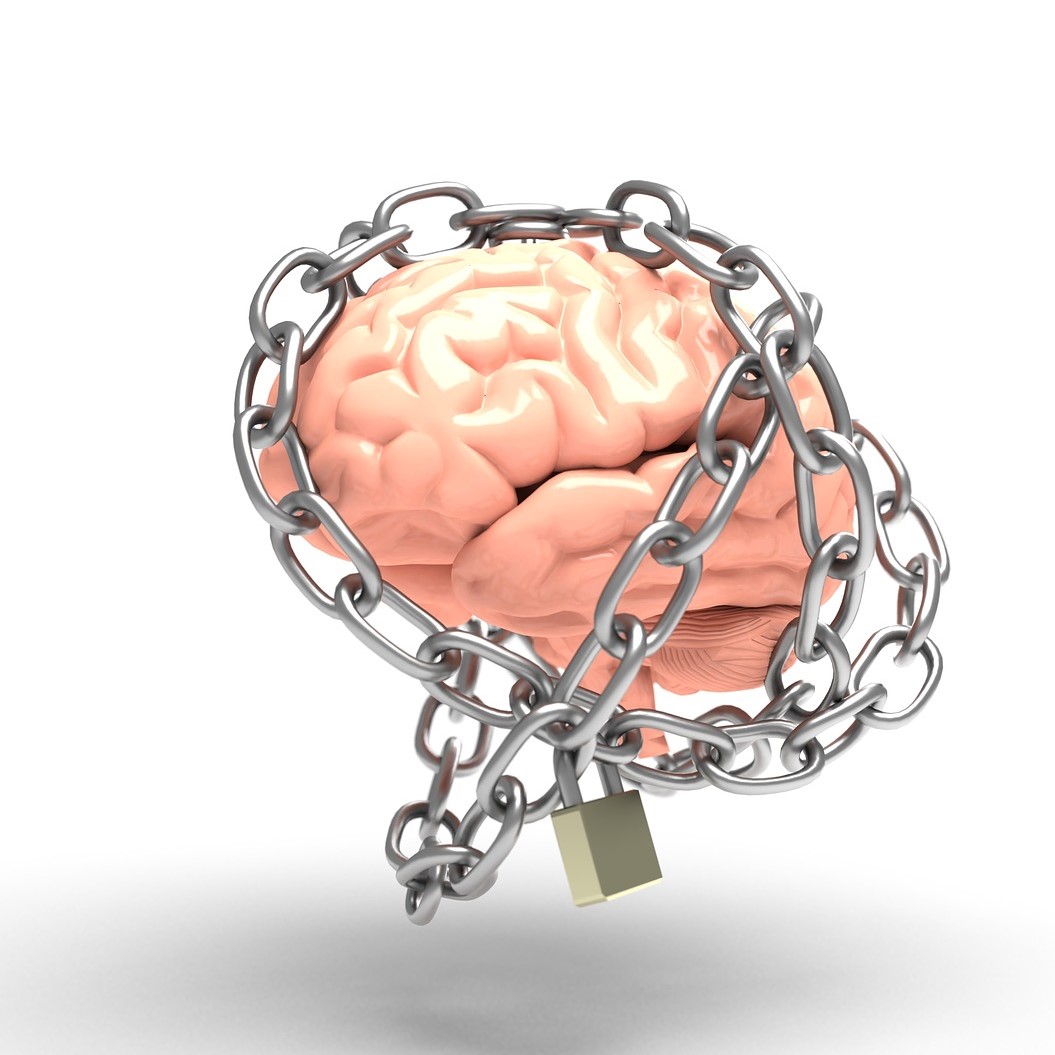 What is this a lower level [of consciousness]? Carl Sagan talked about the development of the human brain: the reptile brain, the mammal brain, the limbic zone, the right and the left hemispheres. . . You can take a look at that in Andean terms as the development of atiy (impulses), khuyay (passions, attachments, emotional intelligence), yachay (thoughts, reason) and munay (love under your will). The human powers. But the lower energy is that of the reptile brain, which makes you a person of the first level. When someone identifies with that, when he allows the lower part of the brain to drive him [the primal impulses], he expresses himself with the lower, least developed aspects of being a human. Other people then identify with that. . . It’s difficult to identify with people who are higher than you in consciousness. You identify with people at your own level or lower.
Yes, you are correct that your level of consciousness expands your impact. But your power attracts those at the same level, and there is power at any level. Part of the characteristic of the zero-level of consciousness is the mob or herd [energy dynamics]. At the first level, to use Hustom Smith’s term, there is the power of the fetish. This can be an individual, like a leader, who people invest their power in. A first-level person can be heavy in and they can have mob mentality too, but they transfer, or invest, their power outside themselves. [That can be onto someone with a lower level of consciousness who they elevate to leadership. That leader is like their living fetish.]
Joan: I can see that happening. It has here in the United States, at least according to some of us. It is happening in Europe, Central and South America, other places. There’s a lot of hucha!
Don Juan: Yes, but hucha is only heavy living energy. It’s survival energy, but very basic. You revert back to being a human of the beginning of our history [like early humans, evolutionarily one step above the apes, driven by survival impulses]. This energy is not evil—it’s hucha. Hucha is hucha! It’s heavy energy.
Don Ivan: You move things with energy, including with hucha energy. You can drive people with hucha. It is just energy. Normally, there are people who express that lower-level consciousness and their hucha to society, and, normally, other people, at higher levels, call them crazy! But in certain unfortunate moments we make them our leaders. They express their hucha and people of the same level identify with that and follow them.
Power is the capacity to do something. In terms of energy, you can use hucha or sami. And you will do it. When you grow on the path of consciousness, you reduce your hucha because you release the heaviness of past mistakes and other things, and that raises the level of your sami. Then your actions will be more elevated. But you can do things with hucha. It’s not a moral judgment. Energy as energy is beyond moral judgment. [Although, what you do as a human being within society is not beyond moral judgement.]
Joan: It’s a challenge to get beyond judgement, especially when a leader’s policies hurt people, cause massive suffering and even death. And when truth and justice fall victim to propaganda, disinformation, and even lies. It seems like politically, at least, we are devolving instead of evolving.
Don Juan: You know what was driving Hitler and others? It was the survival impulse. That is atiy. They want to survive—but in the old-fashioned way, according to the ancient power structures. They were trying to restore a regime that was finished. They were attempting a kind of psychological resurrection. In some places, this is happening again today. There is a big struggle between the old and the new.
Take a look at the book Energy and Structure: A Theory of Social Power by Richard Newbold. He is talking about energy as natural resources, but it applies to how we are talking about metaphysics, about hucha as a kind of energy and power.
But remember, you only can receive what you are capable of receiving. The system of seven levels of consciousness allows you to know what you are capable of receiving in every step. You are not going to go two steps forward, only one—we go one step at a time. And everybody starts at the zero level, remember that. We all do. And at each level what is real for the people there is totally real to them. We cannot argue with that [with what they think is real].
Don Ivan: At the basic level of life for all of us is survival—the will to survive. This is the basic will of the siki ñawi. It doesn’t have to be heavy. In fact, I think it is the energy that triggers every possible thing that can happen or be expressed through or by a human being, starting with our impulses: sex, protecting our territory and our family, all the survival mechanisms. We start there. Then we can grow, if we choose to. We don’t have to. Remember, you can be happy at any level of consciousness. But eventually, because of the energy of our Inka Seed, we feel the pull in the highest direction, what we can say is the search for God, for the numinous. It is not a certainty, but only a possibility, that people will feel that pull and follow it.
Don Juan: Let’s review and approach the problem from the Andean perspective: Kawsay is simply living energy, and energy produces work. Kawsay is [a spectrum from] sami to hucha. They are simply light living energy and heavy living energy. If the action is produced by hucha, it is a heavy action. If it is produced by sami, it is a light action. As an example, a caress and a slap are both totally possible actions, both expressing power. One is the result of the application of sami and the other of the application of hucha. Whether one or the other occurs depends on the quality and intention of the person who executes it.
Joan: Yes, getting back to basics always helps! I feel that both the weighty intellectual discussion and the more practical and simpler discussion have helped me sort through my confusion about hucha and the availability of or ability to wield power. I really get how hucha is power: not a reduction of power as I first thought, but a different expression of power. It’s not as simple an equation as I thought, and, as always, I see how the Andean tradition is applicable to many ways of looking at an issue. Thank you!

 kawsay. This is the runa kawsay pacha, the world of human living energy. [Runa means people or human being.] In that term, human energy is emphasized as a specific part of the kawsay pacha—the energy specifically related with humans.
 down the power of God—it’s like the drink of life. It’s like a trigger of life.
 through our munay and other powers. Let’s talk about this, starting with a general view of connecting in this way.
 between you that is important. Sometimes the image is not so important; it can be a projection or something like that. What we are developing is our ability to perceive energy flows. What meaning you take from it, what it means to you, that is personal because it’s ayni, which is personal.
  conscious or unconscious permission, so it’s just touching you and you decide whether you let it in, whether that intention is conscious or unconscious.
 it was a year that challenged—and perhaps even undermined—our physical health, our economic security, our emotional equilibrium, and our core beliefs and values.
 which we evolve to our highest expression of self here in the human world.
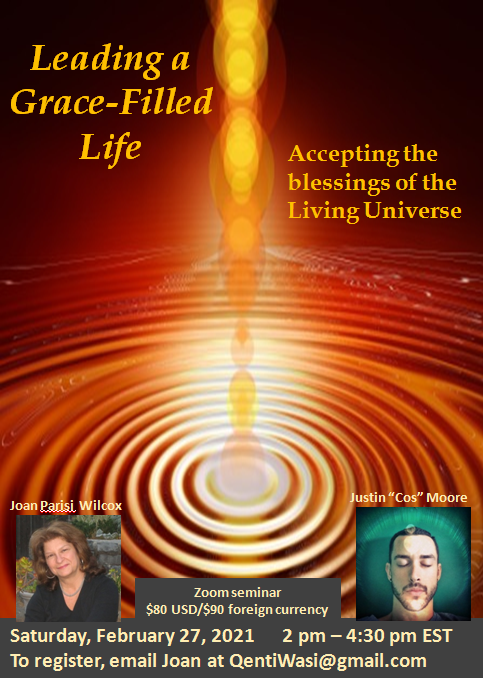 ramifications, I and fellow paqo Justin “Cos” Moore have decided to offer a seminar on this topic: to gather together a group of people who are curious about grace and perhaps ready to invite Creator and grace to work in their lives. If you are curious to know more, I invite you to join us.
 It is a holiday founded upon sober reality (the newly arrived colonists were asserting rights to a land already populated for millennia by others, and the new colonists were suffering terribly) and an unlikely gesture of compassion and cooperation (the Native Americans freely helped those they saw suffering even after being abused by earlier colonists and explorers). An article on History.com explains:
