
“What does it mean to be a paqo?” “Is it okay to call ourselves paqos?” These are common questions asked by people  interested in the Andean sacred arts or who are studying the tradition. They are curious about the different kinds of paqos, how paqos go about their daily lives, what their responsibilities are, and the like. In this post I have gathered together many of these questions and provided my answers to them. The information I provide is my own understanding and knowledge of this tradition, and so nothing I share should be taken as anything more than my opinion.
Question: There are two levels of paqos: pampa mesayoqs and alto mesayoqs. What are the differences?
Pampa mesayoq and alto mesayoq are not designations of “levels,” but simply different kinds of paqos. They practice in similar ways, with a few distinct differences that characterize them as two different types of paqos. Pampa mesayoq can be translated, or understood to mean, the keeper of the earth signs or low signs. Alto mesayoq means keeper of the high signs. Both kinds of paqos share common knowledge, such as of making and offering haywarisqas (despachos), carrying a misha (mesa), healing, and so on. The main difference is that, according to the “old ways,” an alto mesayoq has mystical capacities that a pampa mesayoq does not. For example, alto mesayoqs can “talk” directly to spirit beings, such as an apu (mountain spirit), whereas a pampa mesayoq can only communicate with the spirits indirectly, such as through their misha or dreams. I don’t know if this distinction holds true today, but according to my teacher don Juan Nuñez del Prado, this has always been the main distinction between the two types of paqos.
That said, there is a specific way to think about paqos—both pampa mesayoqs and alto mesayoqs—as having “levels,” because there are stages to their development as paqos. These stages correlate to their accessing and being able to use more personal power. The levels, which are most commonly applied to alto mesayoqs, are: ayllu alto mesayoq, llaqta alto mesayoq, and suyu alto mesayoq. Usually paqos are “in service” to an apu, which is their guiding spirit. The apu teaches them and so helps them develop. All paqos start out in service to an ayllu apu, or an apu whose range of power is limited, such as to a village or town, or a small cluster of them. Hence, they are known as ayllu alto mesayoqs. As they develop their abilities, they may eventually be called by a more powerful apu, usually a llaqta apu, whose range of power reaches wider and farther, encompassing a larger region. Those paqos have reached a stage of development so that their power is equivalent to that of the apu, and so the paqo is recognized as a llaqta alto mesayoq. As paqos continue to learn and grow, they may be called by the greatest of apus, a suyu apu, whose power reaches across a vast region or even an entire nation. Once in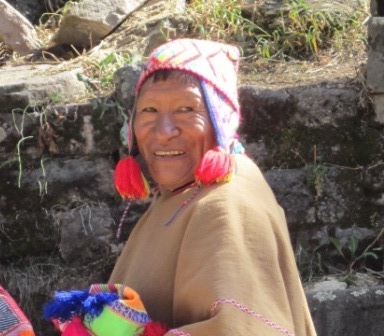 service to this highest level of apu, these paqos are recognized as suyu alto mesayoqs.
There are two more stages of growth. After paqos become suyu alto mesayoqs, they might go on to reach the stage of the teqse paqo, or universal paqo. This is a paqo whose power can reach the entire world. Finally, there is the kuraq akulleq, which translates to something like the Elder Chewer of Coca or the Great Chewer of Coca. To my knowledge, at any one time there is one paqo who holds this position. Kuraq akulleq is a title conferred on an exceptionally wise and highly developed alto mesayoq through the consensus of a community. It is not something a paqo calls him- or herself. Rather, it is an honor bestowed by the community in recognition of that paqo’s expertise and experience and how he or she can serve that community.
Q: Who determines what kind of paqo someone is?
I am sure there are many ways to be called to the paqo path, but from what I have heard from the paqos I have interviewed or talked with (through translation), a paqo is called to be a particular type of paqo by an apu, another spirit being who serves as the representative of the apu, or by Taytanchis/God. When a person feels the call, he or she may go to an already established paqo, particularly an alto mesayoq, to discover if the call is real and, if so, what it means. The alto mesayoq may do a coca-leaf reading or consult with his or her misha, the spirit beings, or an apu to determine if this person’s call is to the path of pampa mesayoq or alto mesayoq. Sometimes, the person will intuitively know which type of paqo he or she is being called to serve as. That person has a choice to accept that call or not. For instance, as one paqo told me, when he consulted an established paqo about anomalous (and challenging) events that were happening in his life, the elder paqo told him he was being called to the path of the alto mesayoq. But this young man did not want the responsibility of being an alto mesayoq. If he was going to learn to be a paqo, he felt he would best fit into the role of a pampa mesayoq. And so that is what he trained to become.
Q: Should we call ourselves paqos? What kind of paqo are we training to become?
Although we might call ourselves paqos, what we mean by this is something different from what that title means in the Andes. For most us, we call ourselves paqos simply as a convenient way to indicate that we are learning or practicing the Andean sacred arts. But we are not literally paqos.
Paqo is a term rooted in the Andean culture. Thankfully, this is a culture that freely shares its tradition and practices. So, we are not in danger of cultural appropriation, for the paqos freely share the tradition. Today, they are almost always compensated for their time and expertise. However, payment does not negate the “ayni” (reciprocity) that truly drives their intent. They feel the energy practices are for everyone: we are all human beings and the goal of the work is to consciously evolve our humanness. However, we are at risk of cultural appropriation if we think of ourselves as either a pampa mesayoq or an alto mesayoq. These are not roles applicable to or recognized within our own cultures, and we risk misunderstanding what we are doing as practitioners of the Andean sacred arts if we think of ourselves as being either of those. An exception might be made if we spend time in the Andes apprenticing with a paqo and that teacher confers one of those titles on us. Still, if we come back to our communities, we no doubt will undertake that role in our own culture in 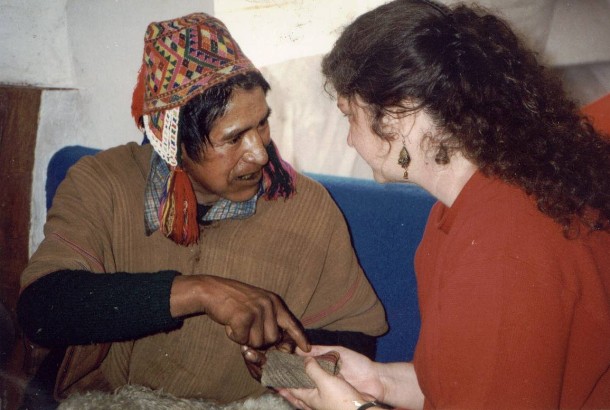 ways that are distinctly different from what it looks like in the Andes.
The bottom line is that we are not training to be paqos except in the most utilitarian sense of using the same techniques that Andean paqos do to foster our ayni and fertilize our personal development. Therefore, calling ourselves “paqos” is mostly just a convenient way to talk among ourselves and acknowledge we are learning and practicing Andean energy dynamics. We likely would not use the term outside of our common community of practitioners since it would be meaningless to anyone else.
Q: What are the duties and responsibilities of a paqo?
Paqos are first and foremost regular human beings, regular members of their communities. They are farmers, herders, weavers, husbands or wives, parents, friends, and neighbors. Their focus is on the duties and responsibilities that occupy daily life. No paqo whom I ever met is engaged full-time in his or her role as paqo. So, paqos are not spending most of the day communing with the spirit beings or performing rituals. They are going about their mundane daily lives until someone needs them to serve in their paqo capacity. What is that primary capacity? To serve their community.
Being a paqo means a person has knowledge and skills (and hopefully wisdom) that are above and beyond those of other community members. Although most Andeans understand and practice ayni and know how to make a despacho and so on, paqos are specially trained. When they are serving in their paqo capacity, they might be doing any number of things. While they may perform a ritual such as a despacho or undertake a healing, mostly they offer advice or solutions to people’s problems, sometimes gaining insight into the problem and the solution by throwing and reading the coca leaves. They may lead life-transition ceremonies such as the hair-cutting ceremony or some other coming-of-age ceremony,. They might lead a festival on a holy day or perform blessings for a wedding or death. Most of what they do is not “mystical” or “shamanic,” but practical. If I were to choose one primary responsibility that a paqo has it would be to foster social cohesion. That in turns helps ensure the well-being of all the members of the community. Don Benito Qoriwaman called the mountain spirits, the apus, the Runa Micheq, the shepherds of human beings. That, too, is the primary duty of an Andean paqo.


 is reached. Then the arc curves downward, with a continuing reduction of sami, which we can see as hucha in that it is the slowing of life-force energy. Finally, the physical life force is extinguished. A seed geminates, a seedling grows, a plant flourishes until it reaches the apex of its growth, perhaps flowering and fruiting, and then slowly, over time, it begins to lose life force, until it collapses to the ground and its physical constituents are reabsorbed into the earth. We are in relationship with Mother Earth in the same way. She is one of the tawantin of powers that support and sustain the body in which we exist. When our life force is extinguished, our body returns to her. She asks nothing of us during this cycle of life.
 is the Self, the core “I” that is both our humanity and our divinity. To use the Hindu terms, it is both Atman (God Within) and Brahman (God Without). We literally use intention to move our Inka Muyu outside of our body and plant it in the earth. Once in the ground, Mother Earth helps fuel our Inka Muyu’s development. We could say she is fertilizing it with her sami. What she is really fertilizing is our capacity for self-inquiry, self-awareness, clarity of intention, and efficiency of action—all the aspects of the self that help us climb the qanchispatañan, the stairway of the seven levels of human consciousness. According to the tradition as passed on by don Benito Qoriwaman, we are under no obligation to develop ourselves. However, if we choose to, we can refine our consciousness and energy until we reach the sixth level of human consciousness—that of the enlightened human being—and even the seventh level—that of a human with godlike capacities. We do not undertake the process of our expansion alone. Mother Earth lovingly helps us.
 excited the anthropologists who were there. They had not heard this term before, and so they probed the Q’ero for more information. What we learned is that they make a distinction between two energies in a person’s or spirit being’s energy body: k’ara and sami. In this post, we take a deep dive into k’ara and its significance.
 things, such as heal. (To understand the following quotation, you need to know a bit about the paqo he uses as an example: don Andres Espinosa. He was deceased by the time of our interview, but had been one of the top Q’ero paqos. In fact, he was a rare kind of paqo—a chunpi paqo, which is a specialized kind of paqo known for having especially powerful healing skills.) Don Juan Pauqar Flores said, “The moon has k’ara. The apus have k’ara, and by calling the k’ara of an apu you can heal a person. Don Andres Espinosa healed diseases by invoking the k’ara of the apu. The apu has more k’ara than a paqo. My master, Andres Espinosa, healed by invoking the k’ara of the condor and the apu. But I do not believe that ordinary men have k’ara.” The other Q’ero paqos concurred: “Only great men [or women] have k’ara.”
 condors in the group do not. There was further disagreement about whether the k’ara of the condor apuchin glowed red or white (with white being the likely color). The k’ara as the visible energy of the apus comes in different colors, according to that apu’s “quality,” which we took to mean power. The highest quality energy is white, followed in descending order by red, yellow, and black. The k’ara of an apu also
 supernatural is inexcusable—it is “magical thinking.” Yet, I prefer to think of what is called the “supernatural” not as inexplicable but as anomalous. Something that is an anomaly deviates from the normal, known, or expected. Science itself progresses because of anomalies, which hover on the border of the known and unknown. They not only draw attention but often beg for explanation. Discoveries frequently are made because during an experiment some parameter deviates from the likely or expected result or range, and then the scientists engage their curiosity and keep probing. Sometimes that probing leads to a eureka moment—something that was formerly unknown becomes known. Over time, it may become accepted and even incorporated into the mainstream. What was once above or beyond nature reveals itself to be an aspect of nature.
 In fact, I cannot even call what mystics and shamans experience occasionally as “anomalous,” for the ways of the liminal realms—those “in-between” realms in which we most often work— may be mysterious but they are played out in what is our normal operating theater. Their liminal nature intersects with our more mundane world, so the separation between “there” and “here” eventually blurs. What appears to be a “magical” event to those who don’t know how to work or live in shamanic or mystical ways is considered more or less normal for those of who do.
 As an example of the universe “reaching out,” consider this example. I was talking the other day with a friend, recounting an experience of this sort that I had not thought about in decades. Back in the early 1990s, I was gathered with a small group of friends in a shamanic drumming circle. We each drummed and undertook a shamanic journey. During mine, at one point, apropos of nothing, I heard the “message” that I needed to acquire the feather of a sandhill crane. What? I wondered if there was such a creature and, if there was, why I needed one its feathers. After the circle, we gathered to share a meal, and during conversation I mentioned that I had received this “message.” The man whose house we were at listened, got up and left the room, and a few minutes later came back with a tawny-colored feather about ten inches long. It was a sandhill crane feather, and without a word he handed it to me as a gift.
 world. We then might begin to loosen those restrictions. We previously may have attached to the belief that such experiences are random events from which we, in our illogic and scientific naiveté, are assigning a superstitious meaning. From our family, religion, science, education, society, and culture, we absorbed the idea that rationality and logic are among the highest of human qualities. They told us (and many continue to tell us) that belief in the liminal is magical thinking. However, when we expand our awareness and begin to experience the liminal, we soften the hold of such restrictive beliefs. We make room for curiosity. We could retreat almost immediately into denial of our experiences, but most of us become intensely curious.
