
In last month’s blog, I discussed some of the qualities, characteristics, similarities, and differences (and mysteries and paradoxes) of the kawsay pacha, kawsay, and sami. I ended by musing about the nature of sami (the light living energy) versus k’anchay (visible light). Here I will become even more speculative as I  consider the mystical implications of k’anchay. K’anchy as visible light is reducible to photons, and the nature of light/photons is an immensely interesting (and paradoxical) study. Taking even a brief look into it can bring us full circle: from the unmanifest realm of the Kawsay Pacha to the manifest material world of the Pachamama and sami and k’anchay, and then back to the immaterial Kawsay Pacha.
The photon is the smallest “packet” or “quanta” of light energy. A standard interpretation among physicists is that light (or the photon) has, like most quantum entities, a dual nature as both wave and particle.* They say it really is not either a wave or a particle until a measurement is made. Or, alternatively, it is a superposition—it is both wavelike and particle-like at the same time until its wavefunction is “collapsed” and it reveals itself singularly as having the characteristics of either a wave or a particle. This quality of being indefinable or essentially unknowable before it is apprehended in some way and takes on distinct qualities is rather like kawsay (the living energy): it is both being and non-being.
Another way that k’anchay, as light or photons, shares similarities with kawsay is that neither a photon nor kawsay has mass, but both have energy. They have energy because neither is ever at rest. Kawsay’s nature is to move unimpeded, and light’s movement dictates the universal constant of motion (in a vacuum): the speed of light, or 186,000 miles per second. As Einstein said, “Nothing happens until something moves.” Currently physicists tell us that theoretically we can approach the speed of light, but nothing that has any mass can ever reach the speed of light. That’s because the acceleration to reach light-speed would require an infinite amount of energy. At the speed of light, there is no space or time. So, there is no duration, distance, or direction of motion. At the speed of light (and perhaps of kawsay), the universe collapses down to . . . what? Nothing that we can define without using metaphysical language. Kawsay and light (from their perspective, rather than ours) exist in what amounts to an unmanifest, dimensionless, atemporal state. Theoretically and mystically speaking, it might be as accurate to say that kawsay and photons are nothing, nowhere, never as it is to say they are everything, everywhere, always.
Another correlation is that Andean paqos say that everything is made of kawsay (or sami as an expression of the most refined kawsay) and scientists tell us that everything relies on photon interactions. The paqo view is that without kawsay or sami there would be no manifest world and, thus, no physical life. Scientists reach the same conclusion about the primacy of photons. Without photons there would be no mass. Photons create the electromagnetic force, which means that without them there would be no atoms. Atoms are the foundation of chemical elements. Without chemistry, there is no life. Therefore, without kawsay and without photons there would be no manifest universe.
I have mentioned only a few of light’s/photons’ characteristics (and even paradoxes) from our perspective. But what is reality like from a photon’s perspective?
I first came across this provocative question in a book by astrophysicist Bernard Haisch. His astronomy-focused scientific research had stoked his curiosity about the nature of light. The deeper he probed into the nature of photons, the more he began to stop resisting beliefs he previously would have labelled as outlandish, or even kooky. One of the core beliefs that arose from his thinking about light (photons) is that consciousness must be prior to matter. (See his book The God Theory: Universes, Zero-Point Fields, and What’s Behind It All.) While his question about a photon’s “perspective” blatantly anthropomorphizes photons (as he acknowledges) and must be cast in metaphoric language (as he acknowledges), it nevertheless sets us up for an interesting thought experiment. (He is not the only scientist who has asked the following kinds of questions about the nature of photons.)
Haisch explains that if we look up into the night sky and see a dim object such as a distant star or galaxy, the reason we are seeing it at all is because photons of light from that star or galaxy travel through space and are absorbed into our retinas. Our brains then interpret that flow of electromagnetic energy to construct an image. He uses the example of looking at the Andromeda galaxy. According to clock time, that light takes two million years to travel from Andromeda to our retinas. When the electromagnetic signal is processed by our brains, we see the faint flow of that galaxy.
Now flip the scenario around to the perspective of the photons. What would photons experience?
Haisch writes, “For a beam of light itself, however, things look different. Instead of radiating from some star in the Andromeda Galaxy and racing through space for two million years, every single photon sees  itself, metaphorically speaking, as born and instantaneously absorbed into your eye. It is one single jump that takes no time at all, according to the theory of special relativity. That’s because, in the reference frame of a particle traveling at the speed of light, all distances shrink to zero and time collapses to nothing. From its own perspective, the photon of light leaps instantaneously from there to here because distance has no place in its existence. We can almost say that the photon was created because it has someplace to land and, in an instant, it jumped from there to here, even across two million light years of space from our perspective.”
Once we fully absorb that scenario, we might ask, as Haisch does, “Is it even possible for a photon to exist if it has no place to go?” This question, he says, is “unresolved in both physics and metaphysics.” But he maintains that “there must be a deep meaning in these physical facts—a deep truth about the simultaneous interconnection of all things. . . .”
Haisch has come to believe that there is an unmanifest realm that is First Cause and that the manifest realm is a subtraction from it. Additionally, he presupposes that there must be a Creator Consciousness—God if you will, although this is an Unmanifest God that is beyond human conceptualization. He further concludes (as do Andeans mystics and the mystics of other traditions, and even some scientists) that consciousness is the driving force of creation, and so consciousness is more fundamental than matter.
Haisch’s speculation makes me think of a line from the song “Sleeping at Last,” by the Palestinian group Saturn: Perhaps “the universe was made just to be seen by my eyes.” Interesting metaphysical speculation. . . . There actually is a lot to say about this idea in terms of the Andean concept of ayni (energetic interchanges, reciprocity) and qaway (clear-seeing, simultaneously apprehending both the metaphysical and physical realms), but space prohibits me from taking you down that rabbit hole except in the most superficial of ways.
Drawing together the points I have made in these two blog posts and wrapping up all this speculation, we could say, along with other mystics and scientists such as Haisch, that the nature of the unmanifest realm (the Kawsay Pacha) is a creational essence (God, Consciousness, Source, the All That Is) and the creational force is kawsay, or the life-force. The photon is similar to sami in that it is foundational to there being a manifest, physical world. Movement from the photon’s perspective also is similar to the flow of sami and the relational interaction of ayni (reciprocity, energy interchanges). Both sami and ayni operate in nonlocal ways. Nonlocality means that certain entities are connected (“entangled” in the parlance of physics) in ways that are not subject to the constraints of time and space. Thus, there can be instantaneous correlations between two entities that were once in contact but have become separated. No matter how far apart they are, they can instantaneously respond as a pair even though there is no known type of information-bearing signal passing between them. What happens to one affects the other regardless of whether they are separated by three inches, three feet, three miles, or three light-years.
From the perspective of mysticism, this is true of us. We are, to once again paraphrase Sri Aurobindo, where God-Spirit meets God-matter, and our separation from Creator is an illusion. Through ayni, which is an exchange (and feedback loop) of intention/consciousness, we are in an instantaneous nonlocal and reciprocal relationship with the living universe, with whatever “God” is in the unmanifest and manifest realms. Our ayni in the physical world may also be nonlocal, but until we have reach advanced levels of consciousness (fifth, sixth, and seventh levels), we do not yet have infallible ayni, and so we can at best only influence the material world, not change it or control aspects of it. (We occasionally may be able to change or control something in the physical world, just not consistently; certainly not infallibly, as can those with more perfect ayni. For most of us, it’s hit or miss.)
All of this speculation is just that, of course—speculation. But it is perhaps one reason to admire the way don Juan and don Benito explained who we are as human beings and as metaphysical beings: we are Drops of the Mystery. Perhaps the manifest realm is, as so many mystics say, the way that Creator knows itself. To have any sense of Itself, It must split into an Other. We are part of that Other, while simultaneously being part of the originating Creator. I tell my students that if we think of ourselves in this way, the momentous consequence is that in the flow of ayni, we are the feedback to Creator’s ayni. Ayni is a process of intent, followed by action, followed by feedback. How would you perceive yourself and your life differently if you granted legitimacy to the premise that you (and every aspect of how you are in life)  are Creator’s feedback about one aspect of its own True Nature?
Acceding to this premise, we can better understand how the universe was created just to be seen by our eyes. Each of us is the center of the universe! This point of view might motivate us in our mystical practice to learn mastery of the self: to be able to absorb everything in “reality” without rejection so that we can live as a being who radiates the All. In other words, to master ourselves is to perfect our ayni so that someday we achieve the sixth-level of consciousness, that of the enlightened human being. And as a literally “enlightened” human being, as a physical-mystical being of pure sami, each of us would visibly glow with k’anchay.
When we are perfect absorbers of sami and so glow with the light of k’anchy, we would live as what and who we truly are: an aspect of Creator. We would have all the abilities of Creator available to us here in the human world. The Andean prophecy of our creating a “heaven” on Earth allows us to understand that achieving such a state of being requires that we achieve a japu in our yanantin nature. Yanantin means the complement of the differences, which when harmonized creates a Whole or Unity (japu). The Whole in this context means that we realize and live from both our God-nature and our human nature in a perfectly integrated, harmonious way. In the view of science, we would be a superposition: expressing both our wave nature and our particle nature simultaneously.
Many mystical texts and adepts express this same relationship far more poetically. As I have already pointed out, don Juan Nuñez del Prado and don Benito Qoriwaman said, “We are drops of the Mystery.” The Indian mystic Kabir reveals the entangled, nonlocal relationship embedded in that metaphor: “All know that the drop merges into the ocean, but few know that the ocean merges into the drop.” I believe that these musings about the relational energy dynamics of the Kawsay Pacha, kawsay, sami, and k’anchay lead us to this same truth.
 everything is comprised of this living energy (kawsay), and while we can perceive it, we can never truly know what it is and from where it emerges.
  the sacred to the Earth (and the material cosmos), whereas Mama Allpa is the termed used in the more mundane context of the land in which Andeans plant their crops and upon which their animals graze.
 radiant. Don Juan confirmed that generally sami is equated not with visible light but with an essence of being. However, a person who is a master of sami and so has evolved his or her consciousness would perceptually reveal this lightness of being through k’anchy—by radiating visible light.
 perfect absorbers of this energy. That is exactly what the Andean tradition teaches us to do.
 dance, and laugh. Creativity—the playful and the sacred—is a part of their sense of sumaq kawsay—living a good and happy life.
 Moon. That first touch was sweet. I was in awe of how real this connection felt. I guess, so early into my training, I was not expecting to really feel Mama Killa as an actual hanaqpacha being. That awe inspired both respect for Mama Killa and a bit of shyness on my part. Decades later, our relationship changed because I had changed. Energy connections had become a common reality, and I was more in touch with how Mama Killa is a bridge from the hanaqpacha to the kaypacha. I was more in touch with how my physical, human self is sacred in its own right. Under the northern California redwood trees with the moon streaming down here and there through the towering canopy, I felt liberated in a kind of fierce kaypacha moon madness.
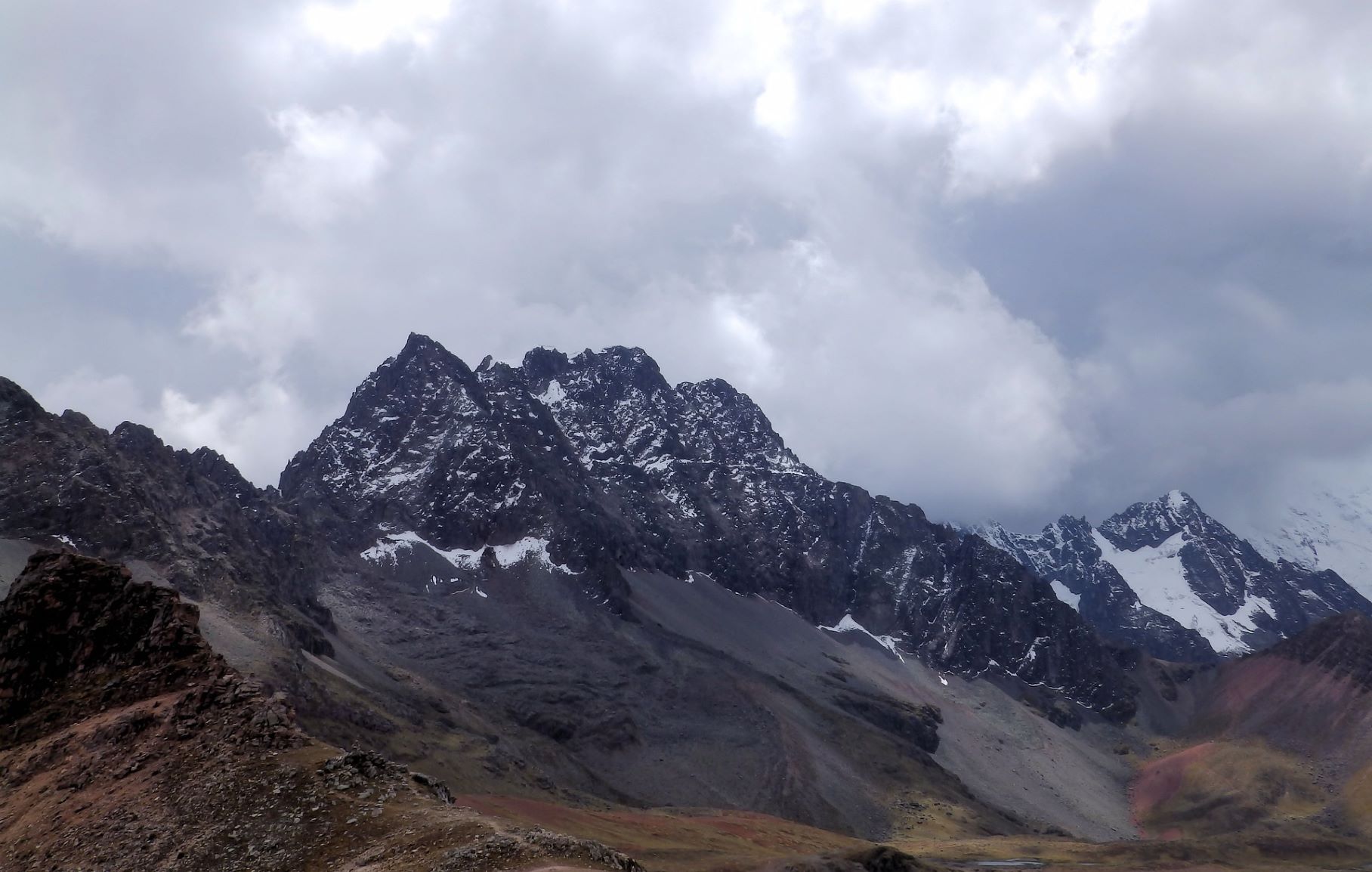 Apu means “Lord” or “Honored One.” The giant snow-covered peaks of the Andes certainly command our attention and respect. My studies in the Native North American tradition had also helped me connect with sacred mountains. In the Native North American tradition, I had come across the phrase “sit like a mountain.” I had learned to meditate at age 17, and over the decades in that practice I had sat still—a lot! But the Andean mountains felt different. They did not seem to me to be about stillness. They seemed to be saying, “Move! Grow! Rise up so you can look me in the eye!” These Andean apus both inspired and confounded me. The Andean way is to be fully engaged in life, not necessarily to “sit like a mountain”—solid, resolved, and still. Introspection is a doorway into the self, and so is not itself a fully static practice, despite the many forms it takes that depend on outer and inner stillness. It seems my two practices were at odds, and all of these thoughts came together in this poem.
 I love Mama Qocha, Mother Ocean. The creatures who crawl along her shore and those who fly above her are each inspiring in their own ways. During a solitary walk along the Florida shore at dusk, the dozens of brown pelicans wheeling gracefully and effortlessly through the sky surely were inspiring, although momentarily, as they landed in a flock, they also became harsh mirrors.
 What’s a collection of poetry without a love poem? The Quechua word munay means both love and will. It is a kind of love that is grounded in reality, yet informed by spirit. It is a kind of love that requires qaway (vision of physical and metaphysical “reality”). Like most Westerners, I learned of love mostly within the realm of romance. Romantic love too often has only a tenuous connection with “reality,” as it tends to be enmeshed with sentimentality, desire, and projection. But after decades of practicing Andean mysticism—and a lot of personal psychological shadow work—my view of love is a lot different today than it was when I first fell in love. Let’s just say my qaway about munay has matured! Although, to confess a truth, despite the claim in this poem, I am still a bit sentimental.
 bad things get in our lives, we eventually return to our individual set point of happiness. For example, many people dream of the day they will be financially stable or even wealthy. How happy they will be! But the evidence does not support this belief. Multiple studies show that people who have gained sudden wealth, such as through winning the lottery, are happier for a while, and then their response levels off. Sooner than we would think, they report that they are not really that much happier than they were before their financial windfall. Most of us do not experience such windfalls. However, the same happiness dynamic occurs in the more common occurrence of a gradual rise in income. Surely, we tell ourselves, we will be happier when our income increases. However, studies showed through self-reported “happiness levels” that people were happier, and remained that way, only until they were making a yearly salary of about $70,000. At higher income levels, people reported that they discovered they were not much happier than they were when they made less money. While the $70,000 income level might be dated, the premise holds. More money thrills us for a while, and then we return to our inner set-point of happiness.
 that we can be), the odds are that we are finally ready to say “Enough!” We finally lose patience with those aspects of ourselves that have been leading us astray from knowing, accepting, caring for, and taking responsibility for ourselves and our lives. As motivational coach and author Kevin Ngo so aptly says, the sacred truth is that “if you don’t make the time to work on creating the life that you want, you’re going to spend a lot of time dealing with a life you don’t want.”
 consciousness I live from. Changing my life is not about setting it right, but seeing it right. Inner transformation must occur before outer change is possible.”
 Seed, we are led to a conclusion that is astutely expressed by novelist and philosopher Ayn Rand: “The question isn’t who’s going to let me; it’s who is going to stop me.”
 matter.” We have the potential to express our God-Spirit right here on Earth in this singular human lifetime.
 reduce ourselves and limit what we can bring to the world. We should make no excuses for our present state of grandeur. And I do mean grandeur! That is a word—along with “glorious”—that I purposefully use with my students, because that is what the training in Andean mysticism is all about: growing our grandeur, becoming more and more glorious. We should have no false humility about what we have far so developed within ourselves. Taking responsibility for ourselves means truly owning all of who we are while also being honest about how much more there is within us that remains to be developed and expressed.
 Q'enti Wasi - House of the Hummingbird