
I and a fellow paqo, Christina Allen, have been holding a series of discussions online with don Juan Nuñez del Prado and his son don Ivan, who are our primary teachers. These discussions have been wide-ranging and deeply engaging—and enlightening. As always, my focus is to bring this information to those of you who have studied with me and Juan, and with others, since much of this information has not found its way into our trainings because of time constraints. So this is the first of what will be a series of interviews with the maestros about the Andean mystical tradition. Today, our focus is on qaway, which is mystical seeing and part of our capacity to perceive energy.
Joan: A lot of our work in Peru, for example, during the Hatun Karpays, is connecting our energy with the spirit beings and sanctuaries, the places of power. We do saiwachakuys or saminchakuys to pull energy to us or we send our energy out and connect  through our munay and other powers. Let’s talk about this, starting with a general view of connecting in this way.
Don Ivan: When you share energy through a seqe, connect with a sanctuary or something, you establish a connection and you will always have the energy of that place with you. You are always connected. You can trust that! It’s like an electrical wire: you turn on the switch and electricity runs, and you trust that to happen. It’s the same with seqes to sanctuaries [or other things]. Of course, the connection and flow depends on the quality of your ayni, but that sanctuary can be a source of light living energy for you.
Don Juan: We do not work alone. During a saminchakuy you receive the support, the sami, of Father Cosmos and you release your hucha to Mother Earth. You are creating a personal relationship with them. In saiwachakuy, Mother Earth returns her energy to us. But we also can take sami from anywhere and everything, as nature is only sami.
Sami is a kind of kawsay, of living energy. Sami is light living energy. But when the masters taught us, they didn’t use the word energy; they used the word kawsay. We translate this into our own culture and everyone uses the word energy. They have their own preferences. That’s okay. But everything has its own configuration of sami, like frequencies of energy. The difference in energy configurations is like the difference between a lemon and a lime: they are close but different. So each material thing has its own configuration. The concept is not hard, and our work is not hard. It’s just nurturing what is already inside you and what is happening with the energy flows.
Joan: A lot of students ask about imagery they receive when they feel a connection with a power place or are running a flow of energy. I tell them it’s personal. It may be something important or it may be a projection or story they are creating, so not to get too hung up on trying to analyze or interpret it. Stick with the energy perception, not the image. Am I wrong to advise them in that way? What do you think about imagery?
Don Juan: Images of the tradition are based in bubbles—in Quechua poq’pos—and cords or seqes. You are the center of the seqes. You are responsible for them. With saminchakuy and other energy practices, you might have an image, but the kind of image you see or the visual perception you have is not so important. Having the [energy] perception is! It’s the fact that you can perceive what is flowing between you that is important. Sometimes the image is not so important; it can be a projection or something like that. What we are developing is our ability to perceive energy flows. What meaning you take from it, what it means to you, that is personal because it’s ayni, which is personal.
Don Ivan: It’s like a dream. I can help you in understanding the dream, the process, but you have to figure it out for yourself. The meaning has to come from you. The meaning is in yourself. We all have our own symbology, and the code is in the person.
Joan: What about if someone sees an entity or something? Usually that can be frightening. But let’s say you hold your fear in check and are energetically curious. How would you work with that spirit being or whatever it is?
Don Juan: We have some rights that we need to be aware of. If someone [an entity] shows himself to you, you have the right to know his name. The first thing you need to do is to ask the being: “Who are you?” Then ask: “What do you want?” Sometimes they come because you need to do something for them and sometimes they come to give you something. “What do you want with me?” That’s it, very practical. And if it feels heavy to you, you have a choice. You can leave it alone. If something is heavy for you, you need to trust yourself. It’s heavy for you! That is all. Even if your big teacher comes to you and says, “It feels light.” No, it’s heavy for you. The Andean tradition is very grounded, not a metaphor. It’s real, it’s grounded. It’s practical.
Don Ivan: But remember, things are not only heavy or light. There are nuances. From the heaviest energy, the slowest energy, to the lightest energy. It’s a spectrum. You can’t see the world in black or white. That can be a big mistake. Because you lose everything in between, which is most of reality! Nothing is perfectly heavy. Your perception will tell you what the quality of energy is. There are gradients. A whole spectrum.
Joan: What if a student or someone new to the path is not able to perceive energy flows, even though they practice and try to develop that capacity?
Don Juan: When a person is not perceiving anything, you can use the misha on the head to pull sami into that person and then they can try again. If you don’t have a misha, you can use any sacred tool. Usually, and this is a general comment, the lack of perception indicates that person has erected boundaries or has a fear of opening their poq’po to incoming energies, sami and other energies. They may have a fear of life, relationships, enjoyment, growth. Sometimes that is the problem.
Don Ivan: Fear closes us. When you are afraid you close up everything and try to save yourself in the most instinctive way that you have. You close every possible access of any kind of energy that can touch you and mentally you are in your head. As you grow, you get afraid less often. Things are not going to touch you in the same way.
Don Juan: Take the practical way. Are you going to receive every energy that comes to you?
Joan: I might feel it, but I don’t have to choose to interact with it. The teaching is that nothing can enter your poq’po without your  conscious or unconscious permission, so it’s just touching you and you decide whether you let it in, whether that intention is conscious or unconscious.
Don Ivan: Yes. The thing is that when you are not yet developed, unconsciously you are going to allow more energies to come in that [feel heavy to you.] You let in things that affect you.
Don Juan: What you need to do is be in control of the kind of energy that you interact with. Energies are there. But you have a filter. And sometimes you want to close [your poq’po]. You don’t want to receive this energy. We have an automatic sense about what energies we are receiving that our bubble cannot digest. You trust yourself.
Joan: Energy is just energy, and what it feels like is in relation to your own energy body. Hucha can’t hurt you, although it can frighten you if it feels heavy to you. Correct?
Don Juan: Hucha is heavy living energy. It’s survival energy, but very basic. It’s not evil, just hucha. Hucha is just hucha! We avoid thinking in black and white [good and evil]. What you feel as heavy or light is subjective; it depends on your level of consciousness. When I face something I don’t know [that feels heavy], I ask to my God or my Inka Seed, “What’s going on?” If you ask, you are going to receive the meaning, the teaching.
 it was a year that challenged—and perhaps even undermined—our physical health, our economic security, our emotional equilibrium, and our core beliefs and values.
 which we evolve to our highest expression of self here in the human world.
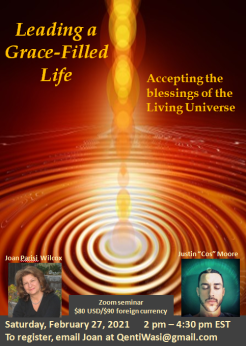 ramifications, I and fellow paqo Justin “Cos” Moore have decided to offer a seminar on this topic: to gather together a group of people who are curious about grace and perhaps ready to invite Creator and grace to work in their lives. If you are curious to know more, I invite you to join us.
 It is a holiday founded upon sober reality (the newly arrived colonists were asserting rights to a land already populated for millennia by others, and the new colonists were suffering terribly) and an unlikely gesture of compassion and cooperation (the Native Americans freely helped those they saw suffering even after being abused by earlier colonists and explorers). An article on History.com explains:


 teaching from a paqo about it. But as I contemplated this question, I came to see a possible Andean mystical approach to forgiveness.
  tat—before forgiveness occurs, then you are restricting the possibilities of what can occur. You might be keeping these possibilities limited and small. As so many psychologists tell us, forgiveness is not dependent on atonement by the person whom you feel has harmed you. It’s not even about that person making amends. No matter how wronged you feel, you are not judge and jury in relation to the other person. Well, perhaps you are if you are operating only at the level of the material world. But in terms of the spiritual or metaphysical realms, forgiveness is a change in yourself, not any kind of compensatory action by the other person. Why is this so? Because, according to so many philosophers, forgiveness is an act of grace—for the self and the other. Grace is not something that is earned or deserved. It is not something you bestow on the other, some kind of absolution. It is a state of being you cultivate within yourself that creates space for release and completion. It is a choice about your preference for the condition of your own inner landscape. Grace is the condition through which you will discover your own power of munay: that your love—or forgiveness—is an energy subject to your will.
 change the past, and surely not the reality of the pain that caused you to reject the other person or be rejected by him or her, but the universe provides you a clean slate in every moment. The word forgiveness means “to give,” not “to get.” It is something you give yourself. Like munay, it is a choice. Although reaching a state of genuine forgiveness may take time, you only have to practice in this moment, and the next moment, and the one after that. In your progression, you likely will experience a lessening of emotional intensity and a gradual lifting of heaviness. You may move from loathing to resentment, then to regret, and to disappointment, and to sadness. Eventually you may feel an acceptance of the reality of the situation that is stripped of the cloak of emotion: what happened happened.
 Q'enti Wasi - House of the Hummingbird