
Don Juan Nuñez del Prado, my primary teacher, calls the Andean tradition the “Andean sacred arts.” Paqos practice the sacred arts. However, art of all kinds flourishes in Andean culture. For example, the Q’ero create intricate weavings, have a distinctive musical style, and rarely pass up an opportunity to sing,  dance, and laugh. Creativity—the playful and the sacred—is a part of their sense of sumaq kawsay—living a good and happy life.
This month, I thought I would bring some art to this blog. So, I offer a tawantin of poems. Offering one’s art to the world can feel risky—doing so might stir up all kinds of vulnerabilities—because our art is so personal. To overcome our resistances, we can engage our khuyay—our passion and our motivation to share our passions. As I take a risk here in offering some of my art—in the form of poetry—I hope you will be inspired to unleash the artist within yourself. Whatever your creative expression is, I hope you, too, will take a risk and share your gifts with others.
As I started along the Andean path, one of my first connections was with the spirit of Mama Killa, Mother  Moon. That first touch was sweet. I was in awe of how real this connection felt. I guess, so early into my training, I was not expecting to really feel Mama Killa as an actual hanaqpacha being. That awe inspired both respect for Mama Killa and a bit of shyness on my part. Decades later, our relationship changed because I had changed. Energy connections had become a common reality, and I was more in touch with how Mama Killa is a bridge from the hanaqpacha to the kaypacha. I was more in touch with how my physical, human self is sacred in its own right. Under the northern California redwood trees with the moon streaming down here and there through the towering canopy, I felt liberated in a kind of fierce kaypacha moon madness.
Dancing for the Moon
By Joan Parisi Wilcox
© 2024 All rights reserved
Dancing for the moon
is dangerous
now.
My cycles have stopped
and the nimbus of a long-lived life
illuminates a self
unafraid
of fierceness.
No supplicant here.
No shy worshiper of reflected light.
No feet afraid of tangled roots
or eyes seduced by shadows.
You, moon, do not intimidate me
with your shapeshifting ways
and that face cratered by legend and lies.
Although I am an admirer, Moon,
I am no fool.
I have crawled from caution’s womb
and, still somewhat bloodied, set myself
free
to dance in this wilderness
of shadow and sparkle,
with you looking
down,
a bit haughty,
and, no doubt, a bit dazzled.
I know. I know.
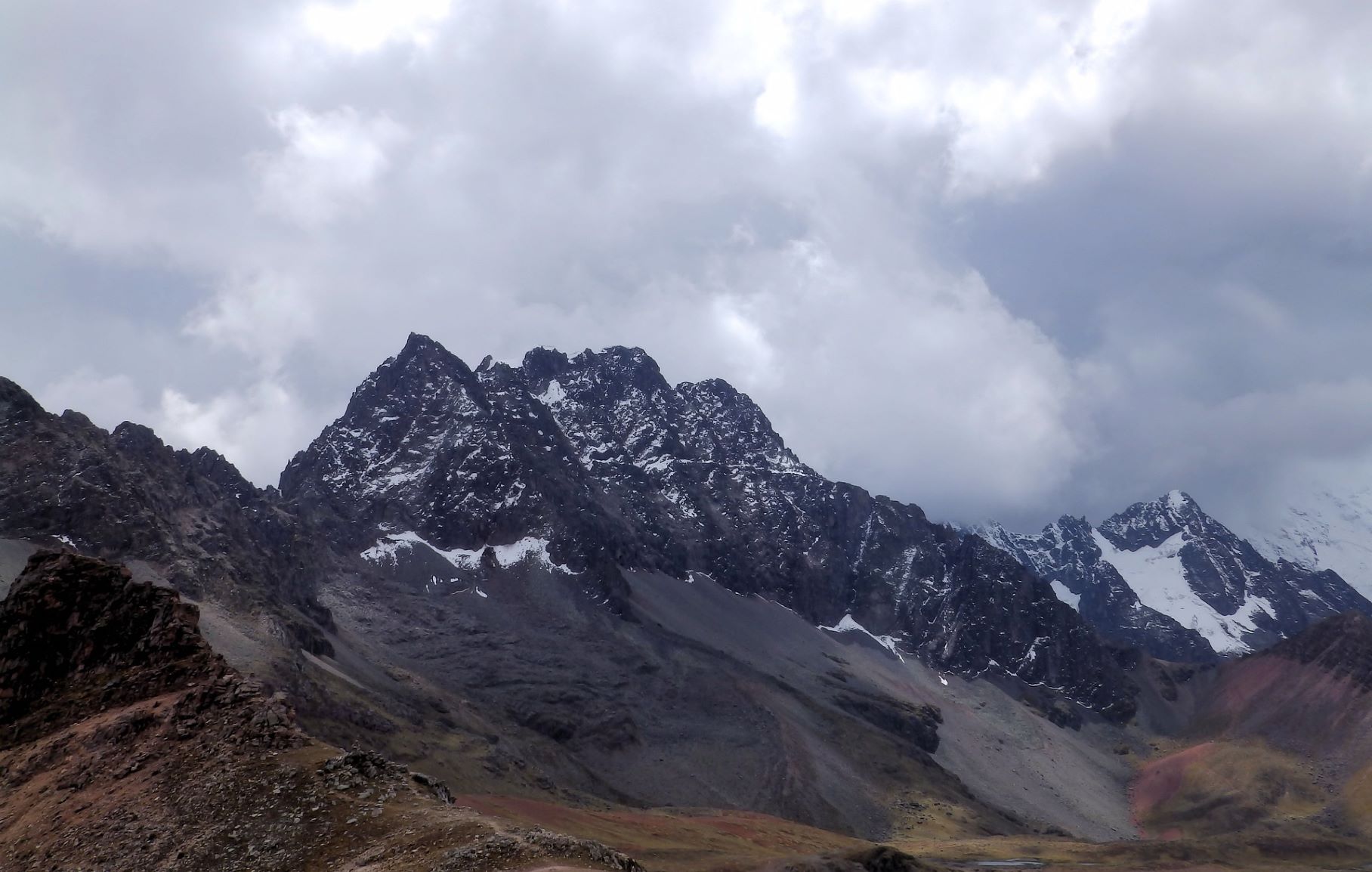 Apu means “Lord” or “Honored One.” The giant snow-covered peaks of the Andes certainly command our attention and respect. My studies in the Native North American tradition had also helped me connect with sacred mountains. In the Native North American tradition, I had come across the phrase “sit like a mountain.” I had learned to meditate at age 17, and over the decades in that practice I had sat still—a lot! But the Andean mountains felt different. They did not seem to me to be about stillness. They seemed to be saying, “Move! Grow! Rise up so you can look me in the eye!” These Andean apus both inspired and confounded me. The Andean way is to be fully engaged in life, not necessarily to “sit like a mountain”—solid, resolved, and still. Introspection is a doorway into the self, and so is not itself a fully static practice, despite the many forms it takes that depend on outer and inner stillness. It seems my two practices were at odds, and all of these thoughts came together in this poem.
Sit Like a Mountain
By Joan Parisi Wilcox
© 2024 All rights reserved
Taking inspiration from
a mountain
is delusion,
so far are we
from being
immovable.
No matter what the gurus say,
awareness is not about stillness.
Or, it may be. But it is not only.
The roiling current of Life,
will be diverted,
neither by intention nor devotion.
When we sit like a mountain,
we prepare for the eruption
of our humanness.
In that terrifying moment,
in that molten thrust toward the surface,
when the ground of self displaces image,
and we glimpse the solidity
that gives shape to our center,
only then
do we touch bedrock
and understand the possible
futility
of sitting
still
at all.
 I love Mama Qocha, Mother Ocean. The creatures who crawl along her shore and those who fly above her are each inspiring in their own ways. During a solitary walk along the Florida shore at dusk, the dozens of brown pelicans wheeling gracefully and effortlessly through the sky surely were inspiring, although momentarily, as they landed in a flock, they also became harsh mirrors.
Dusk on the Florida Gulf
By Joan Parisi Wilcox
© 2024 All rights reserved
Three more swift pumps,
then wings extended,
the pelicans sail shadows
over the cresting water.
Close, close as dark can get to light,
they glide in over the silent shore,
until, legs outstretched in thin black lines,
they connect with land.
Once still, they turn their heads away,
up to the rising moon,
as if they cannot bear to see
my heavy, muscled self
struggling over sand.
 What’s a collection of poetry without a love poem? The Quechua word munay means both love and will. It is a kind of love that is grounded in reality, yet informed by spirit. It is a kind of love that requires qaway (vision of physical and metaphysical “reality”). Like most Westerners, I learned of love mostly within the realm of romance. Romantic love too often has only a tenuous connection with “reality,” as it tends to be enmeshed with sentimentality, desire, and projection. But after decades of practicing Andean mysticism—and a lot of personal psychological shadow work—my view of love is a lot different today than it was when I first fell in love. Let’s just say my qaway about munay has matured! Although, to confess a truth, despite the claim in this poem, I am still a bit sentimental.
Warrior Love
By Joan Parisi Wilcox
© 2024 All rights reserved
Do not be distracted
by the soft earth
at my surface.
Plunge
deep
to bedrock,
solid as tempered steel,
a ground made safe for your arrival:
where resolved, unyielding
to the dark beasts stalking,
you surrender to the giving way
that is the only real way in.
Do not be seduced
by the tender touch.
Reach
beyond
the shiny things,
distracting as iridescent bird wings,
to the space
made luminous
by the steady spark of feeling
that is just beyond
the grasp of the body.
Do not settle for easy or safe with me.
Do not expect me to love you as a lamb
when I know you are a lion.
Expect a warrior love:
unscripted in its honesty,
fierce in its integrity,
unflinching in its courage,
immune to sentimentality.
Expect a warrior love,
where we drop our masks
and expose ourselves,
one to the other—
raw, radiant, and unafraid—
supplicants to the bounty
shimmering just beyond the horizon
of our still-too-small imagining.
 Q'enti Wasi - House of the Hummingbird