
As paqos, when we hear the word apu, many of us immediately think of the tutelary mountain spirits. But apu means much more than that.
The word itself is an appellation, meaning something like “Lord or Lady.” It also  means “superior.” During the Inca Empire, it was an honorific title for those who governed the tawantinsuyu and for high-ranking members of the military. In the mystical vocabulary, it refers to any highly valorized spirit being. Therefore, an apu is not just a mountain, but any high-level sacred being, such as the teqse apukuna—the universal spirit beings. There is a hierarchy to these apukuna. For the universal spirit beings it is, from “lowest” to “highest,” Mama Unu, Mother Water; Mama Allpa, Mother Earth; Tayta Inti, Father Sun; Tayta Wayra, Father Wind; Mama Killa, Mother Moon; Mamacha, Holy Mother Mary; and Taytacha, Father Jesus Christ.
For the mountains as apus—which, like the teqse apukuna, can be either male or female—the order of hierarchy starts with the tutelary apus of towns or communities, the ayllu apus; these also relate, in the three worlds of Andean cosmovision, to the ukhupacha, or lower or interior world. Stepping up the hierarchy, next comes the apus of large towns, the llaqta apus, which connect with the kaypacha, this material world here on Earth. Finally, there are the apus of large regions, the suyu apus, which relate with the hanaqpacha, the upper or spiritual world. We can understand, also, that these three levels represent the first three  levels of consciousness.
Don Benito said that our lives are supported by both the kawsay pacha—the cosmos of living energy—and the apus. Everything we need for a good life, we receive from them. We honor them through the despacho ceremony, providing them sustenance through our energy and intentions as well as through the items we place in the despacho. The center of the despacho, where traditionally we place a shell and cross, is the integration point of all three worlds and levels of apus and represents what Juan Nuñez del Prado calls the “Holy Ones,” the teqse, or universal, apus and beings of the fourth level of consciousness.
Using Christian terminology and overlaying this belief structure on the traditional Andean structure, paqos call the Holy One the “Apu YaYa,” meaning the Apu Jesus Christ, who is the father of all the apus.
 Not all mountains are apus—inhabited by a spirit being. We know a little something about how apus go from being just a mountain to becoming an apu through the story of the great late paqo Manuel Pinta, who was the master of the master of don Benito Qoriwaman and don Melchor Desa. Their primary teacher was the renowned paqo don Julian Chhallayku, and his teacher was don Manuel Pinta. Don Maneul Pinta is now an apu!
The story as Juan Nuñez del Prado tells it is that upon the death of don Manuel Pinta, the people he served were so motivated to honor his service to them that they urged him (his spirit) to enter a nearby mountain, from which they could continue to receive his blessings and counsel. How do they know if he did? They worked with this potential apu, petitioning the apu when they had a need and waited to see if that need was met, if their questions were answered, if the counsel they sought was given. Apparently it was, and so they knew the great paqo had accepted their invitation and was now inhabiting the mountain (and still ministering to them). That’s how and why this mountain is the now the Apu Manuel Pinta. So, we know that an apu is created when a great paqo takes up residence in it after his or her physical death. No doubt there are other ways an apu comes into being, but we don’t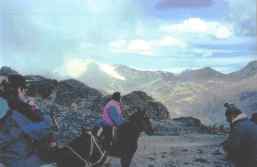 have any other information about how that might occur.
Most groups in the Andes identify a specific mountain as their guiding apu. For the Q’ero, it is Apu Wamanripa. In the local Quechua dialect, the name for this mountain actually is Senecio, which refers to a genus of the daisy family but, more accurately in this case, comes from the Latin senecio, which means “old man.” Apu Wanamripa is the “wise old man” guiding the peoples of the region around Q’ero.
We are not Andeans, so does it make sense for us to connect with and even commune with apus of our area? Or even with mountains elsewhere, such as in Peru?
Absolutely. In terms of local mountains, you won’t know if the mountain you choose to connect with is an actual apu until you work with it and see if it responds. Remember, in the Andean tradition, when we work, we expect results! Getting results may mean that this is not just a mountain but an apu. Even if the mountain is not an apu, you can still work with it as a magnificent energy being that confers sami, as all things in nature are composed only of sami.
If you want to work with an apu, how do you open communication?
The traditional way is to offer a despacho and introduce yourself. Then you ask  permission to work with the apu and listen for an answer. It might not come right away, and could arrive in myriad ways, from a visual sign to in inner feeling. It is said that often an apu will answer you in your dreams.
How do you connect energetically with an apu (beyond the ayni of a despacho)? Use your poq’po (energy body) and intention. All Andean work is based on intention, as energy must follow intention. But you also use that intention to direct energy. So you can throw a seqe—a cord of energy from your poq’po, usually your qosqo or belly area—to the apu. I remember when I first met don Mariano Apasa Marchaqa, back in 1994, and he predicted that if I did my energy work I would, in his translated words, “one day bring the word of Q’ero to the world.” Tal king with him the next day, through a translator, he told me to “throw [my] seqes up to the apus and I will meet you there and give you much information.” I can’t say that I ever felt that actually happened, but the many difficulties of arranging the Q’ero interviews back in 1996 were swiftly and easily overcome, and our interviews were incredibly productive. During those interviews don Mariano provided extensive information. So, perhaps the seqe we had established together in 1994 pulled us through the years to 1996 and the actual exchange in person that resulted in such a rich trove of information. In a similar way, you can throw your seqes to the apus and form a bond that might result over time in a relationship.
Another way I use my seqes with the apus is to establish a welcoming “hello” when I arrive in Cuzco. I usually take a moment to throw my seqes to the many surrounding apus to ask that they receive me, to request their permission to work well in the area, and to appeal for their blessings during my stay.
You can start befriending an apu by doing something similar to a local mountain in your area, which may turn out to be an apu. Simply say “Hello,” as you would upon any introduction. Then open a conversation. Over time, if you hear from a specific mountain—an apu—then you can offer a despacho to acknowledge the new relationship. You can do the same over long distances, to mountains far from your home, across the state, nation, or the world.
Don’t forget you can do the same with any or all of the teqse apukuna—the universal spirit beings. Follow the same protocol. These are spirit beings—fourth level beings, and in the case of Apu Jesu Cristo, a sixth level being—so they will have wisdom to bestow.
Before you work with an apu, however, be aware that doing so is an act of ayni—reciprocity—so you have to be prepared for the possibility that the apu may make a request of you or may advise you to undertake a particular task. Always use your good judgment in determining anything an apu says to be sure it is not your unconscious or ego talking, but if it is the apu, be prepared to follow its counsel or fulfill its request.
So, are you ready to develop your own relationship with the apus and teqse apukuna? Here’s wishing you many new friends (and wise “masters”)!
 word itself is Sanskrit for “wheel” or “disk.” Traditionally, there are seven of them, aligned along the spine from the root of the body to the top of the head. They are centers where energy and matter meet, facilitating the flow of the life-force energy. The chakras are aligned with major nerve plexuses and organs of the body, and each is associated with a color and with various human emotional traits and states of consciousness, which we will discuss briefly later.
 spine. For the three upper belts, the ñawis are at the front of the body. For the lower belt, it is at the back of the body, near the base of the spine.
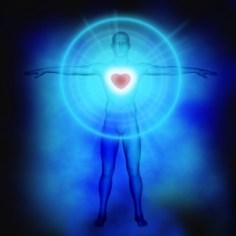 associated with the sacral and solar plexus areas; it is around the entire trunk of the body at the belly area and the eye is usually located below the navel). The belt around the chest/heart level is gold and associated with the sun. The belt at the throat is silver and linked with moon and wind. The quasi fifth belt for the two physical eyes and the seventh eye is violet. However, it is not really a violet band of energy. The color of the belt is that of your two physical eyes. It is sometimes, for ease of reference only, called the violet belt because at the end of the karpay you pull violet light into your poq’po through the seventh eye. But you move that violet light through your entire poq’po and body, not just through this eye area of your head.
 higher cognitive and emotional capacities, such as insight, creativity, and love. The three lower chakras are associated with our more physical and instinctual selves, including survival, self-image, social bonds, power, family, and the like. The elements and senses of the belts are usually identified as follows: the root chakra with earth and sense of smell, the sacral with water and taste, solar plexus with fire and sight, heart with air and touch, throat with ether and hearing, third eye with light and perception, and crown with spirit and being.
 Q'enti Wasi - House of the Hummingbird