
The real ceremony begins where the formal one ends, when we take up a new way, our minds and hearts filled with the vision of earth that holds us within it, in compassionate relationship to and with our world.
―Linda Hogan
Mast’ay is a Quechua word that in daily life refers to unfolding and spreading out a  cloth or weaving, perhaps on the table or a bed. In the mystical tradition, it refers to bringing order, organization, or structure to something. When you make a despacho, you are doing a mast’ay. When you arrange the khuyas in your misha, you are doing a mast’ay. But you don’t only bring order to things outside yourself. You can apply mast’ay to your own beingness. When you bring greater organization to the inner self, everything in your life is affected in positive and productive ways. The inner mast’ay furthers your awareness and, thus, your potential for conscious evolution as a human being.
In the Andes, the primary ceremonial or ritual practice is the despacho, which itself is a teaching about ayni. In my training I learned that there can be no mistakes in Andean ceremony. There is no proscribed way of doing things such that if you do them differently from your teacher or others you are committing an error. Quite the opposite is true. You may learn a ritual in a certain way (and it is in integrity to be a  good student and learn well), but you must ultimately make it your own.
All ritual is ordered by your intention and thus the quality of your energetic interchanges with nature and the spirit beings. Because ayni is personal, so is your ceremony or ritual. It must embody the quality of your inner awareness and the state of your own energy, heart, mind, and intention. That is why every paqo’s despacho, while following a certain ritual structure, actually looks different from everyone else’s.
If someone insists that you do a ritual in one specific way, following an exact protocol, we would call this third-level behavior and thinking. As a paqo, you want to move to the fourth level of consciousness, transcending outer forms and boundaries so that you can deeply immerse in the inner aspects of the practice. So every ritual or ceremony has to have your personal stamp on it—it is your mast’ay, not someone else’s. It represents your state of being, the organizing energetics of your soul and spirit. It is the offering of your truest self to the spirit beings and the cosmos of living energy.
Of course, there are formal ceremonies in the Andes that follow rules and are repeated much the same way year to year. There are religious festivals based on Christian forms  and Andean ones, such as Qoyllurit’i. There are rituals to honor the animals and herds, and the planting and harvesting of crops. There are ceremonies for coming-of-age and joining the community as an adult instead of a child. But unlike these, the mystical ceremonies, no matter what their formal outward appearance, ultimately must embody your own state of consciousness and ayni. They rely on your making an intimate and personal exchange with the kawsay pacha, not a rote one.
There is a viewpoint among many teachers of metaphysics that all the formalities of ceremony—the outward mast’ay, or structuring—have a sole purpose: to occupy the ego so that the spirit can get to work. I agree with the viewpoint, although I honor the ego and do not want to dismiss or negate it. I want all of me involved in ceremony, but not in an egoistic way. I want to marshal all of my three human powers—intellect, actions, and feelings—and make them resonant with my spirit. I want my offering to be about content, not form. So no matter what the ceremony, it is the state of the self that is the fundamental organizing principle, the mast’ay.
Mast’ay is not so much about what you do, but how you do it. You don’t even need anything outer—a poncho, a k’intu, a despacho, a misha—to make an offering or perform a ceremony. Because you are first and foremost offering yourself—your energy and intention—ritual and ceremony in the Andes is, at heart, invisible. It is an exchange that is unseen in the outer world. The spirit beings don’t really care about  the gift wrapping of the self. They are concerned only with the contents of the self.
I think of the inner mast’ay as the reordering of the self whereby the whole is greater than the parts. Anthropologist Ashley Montagu has said that “the deeper personal defeat suffered by human beings is constituted by the difference between what one was capable of becoming and what one has in fact become.” In this process of becoming all that we can be, each of us has to undertake the task of the personal mast’ay. We stem the tide of inner chaos by bringing our awareness to our own inner state and then work to bring order to the many worldly selves we are, so that our one wondrous “original” self shines through.
This inner mast’ay is always more important than the outer forms in ceremony and in life. The inner not only germinates the outer, it births it. While we can honor the old saying, “Actions speak louder than words,” we also understand that, as Plutarch said, “What we achieve inwardly will change outer reality.” That is the power of mast’ay in action.
 splinters and the wounded aspect of the self goes into hiding. Soul retrieval is just what the term implies—the process of coaxing the split aspect of the self to return and integrate back into the self.
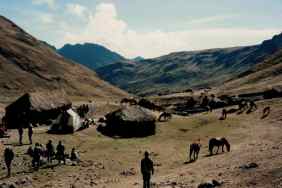 I recently was in Peru and had a chance to talk, over a three-hour dinner, with two anthropologists about many subjects, including both soul retrieval and “secret knowledge” among the Q’ero. One of them has been living among and gathering information from the most respected and reliable paqos in Q’ero. Still, I was not provided much information, really only a few minutes of our hours’ long visit, but what I was told is intriguing.
 is in the paqo’s intent and munay, not in any ceremony. That’s all I ever knew about soul retrieval for almost twenty years.
 complex methods. Or, more accurately, the practices moved from “informal” to “formal.” You try the informal, and quickest, method first, and if that doesn’t work move to the more formal methods. I received only the broadest outlines, but my interpretation is that the calling back of the soul by whispering in the ear is the first approach—the most informal—of practices for a soul retrieval. Another first-line practice is to throw the coca leaves to try to divine what has happened, why the soul split, and how best to recover it.
 hearing about it provoked myriad feelings. I felt humbled by how little most of us who are not native to the mountains of Peru actually know about the tradition. I marveled at how deeply connected to nature and energy the paqos are. I felt chagrin that so much misinformation is flying around the Internet about Andean soul retrieval (at the very least, as regards claims that certain practices are Andean when they clearly are not). I felt honored to have learned this information. And, despite the incredible Italian food and wine I was consuming, I felt hungry for more information, for renewed contact with the paqos, and for an even deeper understanding of the tradition. So, ever the student, my practice continues, as does my learning.
 Q'enti Wasi - House of the Hummingbird