
During part of the Andean training (as passed down through Juan Nuñez del Prado and his lineage of don Benito Qoriwaman, don Andres Espinosa, and don Melchor Desa), students learn to speed up energy to create munay (love—it is a power that is under your will!) and then to speed energy up even more to create hampe, the healing energy. As we discuss healing Andean style, a lot of questions come up because some of these teachings are in conflict with what students may have learned about healing when studying other traditions. So let’s revisit a few of the main questions.
We need to start with reviewing the foundational teaching about intention and  energy. Ayni is your intention to move energy, especially in relationship with the kawsay pacha. You are always in energetic interchange with the cosmos of living energy. The very fact that you are alive means you are interchanging energy with the cosmos. The nuance is that you can be in conscious or unconscious interchange—you can either be directing your intention with awareness or acting unconsciously. But you are always moving energy, and energy is always moving through you.
If you are attempting to do a healing, that healing is predicated upon the energy dynamic overviewed in the previous paragraph. You are by definition consciously using your intention. And energy must follow your intention. The same goes for your client.
With these basic premises established, the questions that arise are several. The ones below are the main ones that come up in training.
Is Energy Healing Affecting the Physical Body?
In the healing of the Andes as passed down through these lineages, a healer is mostly, and usually only, working on the energy body, not on the physical body.
The healing intention (whether using the practice of saminchakuy or of hucha mikhuy) is to release hucha from the poq’po (energy body), which then improves all level of being since the energy body informs the emotional body and the physical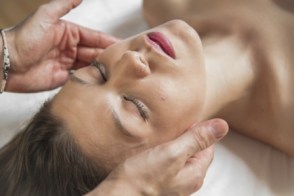 body. So as paqos in this lineage, we do not directly concern ourselves with the physical manifestation of hucha, but with the hucha itself. It’s not about healing a kidney tumor. It’s about getting slow energy moving again through the poq’po. Then the person’s body responds in the way that it can. Maybe the tumor will shrink, maybe not. But you can be sure that with less hucha the person will be empowered and his or her immune system enhanced. That is why we say in this tradition that all healing is self-healing.
Everything I just said applies to paqos of the first four levels of the path. Currently, there are no paqos known to be working at higher than the fourth level of consciousness. At this level, sometimes as healers we are successful (at helping a person activate their physical self-healing capacities) and sometimes we are not. However, this is not so at the fifth level of consciousness.
The mark a fifth-level paqos is infallible healing. They are successful every time they  heal, on every type of disease and ailment. They don’t fail! There have been fifth-level healers in the past, and there may be people we don’t know about who are fifth level now. There no doubt are people who sometimes display fifth-level capacities, but can’t maintain them all the time. We really don’t know how fifth-level healers work. They may be moving energy so efficiently that the poq’po returns to a pristine state of sami and thus physical well-being returns at all levels for the client. Or, they may actually be able to directly affect the Pachamama (the material world) and reform the body at the cellular level. We just don’t know for sure.
I bring this point up to remind you that everything we discuss in this post relates to fourth-level healers.
Do I Have to Ask Permission to Heal?
No. Because you are working only on hucha, you are working at the skin level of the poq’po. Hucha doesn’t get too deep into the poq’po, because there are actually seven layers to it, each like a filter. When hucha penetrates to each level, the filter there speeds it back up, turning it into sami. So most hucha is on the skin of the poq’po and that is where we work in healing. As such, you are not actually penetrating the privacy of the person’s poq’po, and you don’t have to ask permission.
In addition, according to Andean ethics, healing is always empowering. You empower yourself, the person you are working on, and since you are feeding hucha  to Mother Earth and she loves to eat hucha, you are empowering her. The healing forces are munay and hampe, and they are gifts we give others.
That said, just as there are different philosophies about what healing is and what you are doing while attempting healing, there are different ethical systems for different healing traditions. Those ethics grow out of the tradition’s philosophy. So, be clear about what tradition you are working within and follow that ethical system. If you are going to do Reiki, then the ethical system of that practice says you must ask permission. If you using Andean practices, such as saminchakuy to cleanse hucha, the ethics of the Andean system say that you don’t have to ask permission. In fact, the Andean ethical system says that if you have the personal power to help another person, then it is your responsibility as a paqo to do so. Whenever and wherever you see need, you use your practices to alleviate it. It is not really a choice, it is a responsibility. So the point here is that you may know more than one healing technique and you would be wise to follow the ethical system of the practice you are using.
Can Healing Override a Person’s Karma?
According to the Andean system, this question is moot. First, the Andean system does not recognize karma as it is known from the Hindu system. Second, all healing is self-healing, so you are not doing much more than helping to activate a person’s self-healing capacity. You are not doing the healing, the person is, so his or her will is involved and you are not overriding that will or, by extension, that karma.
Remember that Andean techniques for healing use intention to move energy. The energy is all the same, whether it is hucha or sami. It is all kawsay, just kawsay  moving at different speeds, at different levels of refinement. So, really, you are not doing anything except affecting the speed of the energy in the person’s poq’po. If the person doesn’t want to heal (consciously or unconsciously), he or she will just accumulate more hucha and most likely return to the state he or she was in before you attempted to release hucha. In this regard, once again, you cannot trump another person’s will. The way that person engages the world of living energy (ayni) is the deciding factor in every aspect of his or her being and life. So don’t worry about being so Godlike that you are changing a person’s state of being. Just offer the gift of munay and hampe, and let the person receive it or not, use it or not.
What About Using Other Tools?
All work in the Andes is invisible, because it is based on ayni—interchanging energy via your intention. However, once you take that to heart, you are free to play and express yourself as a healing “artist.” If you want to use a crystal, feather, bell, or whatever, go ahead and do so. Healing is an art. Every paqo has a personality, a style, just as every artist does. There is nothing wrong with developing a personal style and artistry. Just don’t turn the external items into fetishes, which means you transfer your personal power to them of instead of claiming it for yourself. The misha and despachos are great eaters of hucha, so it is all well and good to use them. But they, too, can be turned into fetishes. Remember, they are really only symbols of or external physical embodiments of your inner personal power and the quality of your ayni. They have no power if your personal power is not invested in them.
Two other quick points. The first is that a healer always has to meet a client where that client is. If your client needs to believe in the healing by seeing you use a rattle, crystal, or whatever, then without judgment meet that person where they are in their belief system and use such things. Belief is crucial to healing. The placebo effect is not false, it’s just misunderstood by Western medicine to be only about belief. In the Andes we know that belief is a kind of intention that moves energy. It is a form of intention, and energy must follow intention. So engage your client’s belief system, but don’t be fooled yourself into thinking you must use a crystal or feather or whatever. That would be giving away your personal power.
The second point is that the Andean system integrates well with other systems. So as long as you are clear about each of the traditions you are using (say doing saminchakuy with Reiki), there is no conflict with the Andean cosmovision about your using anything and everything that you think will help. The Andean system is not exclusive, but inclusive.
I have one student who, after learning how to loop energy and speed it up to create munay and hampe, experimented with looping the energy through different kinds of  crystals and gems. He found that those gems seemed to vibrate at a higher and more powerful frequency after “charging” them with hampe energy. He then used them on his client. However, he was clear that the flow of energy started with and ended with his own intention to move energy. He controlled the flow of energy through his “tools,” not the other way around, so there was no danger of his turning them into fetishes. Still, he discovered something interesting and useful about energy, and he can now use that to his own and his clients’ benefit.
As Dr. Silva Hartmann says, ““Energy work is priceless. It makes every day extraordinary and transforms the mundane to the holy.” That is the stance of an Andean paqo—and especially so when it comes to working the energies for healing. You are moving energy to make a person believe they can transform themselves from a mundane being to a holy one. And healing doesn’t get any more important than that.
 than Juan Nuñez del Prado, who learned about them differently from the teachings of this lineage. Although I’ve written about them several times before, let me do so again as clarification and review. I’ll do so as an overview for those of you who want a quick “cheat sheet” about them.
 such as the palms, soles of the feet, and top of the head. The ñawis are in place at your birth. However, they are “awakened” in a karpay called the Ñawi K’ichay (pronounced nyow-wee key-ch-eye), which is done at the same time you weave the chunpis.
 into why we call it the violet belt, but you need to know that violet is not the actual color of the belt. The color of the belt is the color of your physical eyes. The capacity of the three eyes is qaway, visionary or mystical seeing and knowing.
 part of the teaching of the Andean path. Always remember, as a paqo you want to not waste your energy. You want to be super efficient and super effective in your ayni—your energetic engagement with the cosmos of living energy. Once they are woven, the chunpis are part of what I call the “energetic anatomy” of your poq’po. There is nothing in your physical body that doesn’t contribute to the core purpose of keeping you, as a physical organism, alive and healthy. The chunpis as part of your energetic anatomy serve fundamental and necessary purposes as well, integrating both your physical and energetic selves to so that you can excel at both the “action” of life and the “art of being” in life.
 space-time continuum, introduced in his theories of relativity in the 1920s, suggested the same fundamental truth about the complementarity of space-time. Now, because of quantum mechanics, quantum electrodynamics, and efforts to discover what the “beginning” is (before the Big Bang; at the level of the Planck constant), some scientists are grappling with what “reality” means and is. The paqos belief/teaching that we are each the center of the universe goes hand in hand with their belief that one of the goals of being a paqo is to “see reality as it really is.”
 cosmic consciousness. One of their conclusions is that “Cosmic consciousness mirrors the observer’s state of being. There is no privileged point of view, even though in the past religion claimed to have a privileged point of view while today’s science does the same. But each story is provided with evidence to support it, because our state of being interacts so intimately with reality that observer, observed, and the process of observation are inseparable.” As they say later in the discussion, “the whole system participates.” [Italics in original.]
 were scanning the entire garden. The words we use—“tasting” the “flavors” of energy—obviously are metaphors for discerning the different qualia of the material world.
 doing so, also contribute to the evolution of the cosmos.
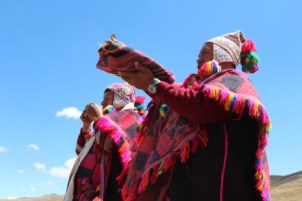 and self-aware than the rest of us. While many of them have mastered incredible energetic practices, they are human beings with failings, foibles, and personality conflicts. They are working the practices to become more self-aware and to further their own conscious evolution, just as we are. They are models for us, but, for the most part, we put them on a pedestal reluctantly. We respect and even honor them, but we would do well not to fall into a hero-worship mode.
 don Manuel Q’espi, who was once the kuraq akulleq of Q’ero, was actually booted out of paqo school when he was a young man! High in the mountains where the Chua Chua and Totorani rivers meet, there was a paqo school that ran every year for the month of August. The year Juan attended was the same year don Manuel attended. The headmaster was the famous Q’ero master don Andres Espinosa. Apparently don Manuel and don Andres had a falling out and don Andres kicked don Manuel out of the school!
 Of all the paqos I knew personally, I spent the most time with don Mariano Apasa Marchaqa, which doesn’t mean I got to know him well, as most of the time he was simply inscrutable. It was impossible to read his face, and thus I was usually left in the dark about what he might be feeling. Overall, his demeanor was dignified but a bit stand-offish. He wasn’t someone you approached spontaneously, giving a big hug. Even though his face
 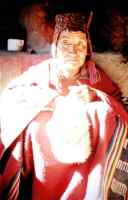 usually was a blank slate, every so often he would break into a smile and, to use a cliché, the room would light up. He also had an oblique sense of humor. I remember during the interviews for my book he looked up at one point and said, with seriousness and great humility, something to the effect of: “If I had known that one day I would be here talking to you, I would have listened better to my father and grandfather when I was a child. I wasn’t interested then. Their stories and teachings went in one ear and out the other.”
 their faces and body language! They were so unsure of themselves, exuding nervousness as Lida laid out plates and cutlery. They watched carefully as we used knives and forks, and then they, clumsily, tried to use them. My heart went out to them. I wished they had had the confidence to just eat with their fingers, so they could really enjoy the meal. None of us would have cared. (I was able to commiserate with their unease because I had felt it many times myself when with the paqos, especially the few times I was in the Q’ero villages. I didn’t know the proper way to do things or what was expected of me.) I have to laugh at something that happened when the lunch was over. One of the Q’ero, I think it was don Julian Pauqar Flores, got up, opened the screen door to the back covered patio/garage area, and stepped out to relieve himself in full view of the rest of us. He didn’t appear tentative at all when it came to that aspect of his comfort!
 The most playful paqos I ever met were the youngest ones—don Juan Pauqar Espinosa and don Augustine Pauqar Qapac. Don Juan has passed on, but he was as mischievous as a six-year-old, always ready to play and quick with a joke (which, because of translation, I mostly missed at the moment and had to play catch up later). Don Augustine appeared to be shy, but what a prankster he was. I understand from people who know him today that he is much less playful. Maybe that’s what age does to you! But when he was a young man and I was interviewing him, he would slip words like “breast” and “vagina” into our mutual Quechua-English
 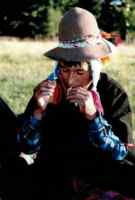 language lessons. It cracked him up as we repeated the words before the translation was given and we knew what they meant. Both don Juan and don Augustine were also game for adventure and to learn anything new. There was a foosball table in the courtyard of the place we stayed in Urubamba during the book interviews, and after a little instruction, they played game after game. And they were wildly competitive with each other!
 have been heavily influenced by outsiders and by practices from other traditions. Some of them are less than particular about explaining what is authentically Andean and what is not. That’s all well and good depending on your preferences. I, for one, prefer to be educated about what is part of the tradition and what comes from beyond it, because as Juan has stressed (based on the teachings from his masters, especially don Benito Qoriwaman, who was not Q’ero), in order to be a fourth-level paqo, you must know your lineage, and that includes the lineage of the practices.
 major teachings (as I have been taught them through the lineage of which I am a part).
 as a paqo is to become conscious of your state of mind and being, and then to take action to go beyond circumstance and recover your awareness of joy. You may still not like what is happening to you, but by recovering joy you will be able to put circumstance into perspective. We all experience pain and heavy emotions, but we can, as mythologist Joseph Campbell said, “Find a place inside where’s there joy, and the joy will burn out the pain.” And as musician Carlos Santana wisely said, “If you carry joy in your heart you can heal any moment.”
 national or global action. It’s become cliché to say that we can only give to others what we first give to ourselves. But that is a core truth.
 Q'enti Wasi - House of the Hummingbird